Logical Reasoning | Formal Logic Inference Questions

My students know I'm not a fan of diagramming most Logical Reasoning questions. However, some questions just beg to be diagrammed. These questions tend to be formal logic inference questions and sufficient assumption (justify) questions.

In this blog post, I'll cover one Logical Reasoning question that should be easy but gives many test-takers a lot of difficulty when they're first starting Logical Reasoning:

It's PrepTest 30 (December 1999), Section 2, Question 18 (page 59 in Next 10). It's about inspired musical performances, good show, etc.

First sentence:
This part of the stimulus is pretty straightforward and contains clear indicator words (If...then), so we can diagram this as:

IP --> GS


Second sentence:
This one's a bit nasty, as it contains the word "unless." It's a clear example where putting the "unless" translation technique into practice comes in handy.

Take the word "unless" to introduce the necessary condition and negate the other part of the clause to make it the sufficient condition.

"NOT GS" becomes "GS" and is the sufficient condition part of this conditional statement.

"SL" becomes our necessary condition, giving us:

GS --> SL

Instead of writing it down separately (as I just did), I would immediately connect this with the first sentence, giving us:

IP --> GS --> SL


Third sentence:
This one has less obvious indicator words than the first sentence does.

"To be" is the sufficient condition indicator. You may know this more commonly as "in order to be", but this meaning is the same.

"Must" is our necessary condition indicator.

This can be diagrammed as:

SL --> MR

As with the second sentence, instead of writing down the new information separately, I would it immediately connect it with what we already have, giving us a long chain (and its contrapositive):
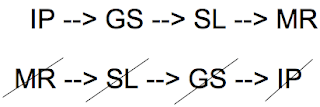
LSAT PrepTest 30, Section 2, Question 18


Attacking the answer choices:
Just check each of the answer choices against the appropriate chain. You'll find that the wrong answer choices are all mistaken negations of one chain and mistaken reversals of the other.

I would not actually diagram or write anything out for any of the answer choices. Instead, I would just read each choice and mentally check it against the choices. It's faster, and you'll find that you don't actually need to write anything out.

Choice A: NOT SL --> NOT IP = CORRECT
Choice B: NOT GS --> NOT MR
Choice C: MR --> IP
Choice D: NOT GS --> NOT MR
Choice E: SL --> IP

Yes, choices B and D are identical - they're just presented differently (D has the word "unless" in it).


What LSAC is likely to ask in a question like this, and why:
The remainder of this blog post is not a description of how I would actually approach this question (or questions of this type). I already covered that above.


I'll number the variables for easy reference:
LSAT PrepTest 30, Section 2, Question 18, Numbered


When asking us what "must be true," LSAC is not likely to ask about any variables that are adjacent to each other (consecutively numbered / touching).

Someone who hadn't connected the sentences into conditional chains would still be able to answer that questions, and LSAC loves it when you're able to connect things.

This means that the correct answer is not likely to be any of the following:

1 requires 2
2 requires 3
3 requires 4
5 requires 6
6 requires 7
7 requires 8

LSAC also isn't likely to ask us anything about the first chain (the variables numbered 1-4).

Asking about the first chain wouldn't require you to have taken the contrapositive. LSAC loves the contrapositive more than milk and cookies. It just makes them so happy.

This means we're likely to deal with the second chain (the contrapositive) - the one with all the negatives.

With the first chain out of the way, our remaining options are:

5 requires 7
6 requires 8
5 requires 8

Sure enough, the answer is 6 requires 8.


Pre-Law Podcast Video Series

LSAT Blog Pre-Law Podcast Video SeriesI'd like to point everyone toward a pre-law podcast series (complete with accompanying PowerPoints) on Facebook. They're put together by Rebecca Wood, Prelaw Advisor at the University of Nevada, Las Vegas.

Judging by the titles, you can see that they're geared primarily towards beginners, but some of them are relevant to anyone compiling their applications.

February 2010 LSAT | Questions and Answers

LSAT Blog Questions AnswersThe February 2010 LSAT is rapidly approaching - only 8 weeks remaining. What would you like to see on the blog between now and then?

Please leave your questions for me (and for each other) in the comments, I'll do my best to answer as many of your questions as possible between now and February 6th.

Quick request: please leave a name rather than posting as "Anonymous." It makes it easier for everyone to respond to specific comments. Thanks!

***

Also see: December 2009 LSAT | Questions and Answers

Photo by lwr / CC BY-NC-SA 2.0

LSAT Logic Game Explanation: Birds in the Forest | Selection

LSAT Blog Logic Games Explanation Birds ForestIn-Out (Selection) Logic Games are definitely in this year.

The September 2009 LSAT had two of them, and then there was another on the December exam. There goes the popular theory that they wouldn't have an In-Out Game again so soon.

Particularly, LSAC loves In-Out Games where all the rules can be connected (see #1). It's not hard to understand why. They require a solid understanding of conditional reasoning and indicator words.

Despite the fact that In-Out games with similar rules have been administered several times in the past, people still have trouble with them.

I've never diagrammed an In-Out game of this type on the blog - it's time I did.

Birds in the Forest - PrepTest 33, Game 2
(p177 in Next 10)

We know this is an In-Out game because we want "to see which of the following...it contains." In any given scenario, the birds that it contains are "In," and the birds that it does not contain are "Out."

We can connect the rules to form two long chains (which are the contrapositives of each other). We do this by looking for cases where the necessary condition of one rule and the sufficient condition of another are identical. If they are the same, we can link them.

For example, suppose we're given the rules:

If X -> Y

If Y -> Z

In this case, Y is necessary in the first rule and sufficient in the second.

This means we can form the chain X -> Y -> Z.

Now that we have that out of the way, let's go look at the Birds in the Forest game:

First rule:

If H is in, then G is not.

H --> NOT G

I diagram this as:


Contrapositive:

If G is in, then H is not.

G --> NOT H.


Second rule:
If J, M, or both are in, then so is H. The both part is redundant, so we can just say that either one is sufficient to bring about H.

This means that if H is out, then both J and M must have been out.

I immediately connect this rule (and its contrapositive) with what I've written down for the first rule (and its contrapositive).

We now have:


Third rule:
If W is in, then G is in.

Contrapositive:
If G is out, then W must be out.

Connecting this to what we already have, it becomes:


Fourth rule:
If J is out, then S must be in.

Contrapositive:

If S is out, then J must be in.

Connecting these to what we already have, it becomes:


Now we have every rule connected in one big chain - in both the original form of each rule, and its contrapositive. I simply connected each new rule (and its contrapositive) with a previous rule (or its contrapositive) as I read it.

With this big conditional chain, we know that when W is in, both G and S are in, and H, J, and M will be out.

When S is out, both J and H are in, and G and W are out. However, we don't know where M is.

On the chain, proximity/closeness doesn't matter.

Anytime we have a positive variable followed by a negative variable, at least one of those two variables is out. (Maybe both are out.) We don't care whether the negative is immediately after the positive or several variables later.

Anytime we have a negative variable followed by a positive variable, at least one of those two variables is in. (Maybe both are in.) We don't care whether the positive is immediately after the negative or several variables later.

The final question of this game requires a new rule (and its contrapositive) to be added to the diagram. On the diagram, it would look like the following:


Since this is the last question of the game anyway, and assuming you’ve answered all the others, it's okay to modify the main diagram since you won’t be using it for anything else. Whenever a Logic Game requires a new rule to be added, taken away, or substituted for an old rule, it'll be in the last question of the game.


Why the technique in this blog post is better than other techniques:

Some companies recommend listing all the rules in their original form, then writing the contrapositive, then looking for connections. Other methods just fail to adequately represent all the inferences. Either way, they take up a lot of space and time.

Both methods require writing out all the rules and then looking for connections. This leads to a moment of panic when you're not confident whether you've made all your inferences or not. You're never confident that you've done everything.

The method I've laid out above does not require any extra writing, which saves space and time. As long as you can do the contrapositive, you can do this. Just remember that you can only follow an arrow in the direction it points.


A hint for those having trouble:


The chain perfectly represents the relationships between the variables. All the information from the rules already appears on the chain.

A sufficient condition appears to the left of a given arrow, and a necessary condition appears to the right of that arrow.

Just follow the arrows in the direction they're pointing in, and you'll be fine.

The difficulty that many of you have with these conditional chains is you're trying to read them backward, which is not "permitted" in logic. Be careful not to confuse necessary and sufficient conditions.


***

To see this technique demonstrated on another game, check out the diagram I posted for my own In-Out Logic Game.

To see more games like this, check out the first category in 7 Logic Games Repeated on Future PrepTests.


Photo by deniscollette / CC BY-NC-ND 2.0
(Those birds in the photo are grosbeaks, which is what "G" stands for in the game.)

Logic Games Selection | In-Out Diagram Explanation

LSAT Blog Logic Game Selection In Out DiagramI've finally written a blog post to explain how I'd diagram my Free LSAT Logic Game | Grouping: Selection / In-Out.

Like the Birds in the Forest Logic Game, this is an In-Out game where the rules can be connected to form long conditional chains.

I designate bills voted "For" as being "In" (positive). I designate the bills voted "Against" as being "Out" (negative).

If you're new to this, or you need a reminder, sufficient is before the arrow, and necessary is after the arrow: Sufficient -> Necessary (see this for more details).


First rule:

G only if NOT E can be diagrammed as


("only if" introduces the necessary condition)


The contrapositive, would be:


Second rule:
(I skip this rule because it mentions variables not mentioned in the first rule. Put a mark next to this rule as a reminder to come back to it.)


Third rule:
This means at least one of E and J must be in, but there's no reason we can't have both in.

This can be diagrammed as:

NOT E -> J

Contrapositive:

NOT J -> E

By connecting this rule (and its contrapositive) to the first rule (and its contrapositive), we get:


and


Second rule:

Now that we have J on our diagram, it's worth taking a look at the second rule because we'll be able to connect the variables in this rule to what we already have on our diagram.

The word "unless" is tricky, but I've recently explained it here.

If you like, you can switch the order of the clauses in this rule in order to think of the rule as "I unless NOT J"

This becomes "NOT I -> NOT J"

Contrapositive:

J -> I

We can immediately connect this rule (and its contrapositive) to what we've already diagrammed, giving us:


and


Fourth rule:

If introduces the sufficient condition, so it should really be thought of as:

H + D -> G

(H and D being in are sufficient to guarantee that G is in.)

Contrapositive:

NOT G -> NOT H or NOT D

On the diagram, it becomes:


Remember that the word "or" is inclusive. This means that if G is out, at least one of H and D will be out, but perhaps both of them will be out.

For the "or," some people like to use a dotted-line arrow rather than a solid line and writing the word "or." With a dotted-line arrow, this rule would look like:


Either way is fine - as long as you know what it means.


Question 7's rule:

Question 7 adds a new rule: F --> NOT J

Take the contrapositive: J --> NOT F

Add both to the diagram, and you get:


***

With the rules correctly diagrammed in these chains, you should be able to get through the game's questions on your own. Most of the difficulty is in setting up the game and forming the chains.

I talk about how to read this type of diagram in my explanation of the LSAC-written Birds in the Forest Logic Game.

Photo by wallyg / CC BY-NC-ND 2.0

LSAT Logic in...Conservapedia

Andy Schafly, creator of Conservapedia (wiki) was interviewed on The Colbert Report Tuesday night.

2:52 in the video below is where the LSAT-relevant action is:
Schafly: Isaac Newton, for example, credited his insights to the work he did translating the Bible - not just reading the Bible.

Colbert: He came up with gravity when a Bible fell out of a tree!

Schafly: Not only did Newton credit his work in translating the Bible, he said that everyone else he knew who translated the Bible also had terrific other insights, so it's a marvelous activity.

See any major flaws?

The Colbert ReportMon - Thurs 11:30pm / 10:30c
Andy Schlafly
www.colbertnation.com


***

Also see LSAT Logic in the Colbert Report | Marijuana Legalization.

Princeton Review LSAT Logic Games Workout - Exposed

LSAT Blog Princeton Review LSAT Logic Games Workout Exposed
In the LSAT FAQ, I discuss some reasons why you shouldn't use books containing fake (non-LSAC-written) LSAT questions.

However, there's one reason I didn't mention. Depending on the source, these "fake questions" might actually expose you to real LSAT questions from recent exams.

How is this possible if the questions are fake?

The Princeton Review's new LSAT Logic Games Workout book fails to mention that, in a way, it does use real LSAT questions. In fact, it implies that it doesn't at the end of the second paragraph on page 1.

However, this book contains games that appear to be slightly-altered versions of several real LSAT Logic Games from recent PrepTests.


I see three major possibilities here:

1. This is just a big coincidence.

2. Earlier this decade, LSAC test-writers used a time machine, traveled forward in time to 2009, saw this book's Logic Games, loved them, and decided to alter them for use in real exams over the next few years. (Reminds me of Biff and the sports almanac in Back to the Future II.)

3. The authors took real LSAT Logic Games written by LSAC and changed the Logic Games' topics and variables. In many cases, they also changed the presentation and order of the rules, as well as the order in which the questions are presented. In some cases, they added a question of their own to the game.

The 3rd possibility appears to be the most likely, so I'll go forward on the assumption that the 3rd possibility is the correct one.


Why is this bad?

Consider the following:

Joe Bloggs, your average uninformed LSAT-taker (who doesn't read my blog, or he would've used these books instead):

1. sees an LSAT Logic Game for the first time and cries

2. works through the LSAT Logic Games Workout

3. does a few recent exams under timed conditions and does much better on the Logic Games than expected

4. merrily strolls off to his test center for the real thing, thinking his improvement was a result of using the Workout book

5. does significantly worse on the real thing than expected


Little does he know that the most recent exams he took basically contained the very same Logic Games as the ones in the Workout book.

For this reason, Joe's practice test scores were inflated. This gave him a false sense of confidence. As a result, he wasn't able to make an informed decision about whether he was ready to take the exam. Had he known that he wasn't as strong in Logic Games as he'd thought, he would've been able to think about whether he needed to cancel his LSAT score, postpone the test, or simply be absent.


Poor Joe...we can't really blame him for not realizing he simply did the same Logic Games twice - first in the Workout book, and then in the actual PrepTests.


After all:

1. Some time had probably passed between doing the Workout book and the full-lengths.

2. Under the pressure of a timed practice exam, he probably didn't have the leisure to have feelings of deja vu. ("Hey, this Logic Game setup looks familiar...")

3. The variables (letters) had been changed. The Workout version of a given Logic Game may have contained the variables A-G, while the PrepTest version may have contained a game with the variables H through N.

4. The Workout version's topics had been changed from the actual PrepTest's LG topics.

5. The order in which the rules were presented had been changed.

6. The order in which the questions were presented had been changed.

7. Some games had an additional question in the Workout version.

8. In general, the wording had been slightly changed.

9. Like most people, Joe probably likes to attribute any good performance to his own intelligence rather than outside factors - like being exposed to the material already.

10. As I said at the beginning of this post, the book's introduction suggests the questions contained within the book are not real (LSAC-written) LSAT questions.

I don't know who should be more embarrassed:

---The Princeton Review - for presenting a bunch of altered LSAC-written games as their own, rather than licensing unaltered LSAT Logic Games from LSAC

or

---Me - for being able to identify the origin of each "fake game" just by looking at its rules.


Luckily, the folks at The Princeton Review were kind enough to allow Google to scan and display part of their Logic Games Workout book.

***

Below, I've linked to the 8 Logic Games from the Workout book available for viewing in Google Books. Along with each game, I've included the actual PrepTest # and Game # so those of you interested in the details can compare the two.

Of course, don't look at any game you plan to complete in the future as part of a full-length practice test. We don't want your practice test score to be skewed.


---

Some Logic Games in the LG Workout Book based on real LSAT Logic Games:

1. Solar Panels (page 14 in Workout)

Compare to:
PrepTest 42 (December 2003), Game 2 - Loading dock - fuel, grain, livestock, machinery, produce, and textiles


2. Mother's Day Bouquets (page 19 in Workout)

Compare to:
PrepTest 43 (June 2004), Game 1 - Civic parade - firefighters, gymnasts, jugglers, musicians, puppeteers, and veterans


3. Blog Rater (page 36 in Workout)

Compare to:
PrepTest 51 (December 2006), Game 2 - Six hotel suites - most expensive to least - F, G, H, J, K, and L


4. Great Bank Bailout (page 40 in Workout)

Compare to:
PrepTest 52 (September 2007), Game 1 - Water treatment plant - G, H, I, K, L, N, O, and P


5. Lounge Crawl (page 50 in Workout)

Compare to:
PrepTest 52 (September 2007), Game 4 - Bread truck / delivery - Figueroa, Ginsberg, Harris, Kanzaki, Leacock, and Malpighi


6. Mixed Nuts (page 59 in Workout)

Compare to:
PrepTest 46 (June 2005), Game 4 - Secret committee - French, Ghauri, Hsia, Irving, Magnus, and Pinsky


7. Six Blind Mice (page 64 in Workout)

Compare to:
PrepTest 52 (September 2007), Game 2 - Field trip to Museum of Natural History - Juana, Kyle, Lucita, Salim, Thanh, Veronica, and Margoles, O'Connell, and Podorski


8. Coalition of Conservationists (page 69 in Workout)

Compare to:
PrepTest 45 (December 2004), Game 4 - Nations X, Y, and Z - Export Alliance - oranges, rice, soybeans, tea, and wheat.


(The LSAC versions of games numbered 2, 3, 7, and 8 above contain only 5 questions each. The Princeton Review added a 6th question to each of these games.)

***

As you can see, these games are primarily from exams test-takers are likely to use for full-length timed practice.

Moral of the story: Don't use The Princeton Review's Logic Games Workout book. Its typos (described in detail in its reviews on Amazon) clearly aren't the only problem.

Any LSAT book you use should include real LSAT questions (and tell you which exams each question came from.)


Necessary Assumption Questions, Negation Test, and Must Be True Qs

LSAT Blog Necessary Assumption Questions Negation TestLast week, I discussed the difference between necessary assumption questions and sufficient assumption questions.

I've already covered some strategies for sufficient assumption questions, but I haven't yet written about necessary assumption questions.

In this blog post, I discuss a common, and effective, strategy for approaching these questions.

I also talk about shortcomings in the way prep companies often teach test-takers to think about necessary assumption questions.

Finally, I give some examples of necessary assumption questions and explain some frequent patterns in each.

A Common and Effective Strategy for Necessary Assumption Questions: The "Negation" / "Denial" test

As the name implies, this "test" requires you to negate each of the answer choices. The correct answer choice, when negated, renders the argument invalid. The argument cannot be valid if the necessary assumption is not true. After all, the necessary assumption is, in fact, necessary for the argument to work

I agree with the consensus that this is a good way to approach necessary assumption questions.


How does this work in practice?

Ask yourself as you read each answer choice, does this *need* to be true for the evidence to require the conclusion?

Well, if it weren't true, what would happen? Would the argument be able to coexist with the negated answer choice?

If it would not be able to, then it is the necessary assumption, so it's our answer.


Again, the correct answer choice needs to be true in order for the argument to work. As the common question stems suggest (examples of those in Difference Between Necessary and Sufficient Assumption Questions), the argument depends upon the assumption being true, requires that it is true, and assumes that it is true.


A Quick Note on Negating Answer Choices

Make sure to translate the answer choice into its logical opposite, not its polar opposite.

Example:

The polar opposite of the statement "All people are standing" is "All people are not standing." In English, that means "No people are standing." It's the other extreme. We don't want this.

The logical opposite of the statement "All people are standing" would be, "It is not the case that all people are standing." In English, that means "Not all people are standing" or "Some people are not standing."


Necessary Assumption Questions Do Not Bring in New Information

Many categorization systems correctly place Must Be True questions under the umbrella of Inference questions (those asking for information we already know to be true based on the stimulus).

However, they typically categorize Necessary Assumption questions differently, placing them with  Strengthen and Sufficient Assumption questions. This is a mistake. Necessary Assumptions don't simply help the argument, and they certainly don't bring new information to the table, as Strengthen questions and Sufficient Assumption questions do.

Necessary Assumptions are things we already know to be true based upon the stimulus.


Necessary Assumption Questions are Really Must Be True Questions in Disguise

In all the LSAT materials I've looked at (and I've looked at quite a few), the authors place Necessary Assumption questions in a separate category from Must Be True questions.

In fact, the negation test described above works precisely because Necessary Assumption questions are Must Be True questions in disguise. I proved it to you above when I plucked key words from Necessary Assumption question stems: "depends upon," "requires," and "assumes." Something required to be true is something that must be true.

We could easily take any Necessary Assumption question, remove its question stem, and replace it with a Must Be True question stem, such as the following:
If all of the statements above are true, which one of the following must also be true?
Nothing would change. The Necessary Assumption question's credited response would answer this question as well because the necessary assumption must be true if we assume the argument is valid.


Why Does the LSAT Even Have Necessary Assumption Questions?

Why not just ask Must Be True questions all the time? Why does LSAC even bother with these? What makes them different from Must Be True questions?

-Must Be True questions often involve connecting a few different pieces of information from the stimulus. (See PrepTest 29, Section 4, Question 23, p42 in Next 10, or see PrepTest 33, Section 3, Question 8 - p170 in Next 10.)

-They often involve formal logic and are simply fact sets, rather than arguments (PrepTest 30, Section 2, Question 18 - p59 in Next 10, or see PrepTest 32, Section 1, Question 7 - p120 in Next 10).

In short, they require you to make various types of connections between different pieces of information in the stimulus.

Necessary Assumption questions, on the other hand, ask for a more specific type of information that must be true. They ask for something that must be true in order for the argument itself to be valid.


Examples:

By this point, you're probably foaming at the mouth for some examples of necessary assumption questions, so I've some picked out for you:

Common Necessary Assumption Question Pattern #1
PrepTest 30 (December 1999), Section 2, Questions 15 and 22 (pages 58 and 60 in Next 10, respectively)

In each of these questions, the stimulus' argument makes the claim only one thing needs to be true for something to occur. For each of these questions, the correct answer dismisses a potential problem that might otherwise prevent the conclusion from logically following.

Common Necessary Assumption Question Pattern #2
PrepTest 37 (June 2002), Section 4, Questions 15 and 19 (pages 312 and 313 in Next 10, respectively)

In each of these questions, the stimulus' argument mentions something new in the conclusion that was never mentioned in the evidence. They also mention something in the evidence that was never mentioned in the conclusion. As such, the new thing in the conclusion needs to be made relevant in some way for its presence in the conclusion to be justified. If it were not relevant to the evidence in any way, the argument would not be valid.


***

P.S. To be clear, I think of Necessary Assumption questions as a specific kind of must be true question - they are asking for something slightly different (an unstated / implicit premise). It's a different question type for a reason. But I certainly wouldn't think of them as being a type of strengthen question.

There's still a difference in terms of approach (which is likely why they're separate question-types).
To elaborate, what I'm saying is - what if you took that entire series of statements, i.e. the entire text of the stimulus, as given? Wouldn't all underlying necessary assumptions need to be true?

For Necessary Assumption Qs (and Must Be True Qs), gravitate more towards moderate language - it's more likely to be correct (supported by the stimulus) than more extreme language would be.


Photo by nathangibbs / CC BY-NC-SA 2.0

LSAT Anxiety and Procrastination Tips | Interview

LSAT Blog Anxiety Procrastination TipsI recently interviewed Kelly Roell, from the Test Prep About.com site, via email. Our discussion follows.

1. Many people have difficulty sitting down and focusing when it's time to study for the LSAT. Suddenly, checking Facebook, cleaning out the spam folder in your email, and baking bread from scratch all seem like immediate concerns. What are some ways that test-takers can force themselves to sit down and look at their LSAT books?

A test-taker has to learn how to focus. First, set yourself up for success by getting rid of obvious distractions like the cell phone and t.v., getting yourself a beverage and snack beforehand, and choosing an appropriate time to study. Once you're settled, do something physical while you're studying if you're antsy and train your mind to get rid of distractions.


2. Given that the LSAT is such a high-stakes exam, what are some ways to make the stress manageable?

Best stress busters:

* Go for a run – Science has proven that a good sweat session positively uses the adrenaline that leads to physical stress symptoms. Take a run early on the day of the exam to calm the nerves

* Practice yoga – The deep, stretching movements and the meditation that goes along with yoga can calm the mind, thus reducing stress. Only do this on the day of the exam, though, if you're practiced. If you try it without knowing what you're doing, you'll only add to the stress.

* Be confident – If you've prepared well, there's no reason you shouldn't do your very best on test day. Go in with a confident attitude. Tell yourself that you're the smartest you've ever been and can do anything you set your mind to – whatever it takes to boost your self-esteem. Those with the highest self-esteem will succeed when no one else does.


3. What are some ways test-takers can cope if they freeze up on Test Day?

Set realistic expectations, envision something positive, use positive language, repeat an uplifting phrase, and shoot down negative thoughts.


4. How can test-takers make the 3-week-wait for their test scores more bearable?

First, you should get support. Let people know that you're anxiously awaiting your scores. Post it all over Facebook. Call your mom. Get your friends and family to rally around you so you have a support system if the scores aren't what you want.

Secondly, go out and celebrate with those friends and family. You did it! You took the LSAT. Regardless of your test scores, you have to be proud of yourself for having the guts to do it. Not many people do!

Last, distract yourself with something fun. Chances are good you've spent the last few months holed up in a room studying yourself sick. Relax. Go do something fun you've never done before. The adrenaline rush you get from experiencing something new and exciting will lessen the anxiety of the wait.

Photo by uaeincredible

Difference Between Necessary & Sufficient Assumption Questions

LSAT Blog Difference Necessary Sufficient Assumption QuestionsBoth Necessary Assumption and Sufficient Assumption questions contain the word "assumption" within the question stem. However, they ask for very different things.


(Also see Sufficient Assumption Questions and the Negation Test.)


This is why it's misleading (and often confusing) to simply refer to both types under the catch-all category of "Assumption" questions.


Others refer to Necessary Assumption questions as "Assumption" questions, and Sufficient Assumption questions as "Justify" questions. However, referring to Sufficient Assumption questions as "Justify" questions is often confusing for test-takers for two major reasons.

Many test-takers mistakenly believe:

1. The question stem must contain the word "justify" in order to be a "Justify" question (i.e. they believe the word "justify" is a necessary condition for it to be a sufficient assumption question).

In fact, Sufficient Assumption questions rarely contain the word "justify."


2. Any question stem containing the word "justify" is a "Justify" question (i.e. they believe the word "justify" is a sufficient condition for it to be a sufficient assumption question).

In fact, "Strengthen" and "Strengthen Principle" questions often contain the word "justify" as well.


Basically, the presence of the word "assumption" doesn't tell you what type of question you're dealing with, and neither does the word "justify".

So...how do you tell the difference?

Instead of focusing on the noun "assumption," focus on the verb in the question stem.

The following indicators are presented in a rough decreasing order of frequency as they appear in PrepTests 50-58, whenever possible. If your materials refer to PrepTests by month and year instead, please see this list.


Necessary Assumption questions often contain the words:

"Depends"
Example #1: "Which one of the following is an assumption that the fund-raiser's argument depends on?"
(PrepTest 56, Section 3, Question 18)

Example #2: "Which one of the following is an assumption on which the argument depends for its conclusion to be properly drawn?"
(PrepTest 52, Section 1, Question 10)


"Requires"
Example: "Which one of the following is an assumption the bureaucrat's argument requires?"
(PrepTest 55, Section 3, Question 19)


"Required"
Example: "Which one of the following is an assumption required by the dietitian's argument?"
(PrepTest 56, Section 2, Question 6)


"Relies"
Example: "Which one of the following is an assumption on which the argument relies?" (PrepTest 56, Section 3, Question 9)


The following three are significantly less common:

"Makes"
Example: "The argument makes which one of the following assumptions?"
(PrepTest 56, Section 2, Question 4)


"Necessary"
Example: "Which one of the following is an assumption necessary for the critic's conclusion to be properly drawn?"
(PrepTest 55, Section 1, Question 12)

(Granted, the word "necessary" is not a verb, but it's a pretty telling indicator that this is a necessary assumption question. If you really want a verb there, we could substitute the word "required" for "necessary.")


"Assumes"
Example: "The argument assumes that"
(PrepTest 30, Section 2, Question 15 - page 58 in Next 10)


Sufficient Assumption questions often contain the words:

"Follows logically if...assumed"
Example #1: "The argument's conclusion follows logically if which one of the following is assumed?"
(June 2007 LSAT, Section 2, Question 6)

Example #2: "The critic's conclusion logically follows if which one of the following is assumed?" (PrepTest 56, Section 2, Question 10)

(The above language is an extremely common indicator of sufficient assumption questions, so I'm including two examples. Yes, LSAC can play with the order of words. They do so in the following example as well.)


"Properly inferred if...assumed"
Example: "Which one of the following, if assumed, allows the conclusion of the therapist's argument to be properly inferred?"
(PrepTest 56, Section 3, Question 16)


"Properly drawn if...assumed"
Example: "The argument's conclusion is properly drawn if which one of the following is assumed?"
(PrepTest 55, Section 1, Question 4)


"Enables"
Example: "Which one of the following, if assumed, enables the conclusion of the argument to be properly drawn?"
(PrepTest 54, Section 4, Question 22)


"Allows"
Example: "Which one of the following is an assumption that would allow the conclusion above to be properly drawn?"
(June 2007 LSAT, Section 2, Question 15)


"Justifies"
Example: "Which one of the following is an assumption that would serve to justify the conclusion above?"
(PrepTest 4, Section 1, Question 2 in LSAT TriplePrep, Volume 1, one of the books of rare PrepTests.)


***

By the way, here's how to tell a Strengthen Principle question from a Sufficient Assumption (Justify) question when both contain some version of the word "justify":

A Strengthen question says something like, "most helps to justify." The "most helps" part indicates you're looking to strengthen it --- to some degree.

Example #1: "Which one of the following principles most helps to justify the mathematics teacher's argument?"
(PrepTest 55, Section 1, Question 6)

Example #2: "Which one of the following, if assumed, most helps to justify the reasoning above?"
(PrepTest 50, Section 4, Question 9)

A Sufficient Assumption (Justify) question asks you to "justify the conclusion" - meaning the correct answer will justify it all the way --- 100%.


***

Also see: Arguments and Contrapositives | Necessary and Sufficient Assumptions


Photo by kharied

LSAC and LSAT Fee Waiver Score Report Delays

LSAT Blog LSAC Fee Waiver Score Report DelaysSeveral blog readers who requested LSAT fee waivers from LSAC recently contacted me to report delays in receiving their LSAT scores. I've decided to do a post showcasing a few of their stories. My brief comments follow their emails.

Blog reader LK, who took the September LSAT, recently wrote to me with the following (slightly edited for brevity and clarity):
I graduated from college in January. I've spent the last 10 months interning with an international non-profit in Guatemala City. The office is essentially a free law firm for children who have been victims of sexual abuse, and alongside our casework the Guatemalan staff are working to strengthen the public justice system in Guatemala. I'm the oldest child in a large, low-income family in Michigan.

Because I didn't decide until late in the year to apply to schools during this admission cycle, I was behind on most of the things I needed to do before applying. I applied for my fee waiver in early October, after taking the September LSAT. The application for the fee waiver itself was fairly simple. The process began with a short questionnaire, then requested bank and tax records from me and from my parents. LSAC's system was easy enough.

After weeks of anticipation, the day before scores were scheduled to be reported I recieved an email from LSAC saying that my score was available, but I wouldn't be able to see it until LSAC finished reviewing my fee waiver application. When I first found out my LSAT score was delayed, I was understandably upset. I couldn't understand the connection between my score on a test which I had paid for in full and LSAC's review process. I emailed LSAC immediately but they only emailed me back repeating the content of their original email. I had never thought for a second that applying for the fee waiver would affect my ability to know my score; I had seen that it put a hold on my account but didn't realize what that meant.

Finally about a week later LSAC approved my fee waiver request and notified me that my score was available in my account. It caused a lot of tears and frustration and stole a week from me. I hope that won't have a negative impact on my applications but I guess that's yet to be seen. My frustration was increased because I was more or less ready to apply and only waiting to find out how I did on the LSAT. It did mean that I applied later than I wanted to;

Perhaps the most frustrating thing about the whole matter is that the same day this all occurred, I started recieving emails from law schools congratulating me on my "excellent record." I'd love to find out if these were just emails the schools sent to everyone, or if LSAC released my score before I even knew about it.

Obviously, I wish I would have filed the fee waiver request earlier in hopes that it would have been accepted or denied before the score release date. For others looking for a fee waiver, read the conditions carefully. I believe that when I submitted the request I agreed that my account would be put on hold until a decision was made. However, I did not connect an "account hold" with a delay in score reporting and somehow missed reading that fact on LSAC's website. I do believe that, probably unintentionally, LSAC put me, a person in financial need at a disadvantage through this process. However, I'm not sure I could have avoided this situation without previous knowledge of the delayed score release (I needed to submit the fee waiver request in order to move forward with my applications) I think that with more careful timing others can avoid it.

Another blog reader who took the September LSAT shared a similar story:
Not receiving my LSAT score for two weeks was a torturous affair.

Basically, I filled out the fee waiver application online, but the mechanistic formula used by LSAC said I was ineligible because my cash reserves were too large. I had compelling reasons for having a decent amount of money in my account, and similarly good reasons as to why I was unable to use that money for application fees. This was in early October.

Being unemployed and stressed about finances in the week before scores came out, I tried to appeal the decision. Little did I know, clicking "Appeal" initiates the appeal process, with no intermediate steps. I could either fax in a letter to cancel, or send in my documentation. I chose the latter, and my documents were received on Wednesday the 14th.

It was not explicitly stated on the appeal page that I would not receive me score, so when scores came out Friday night, I was quite disappointed to get an email from "LSAC Score" saying that my account was on hold.

I waited and waited, called and called, and got lots of different estimates from LSAC as to when my score would be available. Finally, after two weeks, I sent in a fax to LSAC saying that I desperately needed to cancel my appeal, as a prospective employer, a law firm, wanted to know my September score. The hold on my account was released within 12 hours, and I got an email saying that my appeal had been denied. Whether the decision was in response to my letter, or whether the timing was a coincidence and they had been looking at my file already, I'll never know.

Based on information from law school admissions officers, it seems fair to say that the earlier one applies, the better one's chances. By not releasing scores to applicants going through the appeal process, LSAC's policy has the effect of disadvantaging those with financial need. I have yet to think of a compelling reason why LSAC would withhold scores from people with accounts that are up to date. The best guess that I can make is that LSAC wants to weed out those who would rather get their score than wait out the appeal. The only problem with that explanation is that LSAC explicitly told me that once documentation is received, appeals cannot be canceled.

I'm still struggling to pay my application fees, and am applying to less than half the schools I wanted to.

Overall the ordeal set me back a full two weeks in my application process. I am writing rather specific essays for each school, and until I knew my score, it was impossible to target individual institutions. Also, some of my recommenders preferred to know my score before submitting their letters.

Why would anyone apply for a fee waiver with all this potential stress?

Reason #1:

You get free stuff worth a few hundred dollars.

LSAC says:
Each approved LSAC fee waiver will entitle you to:

* two LSATs (test dates must fall within the two-year waiver period);
* one registration for LSAC's Credential Assembly Service (LSDAS), which includes the Letter of Recommendation Service and access to electronic applications for all LSAC-member law schools;
* four law school reports
–included with the Credential Assembly Service (LSDAS), available only after final approval of an LSAC fee waiver;
* one copy of the Official LSAT SuperPrep®.

Value of each free thing you get:

2 LSAT Registrations - $132/LSAT registration x 2 = $264

Registration for Credential Assembly Service (LSDAS) = $121

4 Law School Reports - $12/report x 4 = $48

Copy of the Official LSAT SuperPrep book = $18


Total savings from LSAC if you take the LSAT once: $132 + $121 + $48 + 18 = $319
Total savings from LSAC if you take the LSAT twice: $264 + $121 + $48 + 18 = $451

(Note that a Test Day cancellation will count as 1 of the 2 free fee waivers, but a Test Day absence will not. More on cancellations vs. absences after missing the postponement deadline in Cancel, Postpone, or Absence?)


Reason #2:

Many law schools automatically grant application fee waivers to anyone approved for a fee waiver from LSAC. This has the potential to save you hundreds of dollars, depending upon the number of schools to which you apply. (Of course, you may qualify for law school application fee waivers even if you don't qualify for an LSAC fee waiver. However, an LSAC fee waiver simplifies the process for you.)


Reason #3:

You might unexpectedly qualify for a fee waiver.

LSAC refuses to disclose its guidelines for who it considers worthy of a fee waiver. This *may* indicate that its top-secret guidelines are nonexistent, subjective, or holistic. If you think you may have a shot at fitting their secret definition of "extreme need," you have little to lose by applying.


Lessons learned from LSAC and LSAT Score Report Delays:

If you're submitting a fee waiver, submit it early - ideally, far in advance of taking the LSAT. Make sure you promptly submit all relevant documents that they request. If you don't get the fee waiver taken care of early, it might prevent you from applying as early as you'd like and hurt your chances of admission.


Statistics on Fee Waivers

I found the following information in an LSAC PowerPoint presentation from 2009. I assume these figures are for a one-year period:
Approximately 11,000 requests (for fee waivers)
97% (are submitted) online
62% are approved
Tax documents must be sent within 45 days
1000 appeals, 39% (of appeals are) approved

Further Reading:

LSAC (how to apply for a fee waiver)

UMass Pre-Law Blog (a few years old, but contains info from LSAC about score release holds)


***

Have you applied for a fee waiver? If so, what was your experience like? Anything similar to those described in the emails posted above?

Photo by 14687859@N00

LSAT Words: "Except" "unless" "until" and "without" mean...


I've talked about Sufficient and Necessary Condition indicator words before.

However, I left out a couple of important words (except, unless, until, and without) that factor into conditional reasoning.

These special words don't *quite* fit the mold that the others do, so I decided to give them their own article.

The words "except," "unless," "until," and "without" frequently appear in the Logical Reasoning section of the LSAT. Their presence often trips up test-takers who have difficulty deciding whether to associate them with the sufficient condition or the necessary condition. The truth is that these words don't neatly fall within either category. The condition with which you associate them should depend upon your approach to translating them.

This article will cover two common methods that test-takers can use to correctly translate statements containing these words.

Note: I'm not a fan of Method #1, so just skip to Method #2 if you're not interested in the nitty-gritty.


Method #1: Replace these words with the phrase "If not." This means that you're taking these words to represent the negation of the sufficient condition.

In other words, you're negating whatever immediately follows the words "except," "unless," "until," and "without" and turning that thing, when negated, into the sufficient condition.


The phrase "Not B unless A" would become "Not B if not A." Rearranged in the traditional "If-then" form (sufficient ---> necessary), this would be "If not A, not B."

Diagrammed: Not A ---> Not B

Contrapositive: B ---> A


Example of Method #1 with words replacing variables:

It's not Thanksgiving (B) unless there's turkey (A). (I know it's not Thanksgiving for a few weeks, but I'm hungry for turkey and stuffing now.)

With "if not" replacing "unless":

It's not Thanksgiving if there's no turkey.


Diagrammed: No turkey ---> Not Thanksgiving.

Contrapositive: Thanksgiving ---> turkey.


I'm not a huge fan of this method. Although it seems to be an incredibly simple technique for dealing with these annoying words, it often requires additional steps that Method #2 (below) doesn't.


Remember how we rearranged the order from "Not B if not A" to "If Not A, then Not B" so that the sufficient condition would be in front? Then, we had to take the contrapositive because dealing with a conditional statement involving two negative statements.

Without taking the contrapositive, this method turns "No X unless Y" into "Not Y ---> Not X." We then have to take the contrapositive to create "X ---> Y."


Method #2: Take any of the annoying words ("except," "unless," "until," and "without") as introducing the necessary condition. In other words, whatever immediately follows one of these words is your necessary condition.

Then, whatever other clause is present in the conditional statement will, when negated, become your sufficient condition.


The phrase "Not B unless A" would first become "Not B then A." However, we're not done yet - we still have to negate "Not B" to become "B."

So we have B ---> A. No need to take the contrapositive or rearrange anything.


Example of Method #2 with words replacing variables:

"It's not Thanksgiving (B) unless there's turkey (A)." would first become:

"Not Thanksgiving ---> there's turkey" BUT

we still have to negate "Not Thanksgiving" to become "Thanksgiving."

This gives us "Thanksgiving ---> turkey."

(Meaning that we've directly turned "No X unless Y" into "X ---> Y")

Note: Of course, the sentences containing these words don't always follow the "negative variable - annoying word - positive variable" (No X unless Y) format (or the identical "unless Y, no X" format), so Method #2 isn't always incredibly superior to Method #1. However, I find that Method #2 more frequently gives you a positive and useful conditional statement than Method #1 does.

Keeping the variables positive is especially important when forming long conditional chains. See PrepTest 30 (December 1999), Section 2, Question 18 (page 59 in Next 10) for an example.


RELATED: LSAT Numbers: All, Most, Several, Many, Some, None