PrepTest 58 - Summer School Courses Logic Game, Explanation

PrepTest 58 (September 2009 LSAT), Game 4, gave a lot of test-takers trouble.

It's a Grouping: In-Out / Selection game, but it's not like most In-Out logic games. In-Out games often involve both of the following types of rules:

1. A ---> NOT B
2. NOT C ---> D

However, PrepTest 58, Game 4, only involves the first kind of rule, giving you a ton of "double-not arrows" to work with (read the post linked above if you don't know what those are). These make the game seem deceptively easy - it's actually a bit more complicated.

I consider this game to be the hardest out of the 4 in that section. In this blog post, I'll explain the game from start to finish.

Those of you who haven't seen this game before, please don't look at the rest of this post until the week before your exam. You'll want to save PrepTest 58 until then.

The rest of you, read on.

Also see: Explanations for Recent LSAT Logic Games

Due to LSAC's copyright rules, I'm forced to leave out certain details of the game. You'll need a copy of the exam in order to follow along.

First off, the rules:

H ---> NOT S and NOT M

If H is chosen (IN), then neither S nor M is chosen (so they must be out). This means if either S or M is chosen, H must be not be chosen. However, I wouldn't take the time to write out the contrapostive. I would immediately jump to diagramming it with a double-not arrow, as I have below.

The remaining two rules should be treated the same way:

M ---> NOT P and NOT T
W ---> NOT P and NOT S


The three rules can be diagrammed as follows:
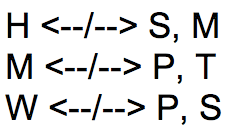
LSAT PrepTest 58, Game 4 - Rules

This means:

H conflicts with both S and M.
M conflicts with both P and T.
W conflicts with both P and S.

This means, among other things, that we must always lack at least one of H and S, one of M and T, and one of W and P. In other words, we must always lack at least 3 variables out of the 7 total.

Since the initial paragraph of the game also says that we must always have at least 3 variables in, this, when combined with the info that we must always lack at least 3 variables, means we will either have "4 in, 3 out" or "3 in, 4 out". ("4 in, 3 out" is demonstrated by the first diagram below.)


Of course, there are other pairs of variables that conflict with each other (pairs from which we must always lack at least one). However, I'm choosing these particular pairs because none of these conflicts overlap.

What I mean is - none of these conflicts mention the same variables - none of the variables are involved multiple times in the conflicts that I've chosen.

By choosing these particular conflicts out of all the conflicts mentioned in the rules, I can create the following 2 main templates / options:


Both diagrams indicate that we must always lack at least one of H and S, one of M and T, and one of W and P. The "4 in, 3 out" diagram is nearly complete because the conflicts I've chosen fill all the "out" slots, so everything else must be in, including L. The "3 in, 4 out" diagram is a bit more ambiguous because we still have 1 "out" slot remaining, and we don't know which variable will fill it.

It's important to remember that these diagrams don't address all of the rules - only the ones I handpicked. We still have to deal with a few conflicts, which are:

PrepTest 58, Game 4 - Remaining Rules

Let's keep these in mind as we go through the game.

Question 18
Typical List/Acceptability question

We're always going to lack at least one of H/S. Choice A violates this.
We're always going to lack at least one of M/T. Choice E violates this.
We're always going to lack at least one of P/W. Choice D violates this.

Looking at the conflicts not included on the diagram, we're always going to lack at least one of M/H. Choice B violates this.

By elimination, Choice C is our answer.


Question 19
Knowing that we must have at least 3 in and at least 3 out, the max we can have in is 4. We already know this from the inferences we made before starting the questions.


Question 20
If both P and W are out, our diagram becomes:

Choice A: We can't lack both H and L because L is definitely in. Eliminated.
Choice B: We CAN lack both H and M because there's no reason we can't have both S and T. This would create:
IN: STL
OUT: HMPW

This doesn't violate any of the remaining conflicts not included in the main diagram, so it's our answer.

I'll go through the rest anyway.

Choice C: We can't lack both H and S because there's only space in the out column to lack one of the two.
Choice D: We can't lack both L and M because L is definitely in.
Choice E: We can't lack both S and T because this would create:
IN: HML
OUT: STPW

H and M can't both be in because this violates one of the remaining conflicts not included in the main diagram.


Question 21
This is a local question asking what must be true if M is in. Remember that there are two major possibilities: having 3 variables in and 4 variables out, or having 4 variables in and 3 variables out.

In both possibilities, if M is in, H, P, and T will automatically be out. H and P will be out because M conflicts with both in the "remaining rules" not included on the main diagram. T will be out because we must always lack at least one of M/T according to the main diagram.

This fully determines the "4 in, 3 out diagram", creating:


This diagram is invalid because due to the "remaining rules," S and W can't both be in.

This leaves us with the "3 in, 4 out" diagram, which is a little ambiguous. We will again lose H, P, and T for the same reasons as above. However, there's still one more "out" slot to take care of. It's addressed by the fact that, in our "remaining rules", S and W conflict with each other. At least one of the two must be out, and since there's only one more "out" slot, whichever one of S and W isn't out must be in.

The diagram becomes:


In this diagram, L must be in, so L is our answer.


Question 22
The most efficient method here is to use previous work (previous valid scenarios).

In Q21's "3 in, 4 out" diagram, we could have lacked both H and S, so Choice A is eliminated.

In Q18, we lacked both L and W, so Choice C is eliminated.

In Q20's diagram, we could have lacked both M and P, so Choice D is eliminated.

In Q21's "3 in, 4 out" diagram, we could have lacked both T and W, so Choice E is eliminated.

By elimination, Choice B is our answer.


Question 23
We already know that M conflicts with H, P, and T. This means that the only courses out of the 7 it could ever be with are L, S, and W. Choice B says this, so it's our answer.

Choice B is just another way of saying something we already know, so if B is true instead of M conflicting with P and T, it'll have the same effect.

Photo created at www.addletters.com/bart-simpson-generator.htm

Recent LSAT and Law School Admissions News

Recent LSAT and Law School Admissions NewsTwo recent articles in the New York Times worth checking out:

1. Recession Spurs Interest in Graduate, Law Schools

2. Law School Admissions Lag Among Minorities

Related, in the Wall Street Journal's Law Blog, Study: As U.S. Grows More Diverse, Law Student Population Whitens.

LSAT Reading Comp Passages, Categorized

LSAT Reading Comp Passages CategorizedLast week, I published a list containing the topic of every LSAT Reading Comprehension Passage. You may have noticed that some topics appeared multiple times.

There are 4 Reading Comp passages per section. Each section contains one passage from each of the following categories: Natural Science, Social Science, Humanities, and Law.

Many prep companies group the 4 RC passages per section into those categories and stop there.

This week, I've gone a step further and done a more comprehensive categorization of many Reading Comprehension passages that have appeared on the LSAT.

Familiarity and comfort with these topics and/or passage styles is a good idea, as LSAC is likely to repeat them at some point in the future.

Some categories are broader than others, and some passages easily fall within more than one category. In these cases, I picked the category that seemed most useful.

The categories, in a loosely logical order, are:

Computers, Internet, Copyright Law
Judge, Jury, Lawyer, Courts
Law and Literature, Critical Legal Studies
Legal and Political Theory / Systems
Slavery and Civil Rights
Psychology
Economics
American Colonies
Immigrants
Women Doing Impressive Things Throughout History
Women's Education
Medieval Times
Native American Land
Other Native American Passages
Authors Mixing Literary Genres
Latin American Lit vs. Spanish Lit
Objectivism / Subjectivism
Environmentalism
Radiation
Thurgood Marshall's Legal Strategies
Bruno Bettelheim and Fairy Tales
Parallel Computing
Animals and Bacteria
Art
Graduate-Level Education
Music
Author/Poet/Artist and Interpretations of Work
Miscellaneous (I have not placed these in any category)

What are you supposed to do with this? Well, if there's a topic that scares you (objectivism/subjectivism, for example), try to get through as many of those passages as possible, just in case you see it on Test Day.

You can also see the following passages arranged by PrepTest (and get copies of them).

The number appearing before each passage's topic tells which passage it is out of the 4 in that PrepTest.


Reading Comprehension Passages, Categorized:

Computers, Internet, Copyright Law
PrepTest 25 - June 1998
1. Email privacy and the law

PrepTest 36 - December 2001
1. Do computer conferences function as communities?

PrepTest 39 - December 2002
4. Canadian copyright law and digitalization

PrepTest 41 - October 2003
1. Course packs and copyright law

PrepTest 42 - December 2003
3. Market system and technological developments

PrepTest 51 - December 2006
4. Computer legal reasoning systems

"PrepTest 51.5" - June 2007 - Free Online (PDF)
3. The Web, links, copyright law, and intellectual property

PrepTest 54 - June 2008
1. Internet - sovereignty and regulation

PrepTest 58 - September 2009
3. Tangible-object theory of copyright


Judge, Jury, Lawyer, Courts
PrepTest 1 - June 1991
3. Criminal procedure - adversarial vs. inquisitorial systems

PrepTest 13 - December 1994
4. Jury inferential errors

PrepTest 24 - December 1997
3. Social science tools to analyze court opinions

PrepTest 27 - December 1998
1. Jury impartiality, judges, media coverage, voir dire

PrepTest 32 - October 2000
1. Defense lawyers and innocence/guilt of clients, obligations

PrepTest 33 - December 2000
4. Jeremy Bentham and evidence reform - nonexclusion principle

PrepTest 37 - June 2002
1. Jury trials, unanimity requirement

PrepTest 40 - June 2003
4. Leading questions and memories

PrepTest 49 - June 2006
1. Computer-generated courtroom displays


Law and Literature, Critical Legal Studies
PrepTest 18 - December 1992
1. Law and literature movement, Richard Posner

PrepTest 21 - December 1996
2. What is "law"? Law and Economics, Critical Legal Studies, Law and Lit

PrepTest 30 - December 1999
3. Denise Meyerson vs. Critical Legal Studies


Legal and Political Theory / Systems
PrepTest B - February 1999
2. Rationales for punishing criminals, social-benefit vs. retributivist

PrepTest 4 - February 1992
1. Territorial waters, regulation of international waters

PrepTest 10 - February 1994
3. Legal realists and vagueness in law

PrepTest 11 - June 1994
2. Robert Dahl, democracy, and polyarchy

PrepTest 12 - October 1994
3. Legal systems in US vs. England - substantive vs. formal reasons

PrepTest 16 - September 1995
2. Native Americans and Supreme Court decisions

PrepTest 17 - December 1995
2. "Hard" legal cases, H.L.A. Hart vs. Ronald Dworkin

PrepTest 25 - June 1998
3. Native American intertribalism, Pan-Indian view

PrepTest 26 - September 1998
4. English marriage contracts and women's property rights, Susan Staves

PrepTest 34 - June 2001
1. Authoritarian rulers and democratic reforms/change
4. Women refugees and definitions according to the United Nations

PrepTest 35 - October 2001
4. Ronald Dworkin, legal positivism, and natural law

PrepTest 36 - December 2001
4. South Africa's legal system and change

PrepTest 38 - October 2002
2. Intellectual authority vs. institutional authority. Legal systems.

PrepTest 40 - June 2003
1. Multipolar vs. bipolar international political systems

PrepTest 44 - October 2004
1. Canadian Auto Workers' Legal Services Plan

PrepTest 45 - December 2004
4. Aboriginal rights in Canada

PrepTest 46 - June 2005
4. Prevention of harm - legal/moral theory

PrepTest 47 - October 2005
3. Family dispute resolution. Mediation programs vs. court adjudication.

PrepTest 48 - December 2005
3. Native Canadians vs. Canadian courts on property rights

PrepTest 53 - December 2007
2. British common law, Peter Goodrich

PrepTest 55 - October 2008
1. Trade secrets and court injunctions

PrepTest 56 - December 2008
3. The Roma and definition of national minority, Capotorti *


Slavery and Civil Rights
PrepTest C - February 2000
3. African American communism in Alabama, Robin Kelley's Hammer and Hoe

PrepTest 10 - February 1994
4. Civil rights movement social theories

PrepTest 11 - June 1994
1. Martin Luther King, Thoreau, and transcendentalism

PrepTest 14 - February 1995
4. Russian serfdom vs. U.S. slavery, Peter Kolchin

PrepTest 15 - June 1995
4. Black economic progress - hypotheses

PrepTest 19 - June 1996
4. Britain's abolition of the slave trade, Eric Williams

PrepTest 30 - December 1999
4. Vernon and African American rice cultivation

PrepTest 33 - December 2000
2. Harriet Jacobs' autobiographical narrative, slave women, domestic novel

PrepTest 47 - October 2005
1. Downstate campaign, Congress of Racial Equality

PrepTest 54 - June 2008
3. Cakewalk, Aida Overton Walker, African American performer

PrepTest 57 - June 2009
1. FCC vs. United Church of Christ, broadcasting license


Psychology
PrepTest 24 - December 1997
1. Risk communication

PrepTest 37 - June 2002
4. Psychology of decision making, and risk-taking

PrepTest 54 - June 2008
4. Groupthink and group cohesiveness


Economics
PrepTest 3 - December 1991
3. Abuse of monopoly power

PrepTest 8 - June 1993
2. Gray marketing

PrepTest 22 - June 1997
3. CEOs' economic vs. moral responsibility

PrepTest 28 - June 1999
3. Steady-state economics vs. neoclassical economics

PrepTest 33 - December 2000
1. Per capita GNP vs. human indicators, measuring a nation's economic health

PrepTest 50 - September 2006
2. Modern bankruptcy laws

PrepTest 55 - October 2008
4. Dutch tulip market, speculative bubble, Charles Mackay, Peter Garber

PrepTest 59 - December 2009
4. Ultimatum Game. Economics, emotion, and evolution


American Colonies
PrepTest 9 - October 1993
4. Political attitudes / institutions in England vs. American colonies

PrepTest 13 - December 1994
2. Freed African Americans in colonial Virginia, Myne Owne Ground

PrepTest 16 - September 1995
4. Women in colonial America vs. England


Immigrants
PrepTest 12 - October 1994
2. Socioeconomic achievements on Chinese and Japanese immigrants

PrepTest 21 - December 1996
4. Southeast Asian immigrants and James Tollefson's Alien Winds

PrepTest 23 - October 1997
4. Fugita and O'Brien's Japanese American Ethnicity

PrepTest 24 - December 1997
2. Korean Americans, cultural identity, Pico Korea Union

PrepTest 43 - June 2004
2. Code-switching among Puerto Rican Americans

PrepTest 44 - October 2004
2. Historiography and Asian settlers of the Pacific Coast

PrepTest 50 - September 2006
1. Mexican-American literature vs. Mexican literature


Women Doing Impressive Things Throughout History
Official LSAT PrepTest - February 1997
3. 19th-century British feminists and legal/labor historians

PrepTest 4 - February 1992
3. Women's participation in French Revolution

PrepTest 6 - October 1992
2. Women physicians in China

PrepTest 11 - June 1994
4. Women medical practitioners in Europe during Middle Ages

PrepTest 15 - June 1995
2. Women folklorists

PrepTest 35 - October 2001
1. Women's memoirs of the French Revolution, Denis Bertholet's study

PrepTest 49 - June 2006
3. Women doctors in ancient Greece and Rome


Women's Education
PrepTest B - February 1999
4. Privileged Renaissance women's education

PrepTest 56 - December 2008
4. French women and egalitarian educational reform


Medieval Times
PrepTest A - February 1996
1. Medieval marriage practices, Alexandrine doctrine

Official LSAT PrepTest - February 1997
1. Childhood in medieval Europe, Philippe Aries vs. Shulamath Shahar

PrepTest 11 - June 1994
4. Women medical practitioners in Europe during Middle Ages

PrepTest 20 - October 1996 - Free Online (PDF)
2. Medieval canon lawyers and lack of disciplinary proceedings

PrepTest 23 - October 1997
2. Medieval women's legal / financial rights

PrepTest 29 - October 1999
4. Medieval law and women, lack of knowledge


Native American Land
PrepTest 7 - February 1993
4. Native American land and the Dawes Act

PrepTest 9 - October 1993
2. Native Americans, land, readjustment, Bureau of Indian Affairs

PrepTest 19 - June 1996
2. Native American graves, individual vs. communal property law

PrepTest 28 - June 1999
1. Native American land claims, Mashpee, legal discourse


Other Native American Passages
PrepTest 3 - December 1991
4. Navajo weaving, Amsden

PrepTest 27 - December 1998
2. Personal names in Hopi culture

PrepTest 29 - October 1999
2. Tribal communities in North America, and teaching traditional languages

PrepTest 32 - October 2000
3. Native American autobiographies

PrepTest 38 - October 2002
1. Native Americans and controlled burning of forests


Authors Mixing Literary Genres
PrepTest 51 - December 2006
1. Ezekiel Mphahlele, South African writer, mix autobiography/fiction

"PrepTest 51.5" - June 2007 - Free Online (PDF)
1. Rita Dove, African American writer, gap between poetry and fiction

PrepTest 52 - September 2007
1. Ousmane Sembene, Senegalese filmmaker, oral tradition, sociopolitical

PrepTest 55 - October 2008
3. Chinese talk-story, Maxine Hong Kingston

PrepTest 56 - December 2008
1. Amos Tutuola, Nigerian writer, folktales, traditional lore

PrepTest 57 - June 2009
3. Willa Cather, novel vs. narrative *


Latin American Lit vs. Spanish Lit
PrepTest B - February 1999
3. Hispanic American writers and Spain, cosmopolitanism vs. nativism

PrepTest 40 - June 2003
2. Latin American poetry vs. Spanish poetry


Objectivism / Subjectivism
PrepTest 18 - December 1992
2. Science - objective vs. ideological bias (subjective), new historians

PrepTest 22 - June 1997
2. Objectivism vs. alternative legal narratives

PrepTest 31 - June 2000
3. Donna Haraway's Primate Visions
4. Objectivism vs. subjectivism when studying the mind

PrepTest 32 - October 2000
2. Multicultural education and proposals for implementation


Environmentalism
Official LSAT PrepTest - February 1997
2. Greenhouse gases and impact

PrepTest 4 - February 1992
2. Biological diversity and human activity

PrepTest 11 - June 1994
3. Species diversity in Amazon River basin

PrepTest 17 - December 1995
3. Industrial carbon dioxide emissions, impose a tax

PrepTest 19 - June 1996
3. Species diversity hypotheses

PrepTest 23 - October 1997
3. Environmental crisis, George P. Marsh, Frederic Clements

PrepTest 26 - September 1998
3. Dolphin die-off, PCBs, brevetoxin, synthetic pollutants

PrepTest 31 - June 2000
1. Ideal industrial ecosystem and Earth's population increase

PrepTest 33 - December 2000l
3. Potential benefits of increased atmospheric CO2 levels / concentrations

PrepTest 41 - October 2003
3. Fossil fuels and renewable energy sources

PrepTest 43 - June 2004
1. Oil well drilling and contaminated groundwater


Radiation
PrepTest 37 - June 2002
2. Marie Curie, radiation/radioactivity

PrepTest 39 - December 2002
3. Max Planck, wave theory, and radiation


Thurgood Marshall's Legal Strategies
PrepTest 31 - June 2000
2. Thurgood Marshall's legal career and his strategies / approaches

PrepTest 42 - December 2003
1. Thurgood Marshall, NAACP, public interest law, tactics/strategies


Bruno Bettelheim and Fairy Tales
PrepTest 27 - December 1998
4. Fairy tales, Bruno Bettelheim, Freud, therapeutic

PrepTest 39 - December 2002
2. Interpreting fairy tales, parents vs. children, Bruno Bettelheim


Parallel Computing
PrepTest 58 - September 2009
2. Parallel computing. Philip Emeagwali, Nigerian-born computer scientist

PrepTest 59 - December 2009
1. Parallel computing and increased computing capabilities *


Animals and Bacteria
PrepTest B - February 1999
1. Invertebrate schooling behavior and benefits

PrepTest C - February 2000
1. Kinglets' survival in cold winters

PrepTest 2 - October 1991
3. Water-bug adaptive responses, micropterous, macropterous

PrepTest 5 - June 1992
3. Bacteria and chemical attractants, concentration gradient

PrepTest 7 - February 1993
3. Phytopathogens, pseudomonas fluorescens / syringae

PrepTest 13 - December 1994
1. Neurogenesis and canaries

PrepTest 15 - June 1995
1. Dinosaur extinction, volcanic-eruption theory vs. impact theory

PrepTest 27 - December 1998
3. Homing pigeons - hypotheses re: how they "home"

PrepTest 29 - October 1999
3. Platypus uses bill to locate prey

PrepTest 30 - December 1999
1. The okapis' relatives, size and location of population, eating behavior

PrepTest 34 - June 2001
3. Lamarck and the inheritance of acquired characteristics - new examples

PrepTest 36 - December 2001
3. Hormones, behavior, and osmolality

PrepTest 46 - June 2005
3. Pronghorn relict behavior, adaptation, fastest land animal

PrepTest 47 - October 2005
4. Pathogen/parasite vs. host

PrepTest 48 - December 2005
4. Embryo polarity, fruit fly, nematode

PrepTest 52 - September 2007
3. Evolutionary game theory, Susan Reichert

PrepTest 53 - December 2007
4. Cyclamen mites and Typhlodromus mites

PrepTest 56 - December 2008
2. Inclusive fitness theory, kin recognition


Art
PrepTest 5 - June 1992
2. Nico Frijdas "law of apparent reality" and emotional responses to art

PrepTest 9 - October 1993
1. Technology and art, video, photography

PrepTest 14 - February 1995
3. Stolen art, legislation, and purchasers

PrepTest 29 - October 1999
1. Are pre-World War I painters prophetic?

PrepTest 39 - December 2002
1. Muralists - Mexican artists / painters

PrepTest 44 - October 2004
4. Modern Movement in architecture

PrepTest 47 - October 2005
2. Chinese Cultural Revolution, Scar Art movement, Revolutionary Realism

PrepTest 48 - December 2005
1. Aurignacian cave paintings / art

PrepTest 49 - June 2006
2. Determining tribal origins of African sculptures/art based on style


Graduate-Level Education
PrepTest 38 - October 2002
4. Medical school ethics training

PrepTest 52 - September 2007
2. Professional (historical/legal) writing and narrative *

PrepTest 59 - December 2009
2. Importance of teaching statutory law in law school


Music
PrepTest 6 - October 1992
. Early music movement

"PrepTest 51.5" - June 2007 - Free Online (PDF)
2. Music, language, and evolution *

PrepTest 58 - September 2009
4. Music, complexity of sounds, and emotions *


Author/Poet/Artist and Interpretations of Work
PrepTest A - February 1996
4. Jose Antonio Maravall's interpretation of Baroque culture

Official LSAT PrepTest - February 1997
4. Robert L. Jackson's Black Writers in Latin America

PrepTest 1 - June 1991
1. Phillis Wheatley, African American poet/poetry

PrepTest 2 - October 1991
1. Langston Hughes and folk poetry

PrepTest 4 - February 1992
4. French Impressionism, Robert L. Herbert

PrepTest 7 - February 1993
2. John Webster, Elizabethan playwright, and critics

PrepTest 10 - February 1994
2. Venetian religious narrative painting, Patricia Fortini Brown

PrepTest 12 - October 1994
1. Otto Wagner's Modern Architecture

PrepTest 13 - December 1994
3. French artist Watteau and admirers

PrepTest 15 - June 1995
3. J.G.A. Pocock and political discourse

PrepTest 16 - September 1995
1. Byron's poetry and personality

PrepTest 17 - December 1995
1. Zora Neale Hurston's Their Eyes Were Watching God

PrepTest 18 - December 1992
3. Cherokee and Euro-American culture, William McLoughlin
4. Luminist paintings, Fitz Hugh Lane

PrepTest 19 - June 1996
1. P.D. James' crime novels

PrepTest 20 - October 1996 - Free Online (PDF)
1. Miles Davis and jazz innovation
4. Collapse of Classic Mayan civilization, John Lowe

PrepTest 21 - December 1996
1. London Pianoforte school and Nicholas Temperley's anthology

PrepTest 22 - June 1997
1. Frida Kahlo and Mexican nationalism

PrepTest 23 - October 1997
1. Dutch artist Rembrandt as entrepreneur, Svetlana Alpers

PrepTest 24 - December 1997
4. Mark Jones's Fake? The Art of Deception (fake art)

PrepTest 25 - June 1998
2. Homer's poetry - studying works vs. peripheral issues, Milman Parry

PrepTest 26 - September 1998
2. James Porter and African influence on African-American art

PrepTest 35 - October 2001
2. Romare Bearden, paintings, and the African-American experience

PrepTest 37 - June 2002
3. Ralph Ellison, Invisible Man, critics

PrepTest 41 - October 2003
2. Countee Cullen - Harlem Renaissance poet, European-style verse

PrepTest 42 - December 2003
2. Roy Lichtenstein, fine art, pop art, comics

PrepTest 46 - June 2005
2. Joy Kogawa's Obasan and rite of passage to become a hero

PrepTest 48 - December 2005
2. Louise Gluck's poetry and gender issues

PrepTest 53 - December 2007
1. Wing Tek Lum's poetry

PrepTest 59 - December 2009
3. Japanese American sculptor Isamu Noguchi


Miscellaneous (I have not placed these in any category)
PrepTest A - February 1996
2. Nontraditional black women filmmakers
3. Alfred Wegener's theory of continental drift


PrepTest C - February 2000
2. Juvenile delinquency
4. Darwin's conception of early prehistoric humans, and taphonomy


PrepTest 1 - June 1991
2. Cell biology / cytology and biochemistry
4. Professions - defining the term


PrepTest 2 - October 1991
2. U.S. railroad, "romantic-era distrust" of it, John Stilgoe
4. War Powers Resolution


PrepTest 3 - December 1991
1. Asteroid satellites
2. English scientists not crediting technicians for their work


PrepTest 5 - June 1992
1. Administrative contracts and altering contracts unilaterally
4. Life-passage vs. life-history studies


PrepTest 6 - October 1992
1. Taft-Hartley Act, "right-to-work" legislation, Thomas M. Carroll
4. U.S. steel industry


PrepTest 7 - February 1993
1. Working mothers in the labor force


PrepTest 8 - June 1993
1. Recombinant DNA (rDNA)
3. African American autobiographical narratives
4. British wealth, Rubinstein's claim


PrepTest 9 - October 1993
3. Literacy in Ancient Greek society and the elite


PrepTest 10 - February 1994
1. Crude oil pumps and offshore processing platforms


PrepTest 12 - October 1994
4. Serotonin and carbohydrate craving


PrepTest 14 - February 1995
1. Earth's magnetic field - hypotheses
2. Deconstruction - term and meaning


PrepTest 16 - September 1995
3. Large interactive systems, catastrophe caused by minor events


PrepTest 17 - December 1995
4. Drought in sub-Saharan West Africa


PrepTest 21 - December 1996
3. Origin of oil - biogenic vs abiogenic theory


PrepTest 22 - June 1997
4. Language and math, essentialist vs. conventionalist views of language


PrepTest 25 - June 1998
4. Analytic method vs. organicism


PrepTest 26 - September 1998
1. Compulsory national service


PrepTest 28 - June 1999
2. Volcano-climate connection, Mass and Portman
4. Movie quality/promotion changes due to mass media


PrepTest 30 - December 1999
2. Greek tragic dramas, and free will vs. gods and fate


PrepTest 32 - October 2000
4. Why wine is healthy in moderation


PrepTest 34 - June 2001
2. The blues, African American folk tradition, and spirituals


PrepTest 35 - October 2001
3. Universal laws, determinism, and biology


PrepTest 36 - December 2001
2. Latin texts in Renaissance England


PrepTest 38 - October 2002
3. Philip Abrams, historical sociology, and structuring


PrepTest 40 - June 2003
3. Dark matter and neutrinos' mass


PrepTest 41 - October 2003
4. Victorian philanthropy and criticism of it


PrepTest 42 - December 2003
4. Neurotransmitters, synapses, and electrical impulses


PrepTest 43 - June 2004
3. Reader-response theory vs. formalism
4. Faculty inventions/discoveries and universities'/institutional policies


PrepTest 44 - October 2004
3. Nerve growth factor (NGF) and Rita Levi-Montalcini


PrepTest 45 - December 2004
1. Natural disaster relief proposals/approaches
2. Hippocratic Oath outdated?
3. Lichen-forming fungi DNA study


PrepTest 46 - June 2005
1. Definition of prosperity. Monetary vs. other considerations.


PrepTest 49 - June 2006
4. Maize / corn cultivation


PrepTest 50 - September 2006
3. Determining national / cultural identity
4. Riddled basins of attraction - John Sommerer and Edward Ott


PrepTest 51 - December 2006
2. Late heavy bombardment (LHB), craters on the moon
3. Impact of TV in developing nations, cultural imperialism


"PrepTest 51.5" - June 2007 - Free Online (PDF)
4. Irish landscape, history, and preserved pollen grains


PrepTest 52 - September 2007
4. Philosophical anarchism


PrepTest 53 - December 2007
3. University research findings as commodities *


PrepTest 54 - June 2008
2. Drilling muds *


PrepTest 55 - October 2008
2. Purple loosestrife *


PrepTest 57 - June 2009
2. Humanists vs. scientists, scientific humanism
4. Fractal geometry, self-similarity


PrepTest 58 - September 2009
1. Ancient textiles, analyzing archaeological remains and texts

* = comparative (dual) passages, started in June 2007.

Photo by eralon CC BY-ND 2.0

Reading Comprehension Passage Topics

LSAT Blog Reading Comprehension Passage TopicsBelow, I've listed every LSAT Reading Comprehension passage topic from every released LSAT PrepTest.

Best LSAT Prep Books lists the books containing these exams. You can also see most of these passages categorized by topic.

PrepTest A - February 1996
1. Medieval marriage practices, Alexandrine doctrine
2. Nontraditional black women filmmakers
3. Alfred Wegener's theory of continental drift
4. Jose Antonio Maravall's interpretation of Baroque culture


PrepTest B - February 1999
1. Invertebrate schooling behavior and benefits
2. Rationales for punishing criminals, social-benefit vs. retributivist
3. Hispanic American writers and Spain, cosmopolitanism vs. nativism
4. Privileged Renaissance women's education


PrepTest C - February 2000
1. Kinglets' survival in cold winters
2. Juvenile delinquency
3. African American communism in Alabama, Robin Kelley's Hammer and Hoe
4. Darwin's conception of early prehistoric humans, and taphonomy


Official LSAT PrepTest - February 1997
1. Childhood in medieval Europe, Philippe Aries vs. Shulamath Shahar
2. Greenhouse gases and impact
3. 19th-century British feminists and legal/labor historians
4. Robert L. Jackson's Black Writers in Latin America


PrepTest 1 - June 1991
1. Phillis Wheatley, African American poet/poetry
2. Cell biology / cytology and biochemistry
3. Criminal procedure - adversarial vs. inquisitorial systems
4. Professions - defining the term


PrepTest 2 - October 1991
1. Langston Hughes and folk poetry
2. U.S. railroad, "romantic-era distrust" of it, John Stilgoe
3. Water-bug adaptive responses, micropterous, macropterous
4. War Powers Resolution


PrepTest 3 - December 1991
1. Asteroid satellites
2. English scientists not crediting technicians for their work
3. Abuse of monopoly power
4. Navajo weaving, Amsden


PrepTest 4 - February 1992
1. Territorial waters, regulation of international waters
2. Biological diversity and human activity
3. Women's participation in French Revolution
4. French Impressionism, Robert L. Herbert


PrepTest 5 - June 1992
1. Administrative contracts and altering contracts unilaterally
2. Nico Frijdas "law of apparent reality" and emotional responses to art
3. Bacteria and chemical attractants, concentration gradient
4. Life-passage vs. life-history studies


PrepTest 6 - October 1992
1. Taft-Hartley Act, "right-to-work" legislation, Thomas M. Carroll
2. Women physicians in China
3. Early music movement
4. U.S. steel industry


PrepTest 7 - February 1993
1. Working mothers in the labor force
2. John Webster, Elizabethan playwright, and critics
3. Phytopathogens, pseudomonas fluorescens / syringae
4. Native American land and the Dawes Act


PrepTest 8 - June 1993
1. Recombinant DNA (rDNA)
2. Gray marketing
3. African American autobiographical narratives
4. British wealth, Rubinstein's claim


PrepTest 9 - October 1993
1. Technology and art, video, photography
2. Native Americans, land, readjustment, Bureau of Indian Affairs
3. Literacy in Ancient Greek society and the elite
4. Political attitudes / institutions in England vs. American colonies


PrepTest 10 - February 1994
1. Crude oil pumps and offshore processing platforms
2. Venetian religious narrative painting, Patricia Fortini Brown
3. Legal realists and vagueness in law
4. Civil rights movement social theories


PrepTest 11 - June 1994
1. Martin Luther King, Thoreau, and transcendentalism
2. Robert Dahl, democracy, and polyarchy
3. Species diversity in Amazon River basin
4. Women medical practitioners in Europe during Middle Ages


PrepTest 12 - October 1994
1. Otto Wagner's Modern Architecture
2. Socioeconomic achievements on Chinese and Japanese immigrants
3. Legal systems in US vs. England - substantive vs. formal reasons
4. Serotonin and carbohydrate craving


PrepTest 13 - December 1994
1. Neurogenesis and canaries
2. Freed African Americans in colonial Virginia, Myne Owne Ground
3. French artist Watteau and admirers
4. Jury inferential errors


PrepTest 14 - February 1995
1. Earth's magnetic field - hypotheses
2. Deconstruction - term and meaning
3. Stolen art, legislation, and purchasers
4. Russian serfdom vs. U.S. slavery, Peter Kolchin


PrepTest 15 - June 1995
1. Dinosaur extinction, volcanic-eruption theory vs. impact theory
2. Women folklorists
3. J.G.A. Pocock and political discourse
4. Black economic progress - hypotheses


PrepTest 16 - September 1995
1. Byron's poetry and personality
2. Native Americans and Supreme Court decisions
3. Large interactive systems, catastrophe caused by minor events
4. Women in colonial America vs. England


PrepTest 17 - December 1995
1. Zora Neale Hurston's Their Eyes Were Watching God
2. "Hard" legal cases, H.L.A. Hart vs. Ronald Dworkin
3. Industrial carbon dioxide emissions, impose a tax
4. Drought in sub-Saharan West Africa


PrepTest 18 - December 1992
1. Law-and-literature movement, Richard Posner
2. Science - objective vs. ideological bias (subjective), new historians
3. Cherokee and Euro-American culture, William McLoughlin
4. Luminist paintings, Fitz Hugh Lane


PrepTest 19 - June 1996
1. P.D. James' crime novels
2. Native American graves, individual vs. communal property law
3. Species diversity hypotheses
4. Britain's abolition of the slave trade, Eric Williams


PrepTest 20 - October 1996 - Free Online (PDF)
1. Miles Davis and jazz innovation
2. Medieval canon lawyers and lack of disciplinary proceedings
3. Birds and status signaling hypothesis, Rowher
4. Collapse of Classic Mayan civilization, John Lowe


PrepTest 21 - December 1996
1. London Pianoforte school and Nicholas Temperley's anthology
2. What is "law"? Law and Economics, Critical Legal Studies, Law and Lit
3. Origin of oil - biogenic vs abiogenic theory
4. Southeast Asian immigrants and James Tollefson's Alien Winds


PrepTest 22 - June 1997
1. Frida Kahlo and Mexican nationalism
2. Objectivism vs. alternative legal narratives
3. CEOs' economic vs. moral responsibility
4. Language and math, essentialist vs. conventionalist views of language


PrepTest 23 - October 1997
1. Dutch artist Rembrandt as entrepreneur, Svetlana Alpers
2. Medieval women's legal / financial rights
3. Environmental crisis, George P. Marsh, Frederic Clements
4. Fugita and O'Brien's Japanese American Ethnicity


PrepTest 24 - December 1997
1. Risk communication
2. Korean Americans, cultural identity, Pico Korea Union
3. Social science tools to analyze court opinions
4. Mark Jones's Fake? The Art of Deception (fake art)


PrepTest 25 - June 1998
1. Email privacy and the law
2. Homer's poetry - studying works vs. peripheral issues, Milman Parry
3. Native American intertribalism, Pan-Indian view
4. Analytic method vs. organicism


PrepTest 26 - September 1998
1. Compulsory national service
2. James Porter and African influence on African-American art
3. Dolphin die-off, PCBs, brevetoxin, synthetic pollutants
4. English marriage contracts and women's property rights, Susan Staves


PrepTest 27 - December 1998
1. Jury impartiality, judges, media coverage, voir dire
2. Personal names in Hopi culture
3. Homing pigeons - hypotheses re: how they "home"
4. Fairy tales, Bruno Bettelheim, Freud, therapeutic


PrepTest 28 - June 1999
1. Native American land claims, Mashpee, legal discourse
2. Volcano-climate connection, Mass and Portman
3. Steady-state economics vs. neoclassical economics
4. Movie quality/promotion changes due to mass media


PrepTest 29 - October 1999
1. Are pre-World War I painters prophetic?
2. Tribal communities in North America, and teaching traditional languages
3. Platypus uses bill to locate prey
4. Medieval law and women, lack of knowledge


PrepTest 30 - December 1999
1. The okapis' relatives, size and location of population, eating behavior
2. Greek tragic dramas, and free will vs. gods and fate
3. Denise Meyerson vs. Critical Legal Studies
4. Vernon and African American rice cultivation


PrepTest 31 - June 2000
1. Ideal industrial ecosystem and Earth's population increase
2. Thurgood Marshall's legal career and his strategies / approaches
3. Donna Haraway's Primate Visions
4. Objectivism vs. subjectivism when studying the mind


PrepTest 32 - October 2000
1. Defense lawyers and innocence/guilt of clients, obligations
2. Multicultural education and proposals for implementation.
3. Native American autobiographies
4. Why wine is healthy in moderation


PrepTest 33 - December 2000
1. Per capita GNP vs. human indicators, measuring a nation's economic health
2. Harriet Jacobs' autobiographical narrative, slave women, domestic novel
3. Potential benefits of increased atmospheric CO2 levels / concentrations
4. Jeremy Bentham and evidence reform - nonexclusion principle


PrepTest 34 - June 2001
1. Authoritarian rulers and democratic reforms/change
2. The blues, African American folk tradition, and spirituals
3. Lamarck and the inheritance of acquired characteristics - new examples
4. Women refugees and definitions according to the United Nations


PrepTest 35 - October 2001
1. Women's memoirs of the French Revolution, Denis Bertholet's study
2. Romare Bearden, paintings, and the African-American experience
3. Universal laws, determinism, and biology
4. Ronald Dworkin, legal positivism, and natural law


PrepTest 36 - December 2001
1. Do computer conferences function as communities?
2. Latin texts in Renaissance England
3. Hormones, behavior, and osmolality
4. South Africa's legal system and change


PrepTest 37 - June 2002
1. Jury trials, unanimity requirement
2. Marie Curie, radiation/radioactivity
3. Ralph Ellison, Invisible Man, critics
4. Psychology of decision making, and risk-taking


PrepTest 38 - October 2002
1. Native Americans and controlled burning of forests
2. Intellectual authority vs. institutional authority. Legal systems.
3. Philip Abrams, historical sociology, and structuring
4. Medical school ethics training


PrepTest 39 - December 2002
1. Muralists - Mexican artists / painters
2. Interpreting fairy tales, parents vs. children, Bruno Bettelheim
3. Max Planck, wave theory, and radiation
4. Canadian copyright law and digitalization


PrepTest 40 - June 2003
1. Multipolar vs. bipolar international political systems
2. Latin American poetry vs. Spanish poetry
3. Dark matter and neutrinos' mass
4. Leading questions and memories


PrepTest 41 - October 2003
1. Course packs and copyright law
2. Countee Cullen - Harlem Renaissance poet, European-style verse
3. Fossil fuels and renewable energy sources
4. Victorian philanthropy and criticism of it


PrepTest 42 - December 2003
1. Thurgood Marshall, NAACP, public interest law, tactics/strategies
2. Roy Lichtenstein, fine art, pop art, comics
3. Market system and technological developments
4. Neurotransmitters, synapses, and electrical impulses


PrepTest 43 - June 2004
1. Oil well drilling and contaminated groundwater
2. Code-switching among Puerto Rican Americans
3. Reader-response theory vs. formalism
4. Faculty inventions/discoveries and universities'/institutional policies


PrepTest 44 - October 2004
1. Canadian Auto Workers' Legal Services Plan
2. Historiography and Asian settlers of the Pacific Coast
3. Nerve growth factor (NGF) and Rita Levi-Montalcini
4. Modern Movement in architecture


PrepTest 45 - December 2004
1. Natural disaster relief proposals/approaches
2. Hippocratic Oath outdated?
3. Lichen-forming fungi DNA study
4. Aboriginal rights in Canada


PrepTest 46 - June 2005
1. Definition of prosperity. Monetary vs. other considerations.
2. Joy Kogawa's Obasan and rite of passage to become a hero
3. Pronghorn relict behavior, adaptation, fastest land animal
4. Prevention of harm - legal/moral theory


PrepTest 47 - October 2005
1. Downstate campaign, Congress of Racial Equality
2. Chinese Cultural Revolution, Scar Art movement, Revolutionary Realism
3. Family dispute resolution. Mediation programs vs. court adjudication.
4. Pathogen/parasite vs. host


PrepTest 48 - December 2005
1. Aurignacian cave paintings / art
2. Louise Gluck's poetry and gender issues
3. Native Canadians vs. Canadian courts on property rights
4. Embryo polarity, fruit fly, nematode


PrepTest 49 - June 2006
1. Computer-generated courtroom displays
2. Determining tribal origins of African sculptures/art based on style
3. Women doctors in ancient Greece and Rome
4. Maize / corn cultivation


PrepTest 50 - September 2006
1. Mexican-American literature vs. Mexican literature
2. Modern bankruptcy laws
3. Determining national / cultural identity
4. Riddled basins of attraction - John Sommerer and Edward Ott


PrepTest 51 - December 2006
1. Ezekiel Mphahlele, South African writer, mix autobiography/fiction
2. Late heavy bombardment (LHB), craters on the moon
3. Impact of TV in developing nations, cultural imperialism
4. Computer legal reasoning systems


"PrepTest 51.5" - June 2007 - Free Online (PDF)
1. Rita Dove, African American writer, gap between poetry and fiction
2. Music, language, and evolution *
3. The Web, links, copyright law, and intellectual property
4. Irish landscape, history, and preserved pollen grains


PrepTest 52 - September 2007
1. Ousmane Sembene, Senegalese filmmaker, oral tradition, sociopolitical
2. Professional (historical/legal) writing and narrative *
3. Evolutionary game theory, Susan Reichert
4. Philosophical anarchism


PrepTest 53 - December 2007
1. Wing Tek Lum's poetry
2. British common law, Peter Goodrich
3. University research findings as commodities *
4. Cyclamen mites and Typhlodromus mites


PrepTest 54 - June 2008
1. Internet - sovereignty and regulation
2. Drilling muds *
3. Cakewalk, Aida Overton Walker, African American performer
4. Groupthink and group cohesiveness


PrepTest 55 - October 2008
1. Trade secrets and court injunctions
2. Purple loosestrife *
3. Chinese talk-story, Maxine Hong Kingston
4. Dutch tulip market, speculative bubble, Charles Mackay, Peter Garber


PrepTest 56 - December 2008
1. Amos Tutuola, Nigerian writer, folktales, traditional lore
2. Inclusive fitness theory, kin recognition
3. The Roma and definition of national minority, Capotorti *
4. French women and egalitarian educational reform


PrepTest 57 - June 2009
1. FCC vs. United Church of Christ, broadcasting license
2. Humanists vs. scientists, scientific humanism
3. Willa Cather, novel vs. narrative *
4. Fractal geometry, self-similarity


PrepTest 58 - September 2009
1. Ancient textiles, analyzing archaeological remains and texts
2. Parallel computing. Philip Emeagwali, Nigerian-born computer scientist
3. Tangible-object theory of copyright
4. Music, complexity of sounds, and emotions *


PrepTest 59 - December 2009
1. Parallel computing and increased computing capabilities *
2. Importance of teaching statutory law in law school
3. Japanese American sculptor Isamu Noguchi
4. Ultimatum Game. Economics, emotion, and evolution

* = comparative (dual) passages, started in June 2007.

Photo by midatlanticbulldogrescue / CC BY-NC-ND 2.0

Sufficient Assumption Questions | Tips and Categorization

I've talked in the past about how Sufficient Assumption questions are generally based in formal logic. This week, I'm going a bit further with this idea.

I recently analyzed every Sufficient Assumption question from LSAT PrepTests 19-58 (primarily by using the LSAT Logical Reasoning Spreadsheet).

(See these LSAT Logical Reasoning Sufficient Assumption slides from a class I taught for more.)

I found the vast majority of these questions fall into one of the following 6 categories:

1. A restatement of the conclusion / argument

Conclusion / Argument: A --> B

Sufficient Assumption: A --> B

I know it sounds incredibly silly that LSAC would test this, but don't laugh. As you can see below, this is clearly one of the most common patterns for Sufficient Assumption questions.

The correct answer may be worded much differently than the argument/conclusion in the stimulus, even though they cover the same concepts (using double-negatives, synonyms, etc.).

The correct answer may also be worded in more general terms than the argument/conclusion in the stimulus.

Examples (29 questions):
PrepTest 22 (June 1997 LSAT), Section 4, Question 2 - page 138 in 10 More
PrepTest 22 (June 1997 LSAT), Section 4, Question 5 - page 139 in 10 More
PrepTest 22 (June 1997 LSAT), Section 4, Question 13 - page 141 in 10 More
PrepTest 24 (December 1997 LSAT), Section 2, Question 21 - page 200 in 10 More
PrepTest 32 (October 2000 LSAT), Section 1, Question 5 - page 119 in Next 10
PrepTest 33 (December 2000 LSAT), Section 3, Question 21 - page 173 in Next 10
PrepTest 33 (December 2000 LSAT), Section 3, Question 23 - page 174 in Next 10
PrepTest 34 (June 2001 LSAT), Section 2, Question 2 - page 194 in Next 10
PrepTest 35 (October 2001 LSAT), Section 4, Question 19 - page 245 in Next 10
PrepTest 36 (December 2001 LSAT), Section 1, Question 22 - page 260 in Next 10
PrepTest 40 (June 2003 LSAT), Section 1, Question 19
PrepTest 40 (June 2003 LSAT), Section 1, Question 21
PrepTest 41 (October 2003 LSAT), Section 3, Question 22
PrepTest 42 (December 2003 LSAT), Section 2, Question 23
PrepTest 43 (June 2004 LSAT), Section 2, Question 18
PrepTest 43 (June 2004 LSAT), Section 3, Question 16
PrepTest 47 (October 2005 LSAT), Section 1, Question 12
PrepTest 49 (June 2006 LSAT), Section 2, Question 19
PrepTest 49 (June 2006 LSAT), Section 4, Question 18
PrepTest 50 (September 2006 LSAT), Section 4, Question 13
PrepTest 52 (September 2007 LSAT), Section 1, Question 17
PrepTest 52 (September 2007 LSAT), Section 1, Question 20
PrepTest 53 (December 2007 LSAT), Section 1, Question 20
PrepTest 54 (June 2008 LSAT), Section 2, Question 13
PrepTest 55 (October 2008 LSAT), Section 1, Question 4
PrepTest 55 (October 2008 LSAT), Section 3, Question 10
PrepTest 57 (June 2009 LSAT), Section 2, Question 12
PrepTest 57 (June 2009 LSAT), Section 3, Question 24
PrepTest 58 (September 2009 LSAT), Section 1, Question 12


2. The contrapositive of the conclusion / argument

Conclusion / Argument: A --> B

Sufficient Assumption: NOT B --> NOT A

Examples (9 questions):
PrepTest 9 (October 1993 LSAT), Section 2, Question 23 - page 64 in 10 Actual
PrepTest 24 (December 1997 LSAT), Section 2, Question 24 - page 201 in 10 More
PrepTest 34 (June 2001 LSAT), Section 2, Question 10 - page 196 in Next 10
PrepTest 36 (December 2001 LSAT), Section 1, Question 26 - page 261 in Next 10
PrepTest 45 (December 2004 LSAT), Section 1, Question 21
PrepTest 46 (June 2005 LSAT), Section 3, Question 24
PrepTest 48 (December 2005 LSAT), Section 1, Question 25
PrepTest 49 (June 2006 LSAT), Section 2, Question 25
PrepTest 49 (June 2006 LSAT), Section 4, Question 22


3. The sufficient condition of an argument

Evidence: A --> B --> C --> D
Conclusion: D

Sufficient Assumption #1: A
Sufficient Assumption #2: B
Sufficient Assumption #3: C

Examples:
PrepTest 35 (October 2001 LSAT), Section 1, Question 20 - page 225 in Next 10
PrepTest 36 (December 2001), Section 1, Question 18 - page 259 in Next 10


4. The sufficient condition of a argument's contrapositive

Evidence: A --> B --> C --> D
Contrapositive: NOT D --> NOT C --> NOT B --> NOT A
Conclusion: NOT A

Sufficient Assumption #1: NOT D
Sufficient Assumption #2: NOT C
Sufficient Assumption #3: NOT B

Examples:
PrepTest 23 (October 1997 LSAT), Section 3, Question 14 - page 167 in 10 More
PrepTest 44 (October 2004 LSAT), Section 4, Question 26


5. The linkage of two pieces of evidence to form a chain that proves the conclusion true

Evidence #1: A --> B
Evidence #2: C --> D
Conclusion: A --> D

Sufficient Assumption #1: B --> C
Sufficient Assumption #2: NOT C --> NOT B

Examples:
PrepTest 46 (June 2005 LSAT), Section 2, Question 23

PrepTest 48 (December 2005 LSAT), Section 4, Question 21

PrepTest 58 (September 2009 LSAT), Section 1, Question 25

PrepTest 58 (September 2009 LSAT), Section 4, Question 19


6A. The linkage of the conclusion's sufficient condition with the evidence's sufficient condition so the former requires (or falls within) the latter.

(This can only be done after making the necessary conditions of the evidence and conclusion identical.)

Evidence: A --> B
Conclusion: C --> B

Sufficient Assumption #1: C --> A
Sufficient Assumption #2: NOT A --> NOT C

Contrapositively...

6B. The linkage of the evidence's necessary condition with the conclusion's necessary condition so the former requires (or falls within) the latter.

(This can only be done after making the sufficient conditions of the evidence and conclusion identical.)

Evidence: D --> E
Conclusion: D --> F

Sufficient Assumption #1: E --> F
Sufficient Assumption #2: NOT F --> NOT E

(You can often manipulate/rearrange evidence and conclusion for both 6A and 6B above by taking the contrapositive of the evidence, conclusion, or both.)


Examples (37 questions):
PrepTest 19 (June 1996 LSAT), Section 4, Question 11 - page 38 in 10 More
PrepTest 23 (October 1997 LSAT), Section 2, Question 5 - page 157 in 10 More
PrepTest 24 (December 1997 LSAT), Section 3, Question 10 - page 204 in 10 More
PrepTest 24 (December 1997 LSAT), Section 3, Question 19 - page 207 in 10 More
PrepTest 25 (June 1998 LSAT), Section 4, Question 18 - page 245 in 10 More
PrepTest 26 (September 1998 LSAT), Section 3, Question 21 - page 272 - in 10 More
PrepTest 28 (June 1999 LSAT), Section 1, Question 24 - page 328 - in 10 More
PrepTest 31 (June 2000 LSAT), Section 2, Question 10 - page 91 in Next 10
PrepTest 35 (October 2001 LSAT), Section 1, Question 22 - page 226 in Next 10
PrepTest 35 (October 2001 LSAT), Section 4, Question 14 - page 244 in Next 10
PrepTest 36 (December 2001 LSAT), Section 3, Question 12 - page 273 in Next 10
PrepTest 37 (June 2002 LSAT), Section 2, Question 5 - page 297 in Next 10
PrepTest 37 (June 2002 LSAT), Section 4, Question 9 - page 310 in Next 10
PrepTest 37 (June 2002 LSAT), Section 4, Question 20 - page 313 in Next 10
PrepTest 38 (October 2002 LSAT), Section 1, Question 1 - page 322 in Next 10
PrepTest 38 (October 2002 LSAT), Section 4, Question 16 - page 346 in Next 10
PrepTest 40 (June 2003 LSAT), Section 1, Question 8
PrepTest 40 (June 2003 LSAT), Section 3, Question 15
PrepTest 42 (December 2003 LSAT), Section 2, Question 19
PrepTest 44 (October 2004 LSAT), Section 2, Question 13
PrepTest 45 (December 2004 LSAT), Section 4, Question 22
PrepTest 46 (June 2005 LSAT), Section 2, Question 4
PrepTest 47 (October 2005 LSAT), Section 1, Question 9
PrepTest 47 (October 2005 LSAT), Section 3, Question 21
PrepTest 49 (June 2006 LSAT), Section 2, Question 7
PrepTest 50 (September 2006 LSAT), Section 2, Question 22
PrepTest 51 (December 2006 LSAT), Section 1, Question 16
June 2007 LSAT, Section 2, Question 6
PrepTest 52 (September 2007 LSAT), Section 3, Question 15
PrepTest 54 (June 2008 LSAT), Section 2, Question 26
PrepTest 54 (June 2008 LSAT), Section 4, Question 22
PrepTest 55 (October 2008 LSAT), Section 3, Question 21
PrepTest 56 (December 2008 LSAT), Section 3, Question 16
PrepTest 58 (September 2009 LSAT), Section 4, Question 24

***

Some notes on understanding the information above:

I placed the categories above in order from least complex to most complex - not in order of how common they are, of course.

The number of variables in an argument's stimulus / correct answer choice may not perfectly match the number of variables in the category templates I laid-out above (the abstracted versions of the argument types using the letters A, B, C, and D.).

After doing enough of these questions, you'll get to the point where simply by reading the stimulus, you'll often have a sense of which category you're dealing with. If you can do this, you'll often be able to pre-phrase (predict) the correct answer before even looking at the choices.

***

The questions categorized above do not include every single Sufficient Assumption question from PrepTests 19-58. They just include most Sufficient Assumption questions from these exams.

Sufficient Assumption questions not covered above from these exams tended to be less formal-logicky and/or unique in some way. They're still worth looking at, of course.

***

For more on Sufficient Assumption Questions:

Difference Between Necessary & Sufficient Assumption Questions

Logical Reasoning | Sufficient Assumption (Justify) Questions

Photo by 80375783@N00 / CC BY-NC-SA 2.0