December vs. February LSAT | Admissions Pros and Cons

LSAT Blog December February LSAT Admissions Pros ConsThe short version:

If you haven't had the expected amount of time to study and are feeling that you won't be ready to take it in December, I recommend you bite the bullet, take the LSAT at a later date, and apply next cycle. A higher LSAT score means you'll get into better law schools and/or, potentially, more scholarship money. 1 year could be well worth the wait.

On the other hand, if you are feeling there's a decent chance you'll be ready by December, then take it in December as planned. The February exam's generally too late for it to be a good idea to take it and still apply this cycle.

***

Law schools consider applications on a rolling admissions basis. The earlier you apply in the admissions cycle, the easier it is to gain acceptance. The cycle begins in September.

For top law schools, it's especially important to apply relatively early in the cycle because admission to these schools is particularly competitive.

December, of course, isn't early in the cycle, but it's not too late either. A few points higher than you would've gotten if you'd taken it in June or October will make up for not being early. However, if you're thinking that you won't be ready for December, February's a bit too late for this cycle. Many top law schools (such as Columbia, Harvard, NYU, and Stanford) don't even accept February LSAT scores for that cycle.

(This means you can't take the LSAT in February 2011 and apply to start at those law schools in the fall of 2011. However, you can take the February 2011 LSAT and use that score to apply to start at those law schools in Fall 2012.)

Even some law schools that aren't typically considered "top law schools" have application deadlines that are before February LSAT scores are released. This means, of course, those schools don't take February LSAT scores (for that cycle), either.

Given enough prep time (and the right kind of prep), most people are capable of scoring decently on the LSAT. However, a month or two generally isn't enough time to adequately prepare.

If you're not feeling ready for the LSAT now, you'll likely do better on it if you prep more and wait. Taking it in February, June, or October and applying next cycle will give you enough time to work through some version of my LSAT study schedules. You've probably started working through some of the materials mentioned there for December's exam, but perhaps you haven't gotten past Logic Games - there's still Logical Reasoning, Reading Comprehension, and several recent full-length practice exams that you should complete before taking the exam. It simply can't all be done in a couple of weeks.

One thing you don't want to do is take it when you're not ready and have multiple scores on your record if you can avoid it.

Some top law schools (such as Columbia and NYU) consider the average of multiple scores, rather than only the highest. Fordham does not disclose whether it takes the average of multiple scores.

Even if the law schools you're considering explicitly state that they take the highest LSAT score (and most do only take the highest when computing your LSAT and GPA), they'll still see your other scores. Ideally, you'll only take the LSAT once and get it right the first time. Try not to take the LSAT until you're as certain as possible that you're fully prepared.

If you're only shooting for less competitive schools, it won't matter as much if you take the LSAT in February and still apply this cycle. However, there's some debate as to whether it's worth going to less competitive (i.e. 4th-tier) law schools at all. See Anna Ivey vs. Ann Levine on this issue.
Photo by lifeontheedge

Law School Application Resume Tips

LSAT Blog Law School Application Resume TipsAside from dealing with the LSAT and law school personal statements, you'll also have to put together a law school application resume.

For this reason, I've compiled the best links I found containing law school application resume tips.


Law School Application Resume Sample and Advice

Sample resumes from Anna Ivey's The Ivey Guide to Law School Admissions (PDF) (full disclosure: I'm featured in her book)

Résumé Writing for Law School Applications


For more guidance on putting together your law school application personal statement and resume, check out my Law School Admissions Guide and Law School Admissions Cheat Sheet.


Photo by oliviercharavel

LSAT Logical Reasoning Grouped by Type Book (More)

LSAT Logical Reasoning Type Book MoreFor those of you who intend to complete every LSAT Logical Reasoning question ever published, there's a book for you. It's called:

More Grouped by Question Type: LSAT Logical Reasoning: The Complete Collection of Actual, Official Logic Reasoning Questions from PrepTests 21-40


This book is incredibly useful for two major reasons (which the title makes obvious):

Reason #1: More Grouped by Question Type compiles all the games from PrepTests 21-40 in one book. This allows you to avoid getting 10 More Actual Official LSAT PrepTests (exams 19-28), Next 10 Actual, Official LSAT PrepTests (exams 29-38), and PrepTests 39 and 40 if you would've wanted any of those books/exams only for their Logical Reasoning questions.

Reason #2: More Grouped by Question Type organizes Logical Reasoning questions by type, rather than by PrepTest (as the traditional books of PrepTests from LSAC do). It divides them into different "chapters" based upon the type of Logical Reasoning question. Because these are not from the newest exams (they're from December 1996 - June 2003), you may want to complete those exams in pieces anyway, rather than as full timed exams.

While this book is a great concept, it may not be for you simply because you'll probably want to complete all of the Logic Games and Reading Comprehension sections in 29-38 anyway, or because you may want to use some of these exams for full timed sections.

Although this would save you some flipping around in the books of PrepTests, we already have a few categorizations of Logical Reasoning questions by type on the blog.

***

I'm listing the chapters of the book below so you can see the types of categories the book uses. While it doesn't perfectly follow the above-linked categorizations of Logical Reasoning questions, and it sometimes uses different terms, it's fairly close. Don't worry too much about the differences in terminology, though, because the book's brief introduction explains how the Logical Reasoning questions are categorized.

Chapters:
1. Introduction

2. Arguments
-Method of Reasoning
-Main Conclusion
-Matching Patterns of Reasoning

3. Flaws in Arguments
Argument Flaw
Matching Argument Flaw

4. What Can Be Concluded From The Information Provided
-Must Be True
-Must Be False
-Most Strongly Supported
-Point At Issue

5. Understanding The Impact of Additional Information
-Weaken
-Strengthen
-Evaluate the Argument

6. Assumptions
-Sufficient Assumption
-Necessary Assumption

7. Principle

8. Resolve

9. Index and Answer Key

***

Who should use this book:

Most test-takers won't find this book necessary. However, anyone who intends to focus specifically on LSAT Logical Reasoning questions by type in exams 21-40 without doing those exams' Logic Games/Reading Comprehension questions (or just wants less to carry around!) will find this book worthwhile and convenient.

***

Also see:

Grouped by Question Type Book
Grouped by Reading Passage Type Book
Grouped by Game Type Book.

LSAT PrepTest 61 Logic Game Explanation #1

LSAT Blog PrepTest 61 Logic Game ExplanationThe October 2010 LSAT (PrepTest 61) Logic Games section seems to have given people enough trouble that it makes sense for me to publish complete explanations for each of the 4 Logic Games in the section.

Don't look at these explanations until you've taken PrepTest 61 as a full-length timed exam.

At the moment, I'm publishing these explanations primarily for those who want to review the exam they just took.

This LSAT Blog post covers the first Logic Game of the October 2010 LSAT.

Also see:

PrepTest 61 (October 2010 LSAT), Game 2 Explanation
PrepTest 61 (October 2010 LSAT), Game 3 Explanation
PrepTest 61 (October 2010 LSAT), Game 4 Explanation

Explanations for Recent LSAT Logic Games

***

The workers here are Faith, Gus, Hannah, Juan, Kenneth, and Lisa, and they must be assigned to either car 1 or car 2. Each must have a driver as well.

This information, combined with the rules, gives us a very basic initial main diagram:
LSAT Blog PrepTest 61 Logic Game 1 Explanation


Explanation of basic initial main diagram
:

This is what I call a "Grouping: Splitting" game because we are splitting (or dividing) the variables (in this case, workers) into exactly two groups, both of which are present. I represent each group vertically, rather than horizontally, because the game has no ordering component.

In this game, the 6 workers are being divided into two different cars. We know that each car has at least 2 people in it, so I've drawn 2 slots in each column. Each car has exactly one driver, so I've designated the top slot in each column as the "driver" slot by writing "(Dr)" to the side of that row.

I've also placed "(Dr)" to the sides of F/G and F/K, since one of each pair must be a driver.

On the other hand, G and L must be together, but it's not required that either one be a driver.

These rules have no bearing on which car is "car 1" and which car is "car 2" leading us to only 4 major possibilities based upon which people end up being the drivers.

Possibility #1:
We can have F drive H and have K drive J.

Possibility #2:
We can have G drive H and have K drive J.

Possibility #3:
We can have G drive H and have F drive J.

These 3 possibilities all assume that the two blocks involving H and J being passengers are separate. However, what if they were one and the same? This would lead us to:

Possibility #4:
We can have F drive both H and J in one of the cars. The other car would have to hold the GL block because each car must have at least two people. The GL block can't be in the same car as F, H, and J, because then we'd have 5 people in one of the cars and only one in the other.

***
Note that none of these possibilities have any relationship to whether the workers are in car 1 or car 2. Car 1 and car 2 are completely interchangeable.

Here's what these 4 possibilities actually look like (click to enlarge):

LSAT Blog PrepTest 61 Logic Game Main Diagram


In each of the possibilities, we can now fill in the remaining people.

In Possibility #1, all we have to do is keep G and L together, and this block can easily go on either side, so I've placed it "on the fence."

In Possibility #2, L must go in G's car since they must always be together. We've satisfied all conditions, so F is "on the fence."

In Possibility #3, L must go in G's car since they must always be together. We've satisfied all conditions, so K is "on the fence."

In Possibility #4, we've satisfied all conditions, so K is "on the fence."

Our diagram now looks like the following, and almost everything is determined:
LSAT Blog PrepTest 61 Logic Game 1 Complete Setup With Full Possibilities


Now, on to the questions:

Question 1:

Each of the incorrect choices will violate at least one rule.

Choice A happens to fit Possibility #4 and just jumped out at me, so I'd pick it and move on.

However, I'll explain why the others are invalid scenarios:

Choice B doesn't have J with either F or K. Eliminated.

Choice C doesn't have G and L together. Eliminated.

Choice D doesn't have H being driven by either F or G. Eliminated.

Choice E doesn't have J being driven by either F or K. Eliminated.


Question 2:

Choice A works in Possibility #3. Eliminated.

Choice B works in Possibility #1. Eliminated.

Choice C works in Possibility #4. Eliminated.

Choice D works in Possibility #2. Eliminated.

By elimination, Choice E is our answer, and we see that it doesn't occur in any of the possibilities.


Question 3:

If L is driving, we must be in Possibility #4. Since K's on the fence, it could easily be with F, and choice A is our answer.

The other choices can all be eliminated simply because none of the others can occur in Possibility #4.


Question 4:

F being with two other workers prevents Possibility #1 from being relevant to this question. F not being the driver prevents Possibilities #3 and #4 from being relevant to this question.

So, only Possibility #2 is relevant, and F goes to the car with K and J.

The hypothetical scenario drawn for this question should look something like the following:

LSAT Blog PrepTest 61 Logic Game 1 Question 4


(I've placed Car 2 on the left and Car 1 on the right simply to make it look more like the original possibility. You may want to draw a new diagram with the columns reversed if that feels more comfortable to you.)

In this diagram, the person in F's car besides the driver and F is J, so choice C is our answer.


Question 5:

This is a general question to which any of the possibilities might apply, so let's look at the general main diagram again:
LSAT Blog PrepTest 61 Logic Game 1 Complete Setup With Full Possibilities


Choice A can be satisfied in Possibility #4, so it's eliminated.

Choice B can be satisfied in Possibility #1, so it's eliminated.

Choice C can be satisfied in Possibility #1, Possibility #2, or Possibility #3, so it's eliminated.

Choice D can't be satisfied in any of the possibilities, so it's our answer. The cases in which K could be with only one other worker are when K himself is the driver.

I'll go through Choice E anyway for you:

Choice E can be satisfied in Possibility #4, so it's eliminated.

Photo by al7ayer

PrepTest 61 LSAT Logic Games Solutions #2

LSAT Blog PrepTest 61 Game 2 SolutionThis LSAT Blog post covers the second Logic Game of the October 2010 LSAT (PrepTest 61).

Don't look at these explanations until you've taken PrepTest 61 as a full-length timed exam.

Also see:

PrepTest 61 (October 2010 LSAT), Game 1 Explanation
PrepTest 61 (October 2010 LSAT), Game 3 Explanation
PrepTest 61 (October 2010 LSAT), Game 4 Explanation

Explanations for Recent LSAT Logic Games

***
This game concerns six ancient artifacts: Figurine, Headdress, Jar, Necklace, Plaque and Tureen being placed in order from oldest to newest (most recent).

The rules in this game are primarily relational, meaning they require that one variable occurs before or after another, so we're dealing with a Pure Sequencing game.

In these games, I like to build the diagram step-by-step.

In this particular game, I diagram the first rule, then connect it with the second, to form:
LSAT Blog PrepTest 61 Game 2 Basic Setup


Whatever's to the left of those lines is earlier than whatever's to the right.


Now, the final rule is a bit tricky. It sets up 2 main possibilities based upon whether P is older than both (to the left of both) or younger than both (to the right of both). Here are both possibilities for this 3rd rule:

LSAT Blog PrepTest 61 Game 2 Third Rule


Now, the hard part is connecting this rule to what we already have, since N and H are spaced far-apart in our connection of the 1st and 2nd rules. There are a number of ways to connect everything together, none of which are incredibly pretty or easy to create, but you'll want to connect the rules in order to make the greatest possible number of inferences.

Here's the connection of the 1st and 2nd rules with the possibility that P occurs before (is older than) both H and N:
LSAT Blog PrepTest 61 Game 2 Possibility 1


You'll notice that I flipped around N and H from what I had previously, and I also flipped around H and J - this was just to bring things together in order to more easily connect them. Whether a variable is higher or lower than another doesn't matter. What does matter is that the relationships are made explicit.

Ideally, we wouldn't have H in the middle of things, but there's not really a way around that.

Here's the alternative possibility, where the connection of the 1st and 2nd rules is combined with the possibility that P occurs after (is younger than) both H and N:

LSAT Blog PrepTest 61 Game 2 Possibility 2


Again, we've needed to do some top-bottom flipping to connect things more easily.

Again, it would've been nice if there weren't a variable in the middle (in this case, N), but there's not really a way around that.

Here are both possibilities, side by side:

LSAT Blog PrepTest 61 Logic Game Solutions Both Possibilities


Now, on to the questions.

Question 6:

Each of the incorrect choices will violate at least one rule.

Choice A happens to fit Possibility #2 and just jumped out at me, so I'd pick it and move on.

However, I'll explain why the others are invalid scenarios:

Choices B and E don't have both N and J before T (they have N after T). Eliminated.

Choice C doesn't have P either before both H and N or after both H and N. It has P between them, which isn't allowed. Eliminated.

Choice D doesn't have F before both J and H (in this choice, J is before F). Eliminated.


Question 7:
In possibility #1, either P or F could be 1st. In possibility #2, either F or N could be 1st. Therefore, generally speaking, any of P, F, or N could be 1st, and choice C is our answer.


Question 8:
We can automatically eliminate choice D. Because N was 4th in the correct answer to Question 6, we know it's possible for N to be 4th.

Now, if something can't go 4th, and we have only 6 variables, then we want to look at something that usually has to go pretty early. The one variable that could consistently be 1st (in both possibilities) is F.

Regardless of which possibility we're in, F always has at least 3 variables that must go after it. In Possibility #1, H, J, and T always have to go after F. In Possibility #2, H, T, P, and J must all go after F. Since there are only 6 artifacts total, F can't ever go 4th or later, so Choice A is our answer.


Question 9:
If F is 3rd, we must be in Possibility #1. Possibility #2 has at least 4 artifacts going after F, so F wouldn't be able to be 3rd in that possibility.

Within Possibility #1, if F is 3rd, H, J, and T must go after it on 4, 5, and 6, with J before T. P must go before N within the 1st 2 slots. This gives us:
LSAT Blog PrepTest 61 Logic Game Solutions Question 9


There are 3 different possible orderings based upon the placement of H, but we're concerned here with what is 2nd, and we know it must be N, so Choice C is our answer.


Question 10:
If P is 1st, we must be within Possibility #1.

If it's 1st, it's before all other variables, of course. In Possibility #1, it's already before every single variable except F. A new diagram representing this limitation will bring us to the answer:

LSAT Blog PrepTest 61 Logic Game Solutions  Question 10


I've flipped J and H around in order to connect J to T more smoothly.

Now, the question asks us how many could be 2nd. Looking at the new diagram, we can see that both N and F could be the next artifacts after P, but no other artifacts could come immediately after P. As such, Choice B (two) is our answer.


Question 11:

This is a rule substitution question. They're removing the 2nd rule that N and J are required to come before T, and asking us which choice, if true, would put things back as they were.

Well, removing that rule simply leaves us with F coming before H and J, as well as the rule that P is either before both N and H or it's after both N and H.

The correct answer will have to bring us back to our two main possibilities from before:
LSAT Blog PrepTest 61 Logic Game Solutions - Both Possibilities


As such, it's going to involve T is some way, and it's going to involve forcing T to go late (towards the end), since T is late in both diagrams. Now, all 5 choices involve T, of course, which makes things a bit more difficult.

Choice A creates the ordering "F - T - H", but we didn't have that requirement in both possibilities. In fact, we didn't have it in either. Eliminated.

Choice B places both F and N before T. While that was certainly true in both possibilities, this does not return things to normal because it doesn't put J before T. Eliminated.

Choice C says that either both N and J are before T, or both N and J are after T. However, we need both to be before T. Having both after T is not an option given the original possibilities. Eliminated.

Choice D requires that everything except H and P go before T. In other words, F, J, N would all have to go before T. Maybe H and P would also, maybe they wouldn't. However, this puts things back as they were before, by imposing that N and J go before T (since F is already before J, it must always go before T as well). Choice D is our answer.

I'll discuss Choice E anyway.

Choice E requires that P is either before both N and T or that it's after both N and T. In Possibility #1, P was before both N and T. However, in Possibility #2, we could've had the general ordering N - P - T. As such, this new constraint violates what was previously possible. Furthermore, this new constraint does not require both N and J to go before T, so it's not limiting things in the same way they were limited before. Eliminated.

Photo by flydime

October 2010 LSAT Logic Games Explanation #3

LSAT Blog October 2010 LSAT Logic Games ExplanationThis LSAT Blog post covers the third Logic Game of the October 2010 LSAT (PrepTest 61).

Don't look at these explanations until you've taken PrepTest 61 as a full-length timed exam.

Also see:


PrepTest 61 (October 2010 LSAT), Game 1 Explanation
PrepTest 61 (October 2010 LSAT), Game 2 Explanation
PrepTest 61 (October 2010 LSAT), Game 4 Explanation

Explanations for Recent LSAT Logic Games

***

This game concerns five runners: Quinn, Ramirez, Smith, Terrell, and Uzoma, four of whom are picked and then placed in order.

Here's a very basic initial main diagram:
LSAT Blog October 2010 LSAT Logic Games Explanation Initial Main Diagram


Explanation of basic initial main diagram:

I've listed the 5 runners to the side of the numbered spaces.

I've written Q on the side and said that if we have Q, we will have Q and T occurring consecutively in that order.

I've placed S with a slash through it below places 2 and 4 because S can't go on those slots.

I've created a double-arrow between NOT-U and R2, because the combination of the 3rd and 4th rules tells us that if U doesn't go, R's 2nd, and if R's 2nd, U doesn't go. Each is both necessary and sufficient for the other, giving us NOT-U <-> R2

Now, we can also take the contrapositive of these statements.

Original = Contrapositive

If U doesn't go, R's 2nd. = If R's not 2nd, U goes.

If R's 2nd, U doesn't go. = If U goes, R's not 2nd.


The contrapositive statements give us:

NOT R2 <-> U


Now, we know 1 of the 5 runners must not be chosen, since there are only 4 races. As such, I create 5 main diagrams, one representing the "non-selection" of each runner:

LSAT Blog October 2010 LSAT Logic Games Explanation Possibilities


I've crossed out the runner who's not going in each possibility, leaving the 4 who are going.

You can leave off here and jump into the questions and answer them all correctly. However, there are many more initial inferences worth making if you can.

Now, possibility 5 is actually the easiest to start with because U being out requires that R go on 2. When R's on 2, QT must go on 3 and 4 (respectively), leaving S on 1. Therefore, possibility 5 is complete.

Possibility 4 can't ever occur because Q requires T to be in.

In Possibilities 1, 2, and 3, we can't have R on 2 because when U is in, R can't be on 2, according to the diagrams drawn on the side.

We're now at this point:
LSAT Blog October 2010 LSAT Logic Games Explanation Possibilities 4 5


In Possibility 1, we don't have Q, so there's not going to be a QT block, and things are kind of open-ended. All we can really say is that either T or U is 2nd.

In Possibilities 2 and 3, we're going to have a QT block, but we don't know where it goes. There are 3 different possible placements of QT (on 1-2, 2-3, or 3-4).

I've now broken each of those apart a bit (and moved the numbering of the "Possibilities" over to the left side of each:


Now, we can easily place the remaining runners on the remaining slots of 2A, 2B, 2C, and 3A, 3B, and 3C.

Since S can't be on 4, 2A will have S on 3, and 2B will have S on 1. 2A and 2B then get U on 4 since that's all that remains, so they're complete.

3A and 3B have no rules to satisfy since they don't even contain S and they've already avoided the possibility of having R on 2, so their remaining slots can interchangeably hold U and R.

In 2C, S can't go on 2, so it must go on 1, leaving U to go on 2.

In 3C, R can't go on 2, so it must go on 1, leaving U to go on 2.

This gives us a complete diagram for nearly every valid scenario:


For those of you who are still reading, it's time to *finally* move on to the questions. First, a comment/caveat:

I know people are going to ask me whether making all these initial inferences is really necessary. The answer is a firm "No." You can get all the questions right without doing all this work beforehand, but doing this will make the questions go more smoothly.

The method you choose depends upon your level of comfort with spending more time in the initial setup, as well as your ability to diagram quickly.

Even if you don't have the time to make all of these inferences and still have the time to get to the questions, that's ok. Again, you don't have to make all these inferences, but I still want to get you thinking about the fact that it's possible to make them. While they might give you more information than you need for these questions, it's better to have too much information than too little.

Question 12:

Since our diagrams contain all valid possibilities, we can simply eliminate those answer choices that don't fit the scenarios we've already drawn.

Choice A can't happen in any of our possibilities. Eliminated.

Choice B can't happen in any of our possibilities. Eliminated.

Choice C can't happen in any of our possibilities. Eliminated.

Choice D could happen in Possibility 1. It's our answer.

Choice E can't happen in any of our possibilities. Eliminated.

Of course, you can also solve this question simply by taking the basic rules one at a time and applying them to the choices.

Using that method:

Choice C's eliminated because it has Q but doesn't have QT occurring consecutively in the correct order.

Choice B's eliminated because it has S on 2.

Choice E's eliminated because it lacks U, yet doesn't have R on 2.

Choice A's eliminated because it has R on 2, yet it still has U.

By elimination, choice D's our answer.


Question 13:

The possibility that didn't work was the one that lacked T, Possibility 4. Therefore, T must always be in. Choice D's our answer.


Question 14:

For this question, we can just run through the choices and see which choice limited things to only one valid scenario, with no ambiguity at all.

Choice A says R1, but R1 could've occurred in any of Possibility 1, 3B, or 3C. Eliminated.

Choice B says R2, but R2 can only occur in Possibility #5. This is our answer.

I'll go through the others anyway.

Choice C says R3, but R3 could occur in Possibility 1 or 3A. Eliminated.

Choice D says R4, but R4 could occur in Possibility 1, 3A, or 3B. Eliminated.

Choice E says R doesn't go at all, but R could "not-go" in any of 2A, 2B, or 2C. Eliminated.


Question 15:

Anything that we've seen occur in our possibilities can automatically be eliminated.

Choice A: R immediately before S never occurs in any of the scenarios we've drawn, and it can't occur in Possibility 1 because S can't be 4th. This is our answer. I'll run through the others anyway, though.

Choice B: S immediately before Q occurs in Possibility 2B. Eliminated.

Choice C: S immediately before T can occur in Possibility 1. Eliminated.

Choice D: T immediately before R can occur in Possibility 1, 3A, and 3B. Eliminated.

Choice E: U immediately before T can occur in Possibility 1. Eliminated.


Question 16:

If U goes 1st, we can be within Possibility 1 or 3B.

Choice A can be eliminated because Q is in Possibility 3B.

Choice B can be eliminated because S is in Possibility 1.

Choice C can be eliminated because in Possibility 1 we could have UTSR. Q doesn't have to be 2nd.

Choice D can be eliminated because Q is 2nd in Possibility 3B.

By elimination, Choice E is our answer.


Question 17:

If both Q and S are in, we could be in any of Possibilities 2A, 2B, 2C, or 5.

Looking across these possibilities, we've only seen Q or S appear 1st. Therefore, Choice B (two) is our answer.


Photo by jmrosenfeld

October 2010 LSAT Explanations: Logic Game #4

October 2010 LSAT Explanations Logic GamesThis LSAT Blog post covers the fourth Logic Game of the October 2010 LSAT (PrepTest 61).

Don't look at these explanations until you've taken PrepTest 61 as a full-length timed exam.

Also see:


PrepTest 61 (October 2010 LSAT), Game 1 Explanation
PrepTest 61 (October 2010 LSAT), Game 2 Explanation
PrepTest 61 (October 2010 LSAT), Game 3 Explanation

Explanations for Recent LSAT Logic Games

***

This game concerns seven nurses: Farnham, Griseldi, Heany, Juarez, Khan, Lightfoot, and Moreau who are placed in order, 1st through 7th.

Here's a very basic initial main diagram:
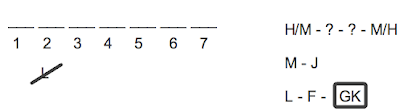
October 2010 LSAT Explanations Logic Games


Explanation of basic initial main diagram:
I wrote down "H/M - ? - ? - M/H" because there are at least 2 nurses between H and M, but there could be more. I've kept things open-ended by representing this with dashes, rather than as a block. I put down H/M and M/H because we don't know which one comes first. The question-marks signify the nurses coming between H and M.

I put down GK with a box around it to indicate that they must be consecutive in that particular order. J later than M is represented with "M-J" meaning that since M is to the left of the dash, it's occurring earlier than J, which is to the right of the dash.

F before K but after L gives us the general ordering of "L - F - K". However, since there is a GK block, the ordering becomes "L - F - GK" (with a box around the GK).

Since L can't go on 2, place an L with a slash through it under the 2nd space.

***

Now, L can't go on 2, and we know that it can't go too late because it has at least 3 variables (F, G, and K) occurring after it. This makes me think about where L might go.

It seems like L could only go on 1, 3, or 4.

However, if we place L on 4, a problem arises:
October 2010 LSAT Explanations Logic Games L on 4 BAD


L on 4 forces FGK to go on 5, 6, and 7, respectively.

We can then try to space apart M and H. Since M must go before J, we can put M on 1 and H on 3. However, we need at least two spaces before M and H. As such, L on 4 is impossible. This leaves L to go on either 1 or 3.

If L's on 3, we can't have the GK block on 4-5, since we need to have F between them. Therefore, when L's on 3, we can either have the GK block on 5-6 or 6-7.

When L's on 3 and the GK block's on 5-6, F must go on 4. When L's on 3 and the GK block's on 6-7, F could be on either 4 or 5.

This gives us the following two possibilities:

October 2010 LSAT Explanations Logic Games Initial Inference


Now, keeping in mind the other rules:

-M and H have at least two nurses between them.
-M is before J.

We know that in the top possibility I've drawn, one of M or H must go on 7 in order to keep M and H spaced relatively far apart. We can't have M on 7 because then J would have no room to go after it. Therefore, in that diagram, H must go 7th, M must go 1st, and J must go 2nd.

In the bottom possibility I've drawn, one of M or H must go on either 4 or 5 (depending upon which one of those F goes on) in order to keep M and H spaced relatively far apart. M can't be the one to go on either 4 or 5, because then F would go on the other one of 4 or 5, and we'd then have no space to place J after it. Therefore, in that diagram, H must go wherever F does not. In order to keep M before J, M goes on 1, and J goes on 2.

We now have:

October 2010 LSAT Explanations Logic Games Deductions


These represent all possibilities for when L is on 3. However, we still have the more open-ended possibility where L is on 1.

In this scenario, F before the GK block must occur somewhere in the remaining spaces, H and M must have at least two nurses between them, and M must go before J. M/H on 2 or 3 seems fine, but having either M or H on 4 is problematic. If H was on 4, we'd need to have M on 7, but then J wouldn't be able to fit after it.

On the other hand, if M was on 4, and H was on 7, we wouldn't be able to fit GK after F while still fitting M before J.

If the GK block is on 5-6, J can't fit after F. If the GK block is on 2-3, F can't fit before it. Therefore neither M nor H can go on 4 when L is 1st.

Here's everything we have so far:
October 2010 LSAT Explanations Logic Games Possibilities


Now, we can split apart the diagram with L on 1 based upon the placement of the GK block. We know GK can't go on 2-3 because we need F before it. It seems that GK can go on 3-4, 4-5, 5-6, or 6-7.

However, placing GK on 3-4 creates a problem. How can M and H have at least 2 nurses between them when they can only go on 5, 6, or 7? It won't work. As such, GK can only go on 4-5, 5-6, or 6-7. (I've numbered the possibilities on the left side for quick reference.)
October 2010 LSAT Explanations Logic Games Setup


In Possibility 3, M and H must be split across 2 and 5 in order to have at least two nurses between them. Now, we know that M must go before J. As such, M will go on 2, H will go on 5, and F and J will be interchangeable on 3 and 4.

In Possibility 2, one of M and H must go on 7. It can't be M because M has to go before J. Therefore, H has to go on 7. Within spaces 2, 3, and 4, we must fit M before J, and then F's floating around within any of those 3 spaces. As such, there are only 3 possibilities for those 3 slots based upon the various placements of F (shown in below diagram).

In Possibility 1, F must go on either 2 or 3 in order to go before the GK block, and J must go on either 6 or 7. If J was on 3, we'd need to have M on 2, and then we wouldn't be able to fit F before the GK block.

This all brings us to our...

Final Main Diagram:
October 2010 LSAT Explanations Logic Games Full Possibilities


Every valid scenario falls within one of these possibilities.

For those of you who are still reading, it's time to *finally* move on to the questions. First, a comment/caveat:

I know people are going to ask me whether making all these initial inferences is really necessary. The answer is a firm "No." You can get all the questions right without doing all this work beforehand, but doing this will make the questions go more smoothly.

The method you choose depends upon your level of comfort with spending more time in the initial setup, as well as your ability to diagram quickly.

Even if you don't have the time to make all of these inferences and still have the time to get to the questions, that's ok. Again, you don't have to make all these inferences, but I still want to get you thinking about the fact that it's possible to make them. While they might give you more information than you need for these questions, it's better to have too much information than too little.

It's now time to (finally) move on to the questions themselves.

Question 18:

Since our diagrams contain all valid possibilities, we can simply eliminate those answer choices that don't fit the scenarios we've already drawn.

Choice A can't happen in any of our possibilities. Eliminated.

Choice B can't happen in any of our possibilities. Eliminated.

Choice C can't happen in any of our possibilities. Eliminated.

Choice D is identical to Possibility 2B. It's our answer.

Choice E can't happen in any of our possibilities. Eliminated.

Of course, you can also solve this question simply by taking the basic rules one at a time and applying them to the choices.

Using that method:

Choice E has only one space between H and M, not the required minimum of 2. Eliminated.

Choice C has J before M, not M before J. Eliminated.

Choice A has F before L, not L before F. Eliminated.

Choice B has L on 2. Eliminated.


Question 19:

Where can't J go? Scanning vertically through each of our possibilities, J's never gone on 5. Of course, J's never on 1 either, but 1's not a choice. (Making 1 the answer instead of 5 would be a little too easy, given that we know it off-the-bat from the simple rule that M is before J). Choice C's our answer.


Question 20:

If J's 3rd, we must be within Possibility 2C or Possibility 3.

If an answer choice doesn't happen in either of those two possibilities, we know it can't be true.

Choice D, G on 5, occurs within Possibility 2C, but none of the other choices occur in either possibility, so they're eliminated.


Question 21:

If K's before M, we must be within Possibility 1, because all of the others have M before K.

In order to have K before M in Possibility 1, we must have M on 6 and J on 7. This would then require F and H to be interchangeable on 2 and 3. F is not a choice, but H is, so choice B's our answer.


Question 22:

If G's on 5, we must be in either Possibility 2 or 4. The correct answer has to occur in both possibilities in order to be a "must". Choice B, H on 7, occurs in both, so it's our "must". I'll run through the others anyway.

Choice A occurs in 2B, but not in 2A, 2C, or 4. Eliminated.

Choice C occurs in 2A and 2B, but not in 2C or 4. Eliminated.

Choice D occurs in 2, but not in 4. Eliminated.

Choice E occurs in 2B and 2C, but not in 2A or 4. Eliminated.


Question 23:

We know L could be on either 1 or 3, but those are the only possibilities, so Choice A is our answer.

Choice B, L on 4, is probably the most tempting wrong answer for those who didn't make the initial inference that L couldn't be on 4, but we've got it under control.


Photo by gbaku

LSAT Diary: A Retaking-The-LSAT Success Story

Retaking LSAT Success Story LSAT DiaryThis installment of LSAT Diaries comes from JT (Justin Timberlake?), who followed one of my LSAT study schedules, scored a 172, and got accepted to UVA Law!

He's got some great LSAT advice for you about how he did it.

If you want to be in LSAT Diaries, please email me at LSATUnplugged@gmail.com. (You can be in LSAT Diaries whether you've taken the exam already or not.)

Thanks to JT for sharing his experience and advice, and please leave your questions for him below in the comments!


JT's LSAT Diary:

After my first practice test, I thought that Logic Games were impossible; they were unlike anything I had seen before. I couldn’t keep track of any of the variables or rules and felt so frustrated. I stumbled across Steve’s blog and attended one of his free LSAT Logic Games workshops in NYC. I was amazed at how quickly he solved them - there was hope! I began working through logic games, and although some games would take me 20 minutes, I was starting to figure them out. I started Steve’s 5-month study schedule and within a matter of weeks I was feeling comfortable with linear games.

By the end of the 5-month schedule, I felt ready to take the June 2010 LSAT. I was averaging a 173 on my 10 most recent timed practice tests and felt confident about meeting my 170 goal. I took a week off from work in the days leading up to the test to maximize study time.

I was restless the night before the test; I kept dreaming about impossible Logic Games and convoluted Reading Comprehension passages. Arriving at the test center I had butterflies in my stomach. I anxiously waited for the test to begin and almost immediately began second guessing my answers. My adrenaline was flowing and heart rate was high. I ended up running out of time on the second LR section and guessed every answer on the last logic game. This had not happened to me in months of taking practice tests. I couldn’t believe it – I was devastated and felt that after 5 months of studying, I had blown the chance of reaching a 170. I simply was not ready for the pressure of the real test and ended up canceling my score.

During the practice tests I felt calm, sure of my answers and confident with Logic Games. After reading the question, I could frequently predict what the answer would look like. The real LSAT felt like a totally different test. I thought I was seeing different question types and logic games that never existed on other tests. When the June test was released, I realized that it was just like all the other tests; the truth was that I simply was not prepared for the pressure of taking the real thing.

I started following Steve’s 3-month retake schedule. I knew that the most important area for me to improve on was overcoming test day pressure. Steve recommended taking practice tests in a simulated setting, with a proctor and other test takers. This truly helped. I felt nervous at the beginning of my first simulated test but quickly got into a rhythm. Success on one section of the test led to success on the next section. After a couple simulated tests, I felt much more confident about taking the real thing and started to relate to Steve’s blog entry “How I Learned to Stop Worrying and Love the LSAT”.

Taking the October 2010 LSAT felt good. In the days prior to the test, I did not take off any time from work and treated the whole thing like it was no big deal. I slept well the night before. I finished each section with time to spare and felt confident in my answers. I had 2 LG sections (1 was experimental) and felt like I crushed both of them. Logic Games turned out to be my best section and I only missed 1 question on it.

I learned that doing well on practice tests is necessary but not sufficient to doing well on the real thing. It is just as important to learn the skills necessary to conquer test day nerves. I scored a 158 on my first timed practice test and scored a 172 (99th percentile) on the October 2010 LSAT. Putting time and effort into the LSAT will pay off; I was just accepted to my dream school, University of Virginia School of Law.

LSAT Self-Study Schedules / Plans / Guides

New LSAT self-study schedules (premium day-by-day versions of my free week-by-week LSAT study schedules) are now available for instant download after purchase.

The newest ones I've made available are for 5-month, 6-month, and 7-month study timelines. They're currently arranged for those of you planning to take the June 2011 LSAT.

If you're taking the December 2010 LSAT or February 2011 LSAT, I've already had shorter premium day-by-day versions of my LSAT self-study schedules available for a few weeks now. Get moving!

October 2010 LSAT Curve - PrepTest 61

LSAT Blog Fancy Line GraphJust wanted to let everyone interested know that I've included the October 2010 LSAT (PrepTest 61) "curve" data in my blog post containing all the other LSAT PrepTest raw score conversion charts.

The "curve" on the October exam was pretty generous. It allowed 12 incorrect answers to get a 170. (The average for September/October exams in recent years was only 10.25 incorrect answers).

The below chart contains recent data regarding the number of questions you could get wrong on recent exams and still achieve a particular scaled score (out of 180):

LSAT Blog December Curve Comparison Averages 2002-2009


This continues the trend of relatively generous curves in the most recent exams.

(See what it's taken to get an LSAT score of 160 or 170.)

How'd everyone do?


Photo by blprnt_van


Writing the Law School Personal Statement

Law School Personal Statement Writing ApproachThe Pre-Law Advisor at Elon University, Dr. Nim Batchelor, has graciously agreed to share some of his excellent thoughts on writing a law school personal statement.

Please thank him in the comments!

An Approach to Writing a Personal Statement

By Dr. Nim Batchelor

Elon University, Fall 2010

When I advise students about how to approach writing a personal statement for their law school application, I begin by posing the following question:

Suppose that the law school admissions committee were to invite you for an interview. You walk in and take a seat before the full admissions committee. The chairperson says, “We have studied all of your application materials—your letters of recommendation, your transcripts, and your resume—and we feel that we have a clear sense of the 'paper you'. However, before we make our final decision, we’d like to get to know the 'human you'. Given that we are somewhat short of time, in the next five minutes, please tell us about the 'real' you that we could not appreciate from your other application materials."

What would you say?

Now, suppose that you had several days to compose your response and that you will be allowed to read your response to the committee. What would you include? How would you organize it?

Once this framing question is in place, I encourage my students to proceed in the following way:

1. Think back across your entire life. As you do this you will come across a set of 10-20 episodes, vignettes, or stories that you commonly use to tell others about your life. Sort through them and select four or five that:

1. represent “who you are as a person,”
2. that exemplify a core trait about which you are somewhat proud, or
3. that reveal something deep about yourself.


2. Next, imagine that your life is a novel. You are both the main character and the author of this novel. Episodes from your “life story” are among the things that shape and reveal your character. You have made many choices and those also reveal something about you. Most importantly, if you are actually living your life—rather than just letting it happen to you—there will be motifs, patterns, tendencies, and a direction in your life story.


3. Your application is a signal to the admissions committee that you believe that three years of law school, passing the bar exam, and taking a job in the legal profession is a natural extension of your life's story. But why is it a "natural" extension of your life's story? The central task of a personal statement is to persuade the admissions committee that this is true about your life.


4. [This is where you start your personal statement] You need to select and very briefly recount three episodes from your life. Each story should both reveal and provide substantive evidence for your claim to have a particular set of character traits. In addition, when taken together, these three stories should make it evident that you’re your life story contains a “must go to law school” motif. That is, from reading these three stories, it should be clear that attending law school is the next logical chapter in your life story. [By the way, if you discover—in all honesty—that your life story does not include a “must go to law school motif,” then you ought to schedule a conversation with your prelaw advisor just to verify that applying to law school is your best move. Of course, it might be; but it is worth the conversation.]


5. The conclusion "therefore, you should admit me to your law school" should remain implicit. However, if you have chosen well, it should be an obvious implication of your essay.


I remind students that this essay needs to be the best writing that they have ever produced. They should expect to go through at least five or six drafts. I also remind them that they should read their early drafts aloud and that their later drafts should be read and critiqued by at least four or five very bright people.

I find it efficient to preempt difficulties by describing a few of the most common mistakes that applicants make in their essays.

* Applicants often devote too much space describing an event or activity and not enough space talking about their own character. It is like what interior decorators say, “Your frames should accentuate your paintings, not dominate them.” Analogously, I press my students to remember to make themselves the centerpiece of their essay. Thus, for example, I often end up saying something like, "No! You’ve written an essay that tells the committee more about our university or more about your parents than it does about you."

* The mere fact that you did something is far less interesting than what it meant to you or how you integrated it into your life. Don’t merely tell the committee that something happened to you; tell them how you reacted to that event or about how it shaped and influenced you. The more you can describe your inner thoughts, dispositions and values the better.

* However, it is not enough merely to say that you have a particular virtue. For example, you can’t simply say, "I'm a very caring person." You need to provide evidence for such claims and you do that with your vignettes. So, for example, you might say, “When I was a kid, my teachers gave me an award because I would play with the handicapped kids when others chose to ostracize them. Ever since then, I am amazed by how often people comment on my sensitivity to the plight of those who are struggling in life.”


Once students see these points, they get what they need to do.

I conclude my advising session with two reminders:

1. I tell them that most people report that faithfully carrying out my recommended process is a genuinely difficult soul-searching exercise. It can be psychologically challenging and frequently results in a few tears. If it feels a little bit like you are exposing your personal diary to the world, then you are probably doing the task well.

2. Finally, I remind them that they are not in an oppositional relationship with the admissions committee. Applicants and admissions committees are collaborating in an effort to discover whether they are a “fit” with one another. It is your job to tell them who you really are. Then, since they know themselves far better than you know them, it is their task to render a judgment about whether you are a fit for their program. If you try to play that silly game where you attempt to say what you think they want to hear, you will thwart this process. So, be honest and be yourself.

Of course, I don’t suggest that this is the only way to go at this task. However, after years of advising, this captures what I’ve settled in on saying to my students.

***

See more law school personal statement tips.

Photo by Allie Brosh / CC BY-NC-ND 3.0