LSAT PrepTests and Dates Administered

LSAT PrepTest List
This LSAT Blog post is an easy reference to help you determine the number of every PrepTest from the date and year it was administered, and vice-versa, as well as how to get just about every single LSAT PrepTest ever.

I recommend getting all your other LSAT PrepTests from Amazon if you want them in books.

Alternatively, you can get most exams online in the digital format as part of Official LSAT Prep Plus (inside your LSAC account).

LSAT PrepTest List:

LSAT PrepTest 93+ (in LawHub)
LSAT PrepTest 92+ (in LawHub)
LSAT PrepTest 91+ (in LawHub)
LSAT PrepTest 90+ (in LawHub)
LSAT PrepTest 89
LSAT PrepTest 88
LSAT PrepTest 87
LSAT PrepTest 86
LSAT PrepTest 85
LSAT PrepTest 84
LSAT PrepTest 83
LSAT PrepTest 82
LSAT PrepTests 72-81
LSAT PrepTests 62-71
LSAT PrepTests 52-61
LSAT PrepTests 42-51
LSAT PrepTests 29-38
LSAT PrepTests 19-28
LSAT PrepTests 7-18
LSAT SuperPrep (A, B, C)
LSAT SuperPrep 2 (62, 63, and LSAT PrepTest C2)
Official LSAT PrepTest (Feb 1997)
June 2007 LSAT

LSAC doesn't provide explanations for any of the numbered LSAT PrepTests. The PrepTests linked above are just the questions.

So, if you want to know why a particular answer choice is wrong, you need to get the explanations separately.

If you already have LSAT PrepTests and would like explanations, see:


-Logic Games explanations for the newest PrepTests
-Logic Games explanations for PrepTests 72-81
-Logic Games explanations for PrepTests 62-71
-Logic Games explanations for PrepTests 52-61
-Logic Games explanations for PrepTests 29-38
-Logic Games explanations for PrepTests 19-28

-Logical Reasoning explanations for the newest PrepTests
-Logical Reasoning explanations for PrepTests 72-81
-Logical Reasoning explanations for PrepTests 62-71
-Logical Reasoning explanations for PrepTests 52-61
-Logical Reasoning explanations for PrepTests 44-51
-Logical Reasoning explanations for PrepTests 29-38
-Logical Reasoning explanations for PrepTests 19-28

-Reading Comprehension explanations for the newest PrepTests
-Reading Comprehension explanations for PrepTests 72-81
-Reading Comprehension explanations for PrepTests 62-71
-Reading Comprehension explanations for PrepTests 52-61
-Reading Comprehension explanations for PrepTests 44-51
-Reading Comprehension explanations for PrepTests 29-38
-Reading Comprehension explanations for PrepTests 19-28


LSAT PrepTests and explanations alone aren't enough to ensure success on the LSAT. Make sure you also get the best LSAT prep books.

***

More info below this huge list.


LSAT PrepTest # - Month / Year - Book

LSAT PrepTest A - February 1996 LSAT - Official LSAT SuperPrep
LSAT PrepTest B - February 1999 LSAT - Official LSAT SuperPrep
LSAT PrepTest C - February 2000 LSAT - Official LSAT SuperPrep
Official LSAT PT - February 1997 LSAT - Official LSAT PrepTest w/ Explanations

LSAT PrepTest 1 - June 1991 LSAT -
LSAT PrepTest 2 - October 1991 LSAT - TriplePrep, Vol. 1, 1, 2
LSAT PrepTest 3 - December 1991
LSAT - TriplePrep, V. 2, 1, 2, 3
LSAT PrepTest 4 - February 1992 LSAT - TriplePrep, Vol. 1
LSAT PrepTest 5 - June 1992
LSAT - TriplePrep, Vol. 1
LSAT PrepTest 6 - October 1992
LSAT - TriplePrep, Vol. 2, 1, 2, 3
LSAT PrepTest 7 - February 1993 LSAT - 10 Actual / LSAT TriplePrep, Vol. 2, alts 1, 2, + 3
LSAT PrepTest 8 - June 1993 LSAT - TriplePrep, Vol. 3 
LSAT PrepTest 9 - October 1993
LSAT - 10 Actual / LSAT TriplePrep, Vol. 3
LSAT PrepTest 10 - February 1994 LSAT - 10 Actual / LSAT TriplePrep, Vol. 3
LSAT PrepTest 11 - June 1994 LSAT - 10 Actual / LSAT TriplePrep Plus with Explanations
LSAT PrepTest 12 - October 1994 LSAT - 10 Actual / LSAT TriplePrep Plus with Explanations
LSAT PrepTest 13 - December 1994 LSAT - 10 Actual, Official LSAT PrepTests
LSAT PrepTest 14 - February 1995 LSAT - 10 Actual, Official LSAT PrepTests
LSAT PrepTest 15 - June 1995 LSAT - 10 Actual Official LSAT PrepTests
LSAT PrepTest 16 - September 1995 LSAT- 10 Actual Official LSAT PrepTests
LSAT PrepTest 17 - December 1995 LSAT -
LSAT PrepTest 18 - December 1992 LSAT- 10 Actual Official LSAT PrepTests
LSAT PrepTest 19 - June 1996 LSAT - 10 More Actual, Official LSAT PrepTests
LSAT PrepTest 20 - October 1996 LSAT - 10 More Actual, Official LSAT PrepTests
LSAT PrepTest 21 - December 1996 LSAT - 10 More Actual, Official LSAT PrepTests
LSAT PrepTest 22 - June 1997 LSAT - 10 More Actual, Official LSAT PrepTests
LSAT PrepTest 23 - October 1997 LSAT - 10 More Actual, Official LSAT PrepTests
LSAT PrepTest 24 - December 1997 LSAT - 10 More Actual, Official LSAT PrepTests
LSAT PrepTest 25 - June 1998 LSAT - 10 More Actual, Official LSAT PrepTests
LSAT PrepTest 26 - September 1998 LSAT - 10 More Actual, Official LSAT PrepTests
LSAT PrepTest 27 - December 1998 LSAT - 10 More Actual, Official LSAT PrepTests
LSAT PrepTest 28 - June 1999 LSAT - 10 More Actual, Official LSAT PrepTests
LSAT PrepTest 29 - October 1999 LSAT - Next 10 Actual, Official LSAT PrepTests
LSAT PrepTest 30 - December 1999 LSAT - Next 10 Actual, Official LSAT PrepTests
LSAT PrepTest 31 - June 2000 LSAT - Next 10 Actual, Official LSAT PrepTests
LSAT PrepTest 32 - October 2000 LSAT - Next 10 Actual, Official LSAT PrepTests
LSAT PrepTest 33 - December 2000 LSAT - Next 10 Actual, Official LSAT PrepTests
LSAT PrepTest 34 - June 2001 LSAT - Next 10 Actual, Official LSAT PrepTests
LSAT PrepTest 35 - October 2001 LSAT - Next 10 Actual, Official LSAT PrepTests
LSAT PrepTest 36 - December 2001 LSAT - Next 10 Actual, Official LSAT PrepTests
LSAT PrepTest 37 - June 2002 LSAT - Next 10 Actual, Official LSAT PrepTests
LSAT PrepTest 38 - October 2002 LSAT - Next 10 Actual, Official LSAT PrepTests
LSAT PrepTest 39 - December 2002 LSAT - Individual
LSAT PrepTest 40 - June 2003 LSAT - Individual
LSAT PrepTest 41 - October 2003 LSAT - Individual
LSAT PrepTest 42 - December 2003 LSAT - Individual
LSAT PrepTest 43 - June 2004 LSAT - Individual
LSAT PrepTest 44 - October 2004 LSAT - Individual
LSAT PrepTest 45 - December 2004 LSAT - Individual
LSAT PrepTest 46 - June 2005 LSAT - Individual
LSAT PrepTest 47 - October 2005 LSAT - Individual
LSAT PrepTest 48 - December 2005 LSAT - Individual
LSAT PrepTest 49 - June 2006 LSAT - Individual
LSAT PrepTest 50 - September 2006 LSAT - Individual
LSAT PrepTest 51 - December 2006 LSAT - Individual 
"LSAT PrepTest 51.5" - June 2007 LSAT - Free LSAT on LawHub

LSAT PrepTest 52 - September 2007 LSAT - Individual
LSAT PrepTest 53 - December 2007 LSAT - Individual
LSAT PrepTest 54 - June 2008 LSAT - Individual
LSAT PrepTest 55 - October 2008 LSAT - Individual
LSAT PrepTest 56 - December 2008 LSAT - Individual
LSAT PrepTest 57 - June 2009 LSAT - Individual
LSAT PrepTest 58 - September 2009 LSAT - Individual
LSAT PrepTest 59 - December 2009 LSAT - Individual
LSAT PrepTest 60 - June 2010 LSAT - Individual
LSAT PrepTest 61 - October 2010 LSAT - Individual
LSAT PrepTest 62 - December 2010 LSAT - Individual
LSAT PrepTest 63 - June 2011 LSAT - Individual

LSAT PrepTest 64 - October 2011 LSAT - Individual
LSAT PrepTest 65 - December 2011 LSAT - Individual
LSAT PrepTest 66 - June 2012 LSAT - Individual
LSAT PrepTest 67 - October 2012 LSAT - Individual
LSAT PrepTest 68 - December 2012 LSAT - Individual
LSAT PrepTest 69 - June 2013 LSAT - Individual
LSAT PrepTest 70 - October 2013 LSAT - Individual
LSAT PrepTest 71 - December 2013 LSAT - Individual
LSAT PrepTest 72 - June 2014 LSAT - Individual
LSAT PrepTest 73 - September 2014 LSAT - Individual
LSAT PrepTest 74 - December 2014 LSAT - Individual
LSAT PrepTest 75 - June 2015 LSAT - Individual
LSAT PrepTest 76 - October 2015 LSAT - Individual
LSAT PrepTest 77 - December 2015 LSAT - Individual
LSAT PrepTest C2 - January 2016 LSAT - SuperPrep 2
LSAT PrepTest 78 - June 2016 LSAT - Individual
LSAT PrepTest 79 - September 2016 LSAT - Individual
LSAT PrepTest 80 - December 2016 LSAT - Individual
LSAT PrepTest 81 - June 2017 LSAT - Individual
LSAT PrepTest 82 - September 2017 LSAT - Individual
LSAT PrepTest 83 - December 2017 LSAT - Individual
LSAT PrepTest 84 - June 2018 LSAT - Individual
LSAT PrepTest 85 - September 2018 LSAT - Individual
LSAT PrepTest 86 - November 2018 LSAT - Individual
LSAT PrepTest 87 - June 2019 LSAT - Individual
LSAT PrepTest 88 - September 2019 LSAT - Individual
LSAT PrepTest 89 - November 2019 LSAT - Individual
LSAT PrepTest 90+ - May 2020 LSAT - LawHub
LSAT PrepTest 91+ - May 2020 LSAT - LawHub
LSAT PrepTest 92+ - June 2020 LSAT - LawHub
LSAT PrepTest 93+ - June 2020 LSAT - LawHub


(There are multiple test forms for each online LSAT administration, which is why both PT90+ and 91+ are from May 2020 and both PT92+ and PT93+ are from June 2020.)


Among other things, the below contains some details on the various books containing older LSAT PrepTests.

Here's a summarized list of all available LSAT PrepTests:

Numbered PrepTests 1-present

Some of the older PrepTests can be difficult to find, but you can get them in the books below.

Official LSAT TriplePrep, Volume 1 (out-of-print, available used) contains PrepTests 2 (October 1991), 4 (February 1992), and 5 (June 1992). Also try this and this to get it on Amazon.

Official LSAT TriplePrep, Volume 2 (out-of-print, available used) contains PrepTests 3 (December 1991), 6 (October 1992), and 7 (February 1993). Also try thisthis, and this to get it on Amazon.

Official LSAT TriplePrep, Vol.3 (out-of-print, available used) contains PrepTests 8, 9, and 10.

Grouped by Game Type
 contains every Logic Game in PrepTests 1-20.

Grouped by Question Type
 contains every Logical Reasoning question in PrepTests 1-20.

Grouped by Passage Type contains every Reading Comprehension Passage in PrepTests 1-20


Lettered PrepTests

The Official LSAT SuperPrep (PrepTests A, B, and C) = 3
This book contains the previously-undisclosed February 1996, February 1999, and February 2000 exams. It explains all answer choices.

The Official LSAT SuperPrep 2 (PrepTests 62, 63, and C2) = 1
This book contains PrepTest 62, PrepTest 63, and PrepTest C2. It explains all answer choices.


Unnumbered and Unlettered PrepTests

Free Sample June 2007 PrepTest = 1

Official LSAT PrepTest With Explanations (out of print - available used) = 1
Fun LSAT trivia: This is the stolen February 1997 LSAT exam with complete explanations written by LSAC.

May 2020 LSAT-Flex Sample PrepTest  = 1


Free LSAT PrepTests

Free Sample June 2007 PrepTest = 1

Digital LSAT PrepTest 71 (in LawHub, aka LSAC's Official LSAT Prep) = 1

Digital LSAT PrepTest 73 (in LawHub, aka LSAC's Official LSAT Prep) = 1


Photo by alish863psu

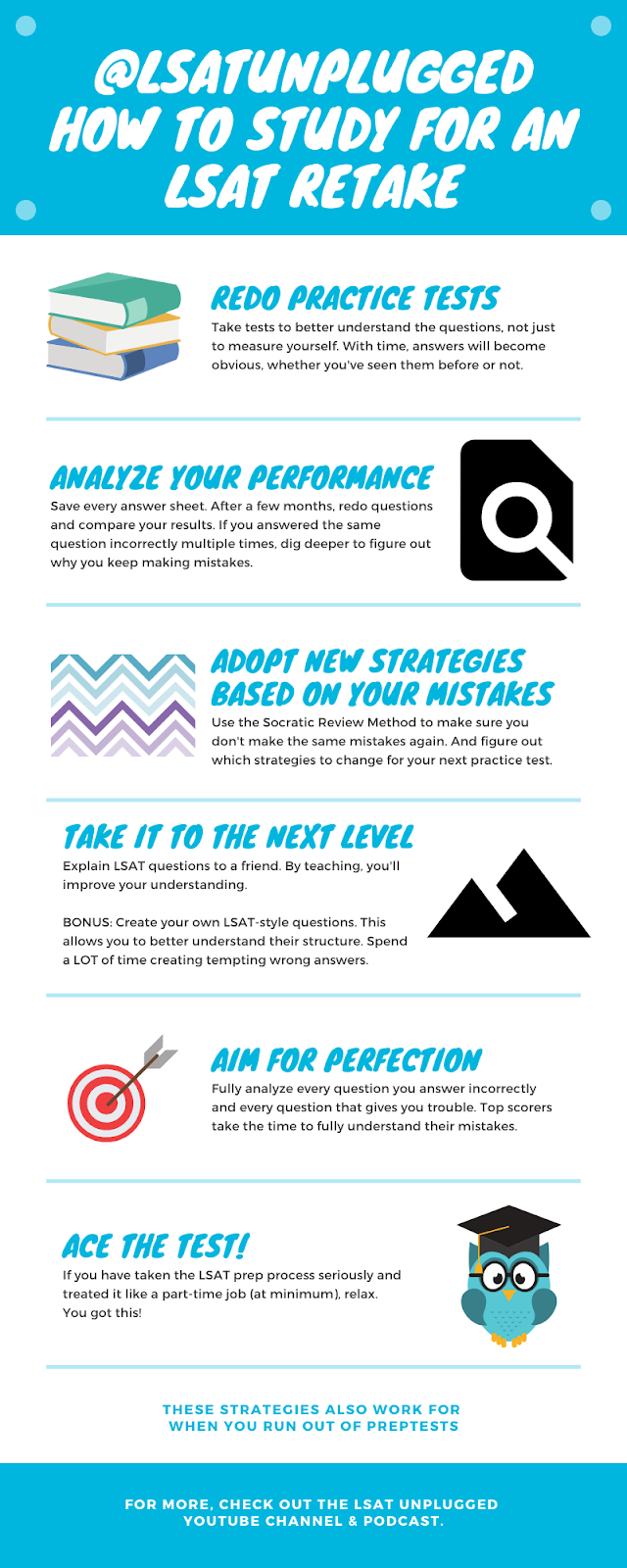
Retaking the LSAT Study Schedule

Also see the Retake LSAT Study Schedule: Premium Day-By-Day Version.

So, you're planning to retake the LSAT.

It's incredibly important to figure out what you did wrong the first time around and plan what you'll do differently this time.

Maybe you didn't have enough time to study for the LSAT. Maybe you just didn't use it wisely. I recommend a minimum of 3 months.

It could be you didn't use the right LSAT prep books.

Maybe you didn't spend enough time on a certain section. Maybe your approach just wasn't flexible enough.

The biggest concern students have is "there aren't enough PrepTests" and/or they've "already used up too many PrepTests." There are more than 70 PrepTests.

Of course, having to resort to the older exams and having to redo newer ones isn't ideal, but it shouldn't be a major concern.

This article will help you figure out to move forward as you prepare for an LSAT retake.

Whitney writes:
"[M]y concern is whether I need to do question type practice or just simply do more full length and section practice."
Ideally, you'll do a mix of practicing specific question-types and doing full-length sections. You'll end with full-length exam practice.

The real issue is figuring out what went wrong the first time around and using that info as you plan your retake schedule.

If you aren't having difficulty with a specific type of question, then full-length section/exam practice is all you need.

However, this situation is rare - most people have more difficulty with some question-types than others.

This means you'll probably need to "Drill, baby, drill."

If you didn't cancel your most recent LSAT score, review that exam and make a list of the question-types you answered incorrectly and/or that gave you difficulty.

If you did cancel it, do a few full exams (untimed) to determine question-types that give you difficulty.

If there were relatively few types that gave you difficulty, you might just want to spend a week or two drilling those types and then move onto doing a practice test or two each week.

The following 3-month retake schedule assumes you already did most/all of what I recommend in my LSAT study schedules for first-timers. If you did little or none of the things contained in those schedules, use those instead.

This schedule also assumes there are 4 Logical Reasoning question-types that give you difficulty and at least two types of Logic Games that gives you difficulty. (Here's an example of one way you might analyze a Logical Reasoning question in more detail.)

Finally, it assumes you've already seen/used dozens of the most recent PrepTests in your prep the first time around.

Feel free to alter this schedule according to your needs.

***

Find out how to get LSAT exams and other study materials in the Best LSAT Prep Books post.

***

Week 1: Study my articles on Logical Reasoning. Do several dozen questions of that type (untimed) using the LSAT Logical Reasoning list or spreadsheet (from exams you've never touched, if any). Review all questions that give you difficulty and write explanations for why each wrong answer choice is wrong and why the right answer choice is right.

Week 2: Do the same with another type.

Week 3: Do the same with another type.

Week 4: Do the same with another type.

Week 5: Study my relevant articles on Logic Games, then complete several Logic Games of a particular game type giving you difficulty (untimed) using my Logic Games categorizations. Create diagrams to disprove each incorrect answer choice and prove why the correct answer choice is right.

Week 6: Do the same with another type.

Week 7: Do the same with another type, or read my articles on Reading Comprehension and do several timed sections of Reading Comp.

Week 8: Complete 3 recent LSAT PrepTests (timed). Splice in sections from another to simulate the experimental section. Review all wrong answers and write out explanations for them. Review each exam on alternating days.

Week 9: Complete 3 recent LSAT PrepTests (timed). Splice in sections from another to simulate the experimental section. Review all wrong answers and write out explanations for them. Review each exam on alternating days.

Week 10: Complete 3 recent LSAT PrepTests (timed). Splice in sections from another to simulate the experimental section. Review all wrong answers and write out explanations for them. Review each exam on alternating days.

Week 11: Complete 3 recent LSAT PrepTests (timed). Splice in sections from another to simulate the experimental section. Review all wrong answers and write out explanations for them. Review each exam on alternating days.

Week 12: Complete 3 recent LSAT PrepTests (timed). Splice in sections from another to simulate the experimental section. Review all wrong answers and write out explanations for them. Review each exam on alternating days.


Weeks 9-12 should include 5-section exams (the 5th section simulates the experimental section). See Preparing for the Experimental Section for why, where, and how to include "experimental" sections.

***

I know this schedule will include exams you've already done. Remember, I said I'm assuming you already used the newer PrepTests the first time around. That's okay.

Your goal shouldn't always be to get an accurate gauge of your progress. No one (except maybe your parents) is going to give you a prize for how you do on a practice exam. The real thing is all that matters in the end.

Even if you've already done these exams (and remember them well) will you really remember all the answers? If you really think you will, do a previously-taken exam or two under timed conditions. Just see if you get perfect scores on them. If you don't, it means you still have something to learn from them.

Besides, doing them in chronological/numerical order puts at least a few months between you and any particular exam. This means if/when you answer questions correctly, it's more likely this will be due to your understanding of the questions' logic rather than your memory.

If you're really concerned about remembering them, substitute those for exams you've never seen before (see the list of all LSAT PrepTests).

However, it's important to redo the newer PrepTests to ensure that you fully understand them because the LSAT changes over time.

Good luck!

New LSAT Reading Comprehension Tips

LSAT Blog New Reading Comprehension TipsSeems like everyone wants more help on LSAT Reading Comprehension these days, so here are some loosely-related thoughts on how to approach Reading Comp.

What to focus on
I like to think of Reading Comprehension passages as big "point at issue" questions like the ones you find in Logical Reasoning.

Comparative reading passages are the most explicit examples of this. You want to be aware of the opinions each passage expresses. Most importantly, look for areas where there's overlap between the two.

In the non-comparative (regular) reading comp passages, look carefully for any opinions expressed by individuals. If you see an opinion without an "advocate," it's the passage author's opinion.

Again, focus on the viewpoints and speakers, not the details (evidence). The LSAT isn't expecting you to remember everything, and it certainly isn't expecting you to memorize what a Koch curve is or how it's created (June 09 LSAT - PrepTest 57, RC Passage #4). It's simply expecting you to remember where in the passage you can find that info if you need to return to it.

In law school, you'll have to get through hundreds of pages a week on boring topics. This is why LSAT passages tend to be on obscure and mostly-uninteresting topics. Your job is to convince yourself that it's interesting and that you care about whatever point at issue or difference of opinion is expressed in the passage.


Identifying viewpoints
Although reading comprehension's grown more unpredictable on recent exams, there are some common RC structures you might see. This is especially true for natural science and social science passages.

Here's one common RC structure (although there are many others):

"In the past, a discussion has generally been limited to one thing, but new research, evidence, or studies have sparked new debate over the issue of X."

Alternatively, the same structure might look like this:

"People used to think things were one way, but new evidence suggests things are actually another way."

The old way of discussing, viewing, or theorizing about something is viewpoint 1.

The new way of thinking about this issue is viewpoint 2.

PrepTest 29, Section 2, Questions 16-21 (page 28 in The Next 10 Actual, Official LSAT PrepTests)
Natural Sciences Example

Old way: Bohringer's finding (Lines 18-20) - Viewpoint 1
New way: Scheich's studies (Lines 4-8, 29-41 and 54-56) - Viewpoint 2


PrepTest 29, Section 2, Questions 22-27 (p30 in Next 10) -
Social Sciences Example


Old way: Most scholars' lack of interest in how medieval law actually affected women (Lines 11-14) - Viewpoint 1
New way: Interest in how the law actually affected women, and what's necessary to study that (Lines 16-28, but especially 25-28) - Viewpoint 2


Summarizing viewpoints
One way I stay engaged and keep track of viewpoints is to reduce them to a core word or phrase. Why?

Because sometimes they'll say, "Some scholars believe X, while other scholars believe Y."

I'd call them the X-ists and the Y-ists.

Example: PrepTest 22, Section 1, Passage 4, Questions 22-26 (p124 in 10 More Actual, Official LSAT PrepTests)

Lines 18-24 of this passage give us the core of the argument:
The debate centers around whether language corresponds in some essential way to objects and behaviors...or...whether the relationship between language and things is purely a matter of agreed-upon conventions, making knowledge tenuous, relative, and inexact.
I'd mark "V1" and "V2" in the margin (to the left) of the words "essential" and "convention," respectively.

One group believes language has an essential meaning, and the other group believes its meaning is conventional/relative.

Throughout the passage, I'd mentally call the viewpoints "essentialist" and "conventionalist," and I'd mentally call the groups in the debate the "essentialists" and the "conventionalists."

This concise summary of the viewpoints allows us to place just about every piece of information in this passage into one of these two groups.


PrepTest 31, Section 4, Passage 4, Questions 21-28 (p102 in Next 10)

In this one, the passage even gives us names for the groups in lines 37-38 - "subjectivists and objectivists." Use these names to make the reading easier for you. You'll now be able to go back and note in the margins where evidence for each viewpoint appears.


Red herrings
Most passages start by jumping into the main topic they're actually about. However, a few begin with a topic that is unrelated to the topic that the passage is actually about. I suspect LSAC does this with the goal of tricking those who want to save their least-favorite topic or type (natural science, social science, law, and humanities) for last. Don't be fooled!

Examples:

The essentialist/conventionalist passage in PrepTest 22 starts with a paragraph about math.

PrepTest 35, Section 2, Passage 3, Questions 15-20 (p332 in Next 10) starts with a paragraph about "philosophers of science" while the passage itself is more concerned with biologists.

Photo by prawnwarp / CC BY-NC-SA 2.0
(FYI, that photo depicts our friend de Saussure.)

25 Future LSAT Logical Reasoning Topics

LSAT Blog Future Logical Reasoning TopicsIf you've done more than a few PrepTests by now, you're probably sick of questions about cholesterol-lowering drugs, climate change, and potential reasons the dinosaurs died.

We get it. Some folks at LSAC (perhaps Stephen Luebke is among them) haven't gotten over their childhood obsession with dinosaurs. It's as if they think writing 1,000 questions about dinosaurs will bring them back. Sometimes I wish the dinosaurs were still around too, but Jurassic Park didn't work out so well in the end.

The dinosaur logic game is the straw that broke the camel's back. It was one thing to have dinosaurs appear in Logical Reasoning on every other exam, but to have them spill over into Logic Games? It's time for a change. After all, you're looking to go into law, not paleontology.

I propose LSAC stop beating us over the head with dinosaur-related topics. In fact, it's time to get rid of all the common LSAT Logical Reasoning topics. LSAC needs to find new obsessions. To pave the way, here are 25 proposed topics for future Logical Reasoning and Reading Comprehension questions.

In no particular order, they are:

1. Reasons for the decline of, and ways to save, the newspaper industry
2. Connection between Internet, cell phones, and Twitter, and decreased attention spans
3. Morality of illegal file-sharing and counterfeit goods
4. Effectiveness of meditation, acupuncture, and feng shui
5. Potential effects of media publishing "top secret" info during wartime
6. Prisons and alternative rehabilitation techniques
7. New/undiscovered life-forms and aliens
8. Pirates (music, software, and traditional ship-sailing)
9. Medieval (knights and samurai) and Mafia codes of honor and loyalty
10. Continental drift and its effects on evolution/speciation
11. Pyramids and how they were built
12. Loch Ness monster and Bigfoot
13. Reasons for the decline of the Roman Empire
14. Fuel efficiency, hybrid cars, alternative energy sources (particularly, algae as a biofuel)
15. Weird sea animals and plants living in the Mariana Trench and chemosynthesis
16. Great Pacific Garbage Patch (credit: my student Tory)
17. Evolutionary links between humans and apes
18. Effectiveness (and effects) of standardized testing, particularly its potential to perpetuate/correct societal inequities
19. Spam-fighting technology
20. Milgram experiment and Stanford Prison Experiment
21. Contemporary musicians, artists, and scholars
22. Economic recession and government policies - proposed ways to end it (bailouts, etc.)
23. Effectiveness of businesses' recession "specials"
24. Plea bargaining in exchange for testimony
25. Salem Witch Trials and how they might have been caused by a psychedelic fungus

What topics would YOU like to see on the LSAT? Leave them in the comments!

Photo by mtsofan / CC BY-NC-SA 2.0

Dinosaur LSAT Logic Game Explanation

Dinosaur LSAT Logic Game ExplainedI would categorize this game as a combination of Selection (In-Out) and Matching.

Basically, we're selecting some variables but not others, and we're associating variables of different types with each other. There's no sequencing or linear aspect to this game.

(Also see my video explanation of this LSAT Logic Game.)

Due to copyright restrictions, I'm forced to leave out the text of the game. You'll need a copy of LSAT PrepTest 57 (the June 2009 LSAT) in order to follow along.

Setup and Main Diagram
We're picking 5 out of 7 dinosaurs. Each dinosaur is one of 4 colors.

7 Dinosaurs: Iguanadon, Lambeosaur, Plateosaur, Stegosaur, Tyrannosaur, Ultrasaur, Velociraptor

4 Colors: Green, Mauve, Red, Yellow


_ _ _ _ _ GMRY (colors)
_ _ _ _ _ ILPSTUV (dinos)

We have definitely have 2 mauves (I didn't know it was a color either).

We also definitely have RS (red stegosaurus - with R above S as a vertical block).

so we can put down:


MMR_ _ = GMRY
_ _ S_ _ = ILPSTUV

Next: I only if G. "Only if" introduces the necessary condition, so we can say "if I -> GI." Because we only care about I's color if it's selected, we can say GI and put it on the side (G above I as a vertical "block")

Same goes for if P -> YP (Y above P as a vertical "block")

V only if U is not = If V-> not U (or U)

Contrapositive: If U -> not V (or V)

This means U and V are never together = V <--/--> U (V double-not arrow U).

If L and U -> ML doesn't happen (ML) or MU doesn't happen (MU). (Again, these should be vertical with M above L and M above U, respectively).

What we have so far should look something like the following picture:


Dinosaur LSAT Logic Game Main Diagram


Inferences and Limited Options / Templates / Possibilities:
Let's take the knowledge that S has to be R, I has to be G, and P has to be Y (if they go, that is).

Indirectly, this is telling us that out of the 7 dinosaurs (ILPSTUV), only L, T, U, and V could ever be M.

However, we know we'll never have both U and V being M. This is because we can never have them both "in" (see the double-not arrow above).

Additionally, we can't have both L and U being M.

The possible combinations of Mauve dinosaurs are, as a result, pretty limited:

LT
LV
TU
TV

We can draw 4 templates using this information. However, we really only need 3, because TU and TV are virtually the same thing. T isn't involved in any other rules, so when T is Mauve and we have one of U/V, U and V are interchangeable - one is in, but the other is out.

This means we can represent the Mauve pairings as really being only possible 3 combinations:

L T
L V
T U/V

Placed on the diagram...

with LT as the Mauve pair:


with LV as the Mauve pair:


with T and one of U/V as the Mauve pair:


This pretty much breaks the game wide open. In each of these templates, the dinosaurs that can be in the remaining two spots are pretty limited.

Below, I've placed the pool of 3 "maybes" in parentheses. Each valid scenario would include any 2 out of those 3.

Template #1:

The "LT Mauve pair" template:


Template #2:

The "LV Mauve pair" template:


Template #3:

The "T and one of U/V Mauve pair" template:


These templates address the V <--/--> U rule and the "LU can't both be Mauve" rule. All we need to keep in mind now when using the templates is that if I is chosen, it will be G, and if P is chosen, it will be Y.


Question 12
Typical question asking which one could be a valid scenario. However, it refers only to dinosaurs and doesn't concern colors, so the templates aren't a huge help here.

Just pick one rule at a time and apply it to the choices.

We always need to have S, so we can eliminate D.
We can't ever have both V and U, so A and E are out.

Choice C lists ILPSU. The problem with this choice is that I, P, and S already have colors associated with them (G, Y, and R, respectively). This would force L and U to both have mauve, which can't happen according to our rules. For this reason, C is out, and B is our answer.


Question 13
If T is out, then we're definitely not going to use the LT or T U/V templates.

We're going to use the LV template, and we're not going to pick T from the parentheses, giving us:


Because the diagram is fully determined, all you have to do now is scan the choices to see which does not appear. Whatever doesn't appear will be your answer. In this case, it's D.


Question 14
Sadly, question 13's diagram doesn't help at all because it doesn't contain GL or YT.

Go back to the templates. GL could never occur in the first 2 templates because L is always M in those templates. However, we could have GL in the third template. In that template, T has to be M, so A works.


Question 15
In the 1st and 3rd templates, T has to be M. However, in the 2nd, it could be Y, so we must be dealing with the 2nd template.

We've never had YT before, so it's time to draw a new diagram:

MMRY_
L V ST_

This leaves GI or YP.

The diagram should look something like the following:


We don't know whether we'll have GI or YP on the 5th pair of slots, but it doesn't matter. MV has to happen, so choice E is the answer.

Question 16
We've never had both I and U before, so we'll need a new diagram.

We don't know whether we're dealing the 1st template or the 3rd, but we know that we're definitely not dealing with the 2nd.

Even without drawing them out specifically to include I and U, we can see that both templates have MT because Templates 1 and 3 are LT and T U/V, respectively. They both include an MT. Making A our answer.

However, for those of you who want to see what I and U being "in" looks like, here it is:

In Template 1, including both I and U would give us:


We still wouldn't know what U is. It could be anything but M. Depending on your preference, you could leave U's color blank, as I did above, or you could do G/R/Y to indicate what color could be.

In Template 3, including both I and U would give us


There obviously isn't room to have both P and L, so we'll have one or the other. If we have P, it'll be Y, but if we have L, we don't know what color it'll specifically be. Again, depending on your preference, you could put G/R/Y to the right of the big slash and box it with L, or you could just leave it empty as I did above.

It doesn't really matter anyway, though, because the question is asking us what must be true across both templates. Both have MT.

Question 17
If we have 2 Gs, what could be true? Well, the bad news is that we could be dealing with any of the 3 templates.

The good news, though, is that we're definitely not going to have P, so each of the three templates is either fully determined or almost fully determined.

Template #1:


Template #2:


Template #3:


In Template #2, it's possible to have a green tyrannosaurus, so B is our answer.

***

Is this a tough game? Absolutely. But is it doable? Yes.

It's not an 8-minute 45-second game for most people. However, the other games in the section (the first one, in particular) are easier in order to balance things out.

Seeing this game explained should ensure Jurassic Park won't give you any more nightmares.

How Logic Games Have Changed Over Time

LSAT Blog Logic Games Change Over TimeThis post includes some brief thoughts on ways Logic Games have changed over the years and what this means for your preparation.

Broad changes in Logic Games over time
Older Logic Games such as those in The Next 10 Actual, Official LSAT PrepTests are more likely to contain major inferences. Once you make these inferences, you've split open the game like a coconut. (The oldest games - the ones in the original book of 10 tend to be a bit weirder, but I won't get into that right now.)

Newer games (the ones in the individual LSAT PrepTests numbered in the 50s) more often require you to make these inferences throughout the game based on the limitations of each "if" question. This means the inferences apply to fewer scenarios.


How to Become a Logic Games Jedi
The key is adaptability.

Newer games are noticeably different than older ones, but this doesn't mean you should skip the older ones. Expose yourself to as many games as possible because LSAC will occasionally include a game on a new PrepTest that's similar to one from an older PrepTest. It's also important to note Logic Games repeat (in disguise).

Some students memorize "tricks" and think in terms of rigid categories. They tend to freeze when they see a game they're unable to categorize.

Other students familiarize themselves with the different types of games and diagramming strategies, but they recognize these strategies don't include every possible type of game. The flexibility these students possess allows them to adjust to new or unusual types of games.

No technique is perfect. Taking any technique as gospel would make you a fundamentalist. Books (or blogs) with techniques won't have to take the LSAT in future months - you will. Feel free to modify any techniques according to what works best for you.

Additionally, no book can offer a roadmap or blueprint for what future Logic Games will look like. They only give you a limited set of tools - it's your job to be creative when you apply those tools to new and unfamiliar situations.

Also, keep in mind: the LSAT isn't actually meant to be learnable. (I know, I know, what was LSAC thinking, right? Of course it's learnable.)

The LSAT has to test the skills it's intended to test. This means LSAC must separate those who naturally have "LSAT skills" from those who try to "game" the Logic Games. In order to effectively distinguish between these groups, the LSAT constantly throws twists into the Logic Games to confuse anyone who didn't spend their summers at math camp.

In this arms race between you (the test-takers) and LSAC, you'll need to adapt and adjust to what LSAC's been throwing your way in the past few years.

The good news is that with over 60 PrepTests, you have the potential to be better-prepared than any test-takers before you.

Photo by evaekblad

LSAT Logic | Sufficient vs Necessary Conditions

LSAT Blog Logic Sufficient Necessary ConditionsWe deal with "if-then" statements all the time in everyday life. "If I have another drink or two, I won't be able to drive safely." "If I get a higher LSAT score, I'll be competitive at better law schools."

The LSAT Logical Reasoning section requires us to think about these statements a little more formally than we're used to. (If we want to do well on the LSAT's Logical Reasoning section, we'll have to think about these statements more formally.)

This blog post will explain "sufficient" and "necessary" and describe them with a few examples.

The "sufficient" condition is often introduced by words such as "if," "when," and "whenever."

Something that's sufficient is enough to get the job done. However, without more info, we can't assume that it's a requirement (necessary).

It might help to think of the sufficient condition as "activating" the necessary condition.


The "necessary" condition is often introduced by words such as "then," "must," and "required."

Something that's necessary has to happen in order for the "sufficient condition" to occur.

However, without more info, we can't assume that it's the only thing that has to happen in order to know that the sufficient condition also happened (or will happen).


Here are a few examples of the sufficient and necessary conditions in action:

Limos
"If I take a limo, I'll get where I want to go."

A limo would be sufficient to get me wherever I want to go.

However, I don't need fancy forms of transportation. There are other ways to get to where I need to go - I could walk, run, bike, or take the subway, bus, or a taxi.

(In fact, I'd prefer a helicopter or rocket ship over a limo if I had my pick.)


Un-friending on Facebook
"If we break up, I'll un-friend him/her on Facebook."

Breaking up might be sufficient to un-friend a significant other, but breaking up isn't required (necessary) to un-friend him/her.

You might un-friend him/her in the middle of a fight without actually breaking up.


Becoming President
"If you have a reasonable chance of becoming President of the United States, then you must be affiliated with one of the two major political parties."

However, being affiliated with the Democrats or Republicans is not enough to become President. You also need to win your party's nomination and, eventually, the Electoral College.

***

For more Logical Reasoning fun, check out Conditional Reasoning: Contrapositive, Mistaken Reversal, Mistaken Negation and Formal vs. Informal Logic in LSAT Logical Reasoning.


Photo by muckster / CC BY-NC-SA 2.0

LSAT Logic in Arrested Development

LSAT Logic Arrested DevelopmentArrested Development is probably my favorite TV show ever, so I've been looking for an excuse to mention it here for a while. Luckily, one of my favorite episodes ("Pier Pressure" in Season 1) contains LSAT-style logical fallacies worth mentioning on LSAT Blog.

George Michael (the dorky kid on the show, not the singer-songwriter) believes doing well in math is necessary for success. He also thinks failing math is sufficient to destroy his chances at success. (Learn about necessary and sufficient on Wikipedia and in this week's blog post on necessary and sufficient conditions.)

You can watch this clip in the video below, in this link, or you can just read the quote. You'll probably enjoy it even more if you watch the whole 20-minute episode, but watching it isn't necessary to understand the LSAT-related part.

The quote starts at 5:37 in the video. George Michael (a classic burnout case) is doing his homework when his dad walks in...
George Michael (Michael Cera): [Arguing with his math book] Dumb, dumb George Michael, dumb...

Michael Bluth (Jason Bateman): Hey, calm down there, you two; it's just a math problem.

George Michael: Yeah, but if I fail math then there goes my chances to get a good job and have a happy life full of hard work, like you always say, right Dad?


So what's wrong with George Michael's statement?

Necessary and sufficient
George Michael assumes failing math is sufficient to end his chances of getting "a good job and...happy life full of hard work." There might be ways for him to get that "good job and happy life full of hard work" even if he fails math.

Another way to say this is: George Michael believes not failing math is necessary to get those things. We only need one example of someone who got those things after failing math to disprove the principle underlying his argument.

Appeal to authority
George Michael makes his argument simply by appealing to his father's authority. Citing an authority doesn't count as sufficient evidence for any argument.


***
Believe it or not, even after searching through a comprehensive list of Arrested Development quotes, I was unable to find any examples of actual logical fallacies made by "Gob" (played by Will Arnett).

Arrested Development fans, please post examples of logical fallacies from any character in the comments.

LSAT Prep Courses vs. Private Tutoring

LSAT Blog Prep Courses vs. Private TutoringReaders frequently ask me, "Should I take an LSAT prep course or get a private tutor?"

The LSAT Blog Manifesto already lays out several areas where big prep companies are lacking, so it's no secret that I'm not a fan of prep courses.

Since I'm an LSAT coach, it's no surprise I recommend coaching over prep courses. However, I have several reasons for this.

Individualized help is more effective
Self-study combined with private tutoring is more effective. If you need extra help, you'll learn best with individualized tutoring and attention.

A private tutor can focus on your personal needs and create a schedule based on exactly what you need to cover. A private tutor can explain things for you without having to balance your needs with those of other students.


Prep classes cater to two main groups:
1. Students who lack the motivation and discipline to self-prep. However, while an LSAT class may force you to do some work in class, it won't make you do the homework. See more on this in LSAT FAQ.

2. Students who struggle with the basics. This group would benefit from the LSAT prep books I recommend.

Unfortunately, prep course instructors can't give individualized attention or flexibility to those who need it most. If you fall behind and don't do the homework, or if you can't go to class one week, you lose out. Even if you attend a make-up class, it may be taught by an instructor you dislike. Many prep courses don't have the most stringent hiring standards, either.

Even if you attend every class, you may not experience the consistent instruction that you need. Test prep companies experience a high instructor turnover rate due to low pay and the part-time nature of the job.


Which instructor would you prefer:
1. A college kid tutoring for a prep company on the side for $25-$50/hour (maximum) who might not have even taken an LSAC-administered LSAT. There's a correlation between pay, experience, and quality of instruction.

2. A seasoned professional who loves the LSAT and has what some might call an unhealthy obsession with it? In case you haven't guessed, I devote more time to this site (and to coaching) than I should.

As a full-time LSAT coach, I spend several hours each day thinking about the LSAT. I'm familiar with the techniques taught by the major test prep companies. I've also developed several of my own approaches that are more effective than anything you'll find elsewhere.


Several approaches
I'm not limited to showing you one particular approach. Prep course instructors are. Even if they knew other techniques, they wouldn't be allowed to teach them.

If companies let instructors admit their techniques didn't work for everyone, they'd hurt their company's brand. On the other hand, I have the freedom to show you a variety of techniques and approaches to the LSAT until we find the one that works for you.


One-on-one tailor-made LSAT coaching
See this page for details about my LSAT coaching.

Photo by mofle

Free LSAT Diagnostic Tests | The Shocking Truth

LSAT Blog Diagnostic Test Bubble SheetMany prep companies offer free proctored LSAT diagnostic tests. At first, this seems like a good idea. You take a free LSAT PrepTest under test-like conditions, and your test score lets you know where you stand before doing any prep.

In exchange, prep companies get all your contact info and the opportunity to market their prep courses to you at the end of the exam (and via email and phone, unless you give them a fake email address and phone number).

So what's my problem with free LSAT diagnostics? After all, sitting through a sales pitch in exchange for free stuff is a time-honored tradition.

However, free LSAT diagnostics aren't as useful as they might sound. Most people take them before doing any studying at all. As I wrote in the LSAT Blog Manifesto, diagnostic results are misleading. Everyone improves with some exposure to the exam, whether it's through self-studying, tutoring, or a prep course.

Because most people don't use LSAT-style thinking in everyday life, seeing the LSAT for the first time at the diagnostic is like taking a diagnostic in a language you've never spoken. The diagnostic doesn't come close to measuring your ability - it just demonstrates what you already know -- that you haven't learned the language yet.

Suppose you wanted to learn French, but you only knew a few random words of French. Would you take a diagnostic to see where you needed to focus? Of course not. With virtually no knowledge of the language, there wouldn't be any point - the results would be meaningless.

Same goes for the LSAT. Although the LSAT isn't actually a foreign language, it can seem like one the first time around. "Logic Made Easy" (interview) demonstrates several ways we're less logical in everyday life than you might think.

Logic is learnable, but it requires practice.

Taking a timed LSAT diagnostic before learning any strategies is like being sent off to war without any training, supplies, or body armor. Sure, it's a wake-up call, but is it really necessary?

After discussing these diagnostics with many of you, it sounds like you find it frustrating to sit through a full exam before learning any strategies - with no systematic approach to Logical Reasoning, no idea of how to attack Reading Comprehension passages, no diagramming techniques for Logic Games...

Not only can it be discouraging, but it actually wastes a recent exam you could've used to gauge your ability after learning the strategies. Being able to take that exam later in your prep would've actually yielded meaningful results.

So what should you do about the free LSAT diagnostics offered by the major companies? If you don't mind the sales pitch, take one at the end of your prep, and use the experience to simulate test-like conditions. You can even bring your own PrepTest if you don't want to use theirs.

***
What do you think? Are LSAT diagnostics taken at the beginning of your prep worthwhile, or are they a waste?

Leave your thoughts in the comments section!

Photo by jfer / CC BY-NC-ND 2.0

3-Month LSAT Study Schedule

Also see the 3-Month LSAT Study Schedule: Premium Day-By-Day Version.

3 months is just enough time to prepare for the LSAT if you stick with this schedule. If work/school/life obligations make this schedule too difficult to follow, you're probably best off taking the LSAT at a later date.

I've reviewed all books and PrepTests below in my best LSAT prep books article.


Month 1:

Review my relevant articles on Logic Games and complete this list of Logic Games from PrepTests 52-61 ordered by difficulty during the first 3 weeks.

Week 1: Complete Pure Sequencing, Basic Linear, and Advanced Linear games. Review each game that gives you trouble.

Week 2: Complete Grouping: In-Out / Selection, Grouping: Splitting, and Grouping: Matching games. Review each game that gives you trouble.

Week 3: Complete Combination games. Review each game that gives you trouble. Then complete any Logic Games in older exams of the types that give you difficulty. Complete a few sections of Logic Games under timed conditions, and read A Rulebook For Arguments.

Week 4: Review my articles on Logical Reasoning before completing LSAT questions of each type in PrepTests 52-61 using the LSAT Logical Reasoning spreadsheet (untimed). Complete a few timed sections of Logic Games.


Month 2
:
Week 5: Continue work from Week 4 with additional Logical Reasoning question-types and complete a few timed sections of Logic Games.

Week 6: Continue work from previous week with additional Logical Reasoning question-types and complete a few timed sections of Logic Games and Logical Reasoning.

Week 7: Read my articles on Reading Comprehension and complete several sections of Reading Comp from PrepTests 52-61 (untimed). Complete a few timed sections of Logic Games, Logical Reasoning, and Reading Comprehension.

Week 8: Complete the 3 tests in LSAC's SuperPrep (timed) and review the explanations. Although the explanations are technical, it's good to learn how the test-makers think. Alternatively, complete 3 recent LSAT PrepTests (timed).


Month 3
:
Week 9: Complete 3 recent LSAT PrepTests (timed). Splice in sections from another to simulate experimental sections. Review each exam on alternating days.

For the remaining weeks, use these free Logic Games Explanations, these video explanations, and these other LSAT explanations after completing the relevant exam.

Week 10: Complete another 3 recent LSAT PrepTests (timed). Splice in sections from another to simulate experimental sections. Review each exam on alternating days.

Week 11: Complete another 3 recent LSAT PrepTests (timed). Splice in sections from another to simulate experimental sections. Consider using one section to create a 6-section exam for extra practice. Review each exam on alternating days.

Week 12: Complete another 3 recent LSAT PrepTests (timed). Splice in sections from another to simulate experimental sections. (Again, consider using one section to create a 6-section exam.) Review each exam on alternating days. More thoughts on how to simulate the experimental section in this article.

Finally, rock the LSAT on Test Day.

***

Also check out my other sample LSAT study schedules and plans.