Law School Selection and Prep Advice | Interview

I recently interviewed Ursula Furi-Perry, Esq., author of Law School Revealed, via email. Our discussion follows.

1. You write that one benefit of waiting before attending law school is that you can gain exposure to the legal field to determine whether or not you truly like the law. However, don't most paralegals do mind-numbing busywork? If that's the case, won't the majority of paralegal applicants be discouraged through this exposure, even if this dislike of the law is unfounded? As a follow-up, what kind of meaningful and substantive experience can applicants get prior to law school?

Actually, paralegals serve a valuable function at many firms and often perform substantive legal tasks, such as legal research, writing, drafting, investigation, interviewing, and assisting attorneys with trial preparation. Those substantive tasks can introduce a future law student to legal concepts, process, and terminology, which can be helpful when trying to navigate, survive, and succeed during the first year of law school.

I believe that either a full-time position at a law firm or other legal employer or a part-time or volunteer position can provide prospective law students with valuable experience. Again, the benefit of working or volunteering in a legal setting isn't just limited to substantive or practical knowledge: students can gain insight into different legal environments by working or volunteering in a legal position, which in turn can help them determine whether the law really is the right fit for them.

Having worked in the field before and during law school helped solidify my desire to become a lawyer. It also opened my eyes to the wide variety of career paths one can choose with a law degree, which is such a versatile and valuable degree.


2. You describe legal writing as being much different than undergrad-style writing. How does it differ, and what types of books/websites can prospective law students use to practice this writing style prior to law school?

In my opinion, successful legal writing has the following characteristics: clarity and precision; thorough and polished analysis; a clear identification and statement of the issue or thesis being addressed; good organization and flow; and overall readability, including attention to proofreading and editing. Those characteristics don't differ all that much from other forms of good writing. What is different is the method. Legal writing requires students and lawyers alike to master a very precise analytical formula (whether using IRAC or one of its "sister" methods like TRAC or CRAC,) where the writer: states the (I)ssue; conveys his or her knowledge of the applicable (R)ule of law; (A)nalyzes the problem by applying the rule of law to the facts; and (C)oncludes on the call of the question and the issue. (Note: In the TRAC method, the writer states a thesis rather than a legal issue/question; in CRAC, the writer begins by stating a conclusion.) Because lawyers, judges, and legal professionals use this same method of analysis in practice, it is essential that law students learn it in school. Writing is the lawyer's craft--so, polishing one's analytical and writing skills as a law student is extremely important.


3. You devote a few pages to law school prep courses. What topics do law school prep courses cover, who (if anyone) "needs" one, and what books/websites would you recommend for someone who wants to self-study rather than take one?

Law school prep courses can serve as a valuable overview of what students can expect during the first year in law school. For example, I profiled the Law Preview course, which offers an overview of the subjects students will study, such as Torts and Contracts, as well as an overview of legal writing, study skills, case briefing, and outlining. I think most students benefit from a law school prep course, particularly those who know little about legal education and what to expect during the first year.

For those who choose to self-study, I recommend that they learn how to properly read and brief a case (I devote a large part of an entire chapter to this skill in my book) as well as put together a law school course outline (likewise.) There are a couple of books I recommend on honing legal writing skills: The Lawyer's Craft by Glaser, Lieberman, Ruescher, and Boepple Su, and Just Writing by Enquist and Oates. I also recommend that you visit the National Jurist and PreLaw Magazine.

Along with three other law professor colleagues, I am putting together a comprehensive yet concise set of study materials for first-year law students. Please read our 1L BootCamp and Bar Exam BootCamp blogs for tips and advice on academic success in law school and on the bar exam, along with information about product release dates.

Finally, be sure to visit your prospective law schools' websites for information on academic support, study skills, and recommended resources. Many schools provide invaluable help and links to resources online. Remember: the administrators at your law school are there to help you -- use their help wisely!


4. What factors are important to consider when choosing a law school?

In my book, I pinpoint the following factors as the most important to consider when choosing a law school:

The school’s reputation with legal employers and the general legal community. A law degree will do you no good if you can’t find a job after graduation; so before you pick a school, consider the school’s reputation among lawyers, law firms, and other legal employers.

Alumni employment rates, bar pass rates, and career satisfaction. How well the school’s graduates do and how happy they report to be in their careers can be good indicators for what may await you if you graduate from the school. You can find some employment data through the National Association for Legal Professionals, to which many law schools report their statistics.

Rankings. Several sources rate U.S. law schools annually: the U.S. News & World Report’s Top 100 Law Schools [Ed: See today's post on the new US News law school rankings - SS] and Ultimate Guide to Law Schools, and the ABA-LSAC Official Guide to ABA-Approved Law Schools, to name a few. Focusing solely on the rankings may mean that you fail to consider other factors and end up at the school that may be the right ranking, but the wrong fit. Still, to some extent, a law school’s ranking, reputation, and job placement rates are all connected.

Location. Even if you think you couldn’t care less about where you spend the next three years as a law student, you should give your law school’s location some serious thought.

Faculty accessibility. Many law schools have a great reputation and are ranked high on the lists, yet their faculty may not be as accessible to students as faculty at other schools—simply because the faculty may be pulled in many different directions.

Cost. Most people can’t afford to pay the (often six-figure) price tag for law school in cash. So, at some point, you have to consider what law school will cost you, how you plan to finance your legal education, and how and when you can expect to see a return on your investment.

Admission requirements. You may have your sights set on a particular school, but if you can’t get in, you won’t go there.


5. Anything else you'd like to add?

Law school for me was an extremely rewarding experience. Though law school often gets a bad reputation as a stressful, competitive experience where you'll barely survive, you can thrive and succeed as a law student. Be sure you approach law school for the right reason: because you've done your research and determined that the law degree is the right path for you, not because you're lured by money or someone else is pushing you to go to law school. Also be sure to make the most of your law school experience: participate in activities, explore clinical and practical programs, consider internships and externships, look into academic concentrations, and check out opportunities for international legal study. Law schools today offer an incredible variety of exciting programs. Make your legal education your own!


Ursula Furi-Perry, Esq. is the author of more than 300 published articles and six books on legal topics, including Law School Revealed (Jist Publishing, 2009) and Your First Year as a Lawyer Revealed (Jist Publishing, forthcoming in 2010.) She is an adjunct professor of legal writing and analysis and the incoming Director of Academic Support at the Massachusetts School of Law at Andover.

LSAT Logic in The Economist Magazine

A recent article in The Economist discusses a study of poverty's effects on children's memories. However, as the LSAT teaches us, studies that imply causality can be flawed in a variety of ways.

Nick, an LSAT student of mine, sent me a linguistics professor's analysis of this article in The Economist.

However, as one might expect, the professor's analysis was overly technical. For this reason, I'd like to share with you my breakdown of what Professor Liberman had to say about the article and my thoughts on his analysis.

Here's the most relevant portion of The Economist article, as excerpted by Liberman:
THAT the children of the poor underachieve in later life, and thus remain poor themselves, is one of the enduring problems of society. Sociologists have studied and described it. Socialists have tried to abolish it by dictatorship and central planning. Liberals have preferred democracy and opportunity. But nobody has truly understood what causes it. Until, perhaps, now.

The crucial breakthrough was made three years ago, when Martha Farah of the University of Pennsylvania showed that the working memories of children who have been raised in poverty have smaller capacities than those of middle-class children. [emphasis added]
Liberman finds 3 major flaws in The Economist article. I have no background in statistics or linguistics, but here’s what I got out of his response to it:

1. Group vs. individual
The characteristics of a group (on average) may not represent those of an individual. The working memory of a studious child raised in poverty may exceed that of a lazy middle class child.

However, Liberman addresses this issue by allowing us to bet on 100 trials with 100 impoverished and 100 middle-class children.


2. Relatively small gap between the groups
The performance gap between raised-in-poverty and raised-middle-class children is not that large. This means that the article makes an over-generalization. The difference is small enough that Liberman’s betting odds aren’t worth taking. His odds imply that the middle-class kids are more likely to beat the poor ones than they actually are.

He suggests that if you’d only read the article, you’d be likely to take his bet when you shouldn’t.


3. What a working memory test actually tests
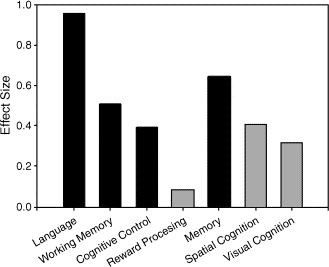
This is the most interesting and relevant flaw - working memory is not the only thing tested by a working-memory test. I’m probably oversimplifying this, but I believe that Liberman's graph suggests language and memory impact working-memory test results more than working memory does.

The bottom line: the working-memory test may actually test one’s comprehension abilities more than it tests working memory, so the test doesn’t do enough to isolate the variable it supposedly tests.

***
For another great example of real-world LSAT logic, check out "Facebook Use Linked To Lower Grades In College." (found via Freakonomics blog post - "Your Brain on Facebook").

In this article, the study's authors do an excellent job of acknowledging their study's limits. How? By raising the potential of a third variable that may lead to Facebook use and to lower grades.

Update: "Facebook Use Does Not Make You Stupid." It just goes to show correlations don't always mean as much as you might think.

LSAT Diaries: The 30-Something Chemist with a Family

LSAT Blog Diary LSAT Studying With FamilyThis installment of LSAT Diaries comes from Jon in Richmond, Virginia. He writes:
I'm a bit of a non-traditional, 32, PhD in chemistry, married, two (little) kids. I work for a Big Pharma company. Oh, and my younger brother is currently in law school. I very much want to beat his LSAT score (161). Well, I really want to crush it.
If you want to be in LSAT Diaries, please email me at LSATUnplugged@gmail.com. (You can be in LSAT Diaries whether you've taken the exam already or not.)

Please leave Jon some encouragement and advice below in the comments!


***

(Quick note: Below, LG=Logic Games, LR=Logical Reasoning, and RC=Reading Comprehension.)

Jon's LSAT Diary:

Day 1:
7:09: Rise and Shine

8:10: The wife and kids are out the door. I toast a Pop-Tart, grab a snack for the kids, pick up my computer bag, and head out myself. My bag is lighter without The Next 10 LSATs book. I finally got a chance to photocopy a couple of games sections. The photocopies are in the bag. I'm going to try to take a couple of ten minute breaks during my day to do a puzzle or two.

5:00: I've been very busy in the lab for the last couple of weeks and today was no different. All morning was spent getting four experiments going. The afternoon was filled with documenting the experiments and attending a meeting that was actually fairly productive. No chance to squeeze in a quick game.

5:10: I took a few minutes to search my email for a message that I have from my brother about his LSAT score. I'm trying to find which test he took. My brother's a 2L at a Boston law school (not Harvard). I have every intention of destroying his LSAT score. I know it's immature, but competition is a good motivator for me. So is shame. He got a 161. I'm aiming for 171+. December 2006. I'll have to find out which PrepTest that is. I plan on taking that test right before my official test in June. He was practicing in the low 170's but only scored a 161? I'll have to ask him about that later.

5:25: I leave work to pick up my two kids and head home for dinner and some family time.

8:50: With the kids in bed and my wife in the garage using our treadmill, I have some time to study. I usually study at the kitchen table, but I'm just not feeling it tonight. I decided to sit in a comfortable chair and review Grouping games. The games are my weakest section in the test. It just takes me too long to to work through them. My chemistry background has trained me to be very deliberate and careful in approaching problems. The time limit's killing me. I've been getting better and am working on improving my pace. I managed to get through a few games.

11:30: I decided to do a quick workout myself instead of getting right to studying after the wife went to bed. Given the progress I made during the early evening, I decide to do Section 1 of PrepTest 34. Ah, reading comprehension (RC). Easily my best section on the test. I whip through it with a minus 2. I'm alright with missing one of them, but I should have gotten the question about the anteaters.

12:20: I decide to call it a night. This is an early night for me.


Day 2:
6:50: My daughter is making sure we get an early start this morning.

8:30: I should have pretty much the same routine at work today. All morning will be at the lab bench with the afternoon full of paperwork. I may be able to find 10 minutes or so to tackle a game.

5:00: I've done all that I need to do today. I'm going to do the first game from PrepTest31. Let's figure out everyone's locker assignments!

5:10: Wow, I zipped through that in 5 minutes. I had done it before, but I didn't really remember it all that well. I'm pleased with how that went.

7:15: I manage to read a few pages of a book about the Seven Days campaign during the Civil War around Richmond, Va while my son is watching Scooby-Doo before heading upstairs to bed. I tell myself I'm doing RC prep.

8:30: I was just sitting down to study when my wife came back in from the garage. She's having some problem with her iPod. It's dead. I wanted a new iPod but it looks like she's going to get one instead. I guess the practice with grouping games will have to wait.

11:30: That's twice. Just as I was getting situated my daughter started crying. I'm at the kitchen table and ready to go again. I'll be really quiet so I don't wake anybody up.

1:00 am: I worked through the grouping game setup exercises and moved onto the first practice game. I have done the PrepTest the game is from already, but the material wasn't too fresh. I made it through the game in about 11 minutes with one stupid mistake. There are 7 or 8 questions so an extra minute or two might not be a real show stopper. It's bedtime.


Day 3:
6:50: This is getting old. I like getting up at 7:10 better.

8:36: My brother's replied to my email about the disparity between his practice LSAT scores and his official score. His story is that some guy next to him was flipping test booklet pages pretty quickly while he was stuck in the same section. He started freaking out that he was going too slow so he started to hurry through his first section (games). It took him a few minutes to remember that the order of the sections aren't the same for everybody. I guess he righted the ship after that, but the damage was already done.

You can only turn the pages a couple of times in the games section, but I guess his mental energies were too focused on the task at hand to realize that. He took the test once before, but he refuses to tell anybody his score. I'm sure that dismal performance was probably on his mind as well.

Noon: I'm going to take the first 15 minutes of my lunch to do game 2 in PrepTest 31, the CD store. I didn't like this game the first time I did it...

12:15: I still don't like it. I just have a hard time managing all of that information. I'm going to stay positive though. I've found something that I'm not good at so that means getting better at it should help my score. I see a good opportunity to to crack a piece of the LSAT code by figuring this one out. That will have to wait for later. I'm hungry.

4:30: I went to a chemistry seminar today. It was pretty boring (surprise), but seeing that I spend pretty much all of my free time on LSAT prep, my mind shifted into that mode during the presentation. I couldn't help but think about how the figures the speaker was using to tell us about his research were similar to games diagrams. Thinking about it during the talk, I realized that I've been so focused on getting the games questions answered in under 35 minutes that I've totally overlooked the key of the section. It's all about understanding how different pieces of information relate to one another.

I was reminded of instances where I've been stuck on a problem at work. I have all of this data in front of me. I know the answer is in the data somewhere, but I just couldn't see it. By changing how I look at the data, the answer I was looking for just jumps out at me. These games are basically the same thing. Once you take those random rules and put them into an order that really makes sense, inferences and question answers are much easier to find. Maybe I can take what I know about how I like to look at problems and add a wrinkle that will improve my score.

5:10: Back at work with a few minutes left until I have to leave to get my kids. There's plenty of time to do game 4 in PrepTest 31, building a partition.

5:25: I worked through this one with an eye to time and did alright, but after I looked at it a second time, I elaborated on one of my diagrams and suddenly all the pieces fell into place. I looked back over the questions and the answers were very easy to find with my improved diagram. I've known that the setup is key, but this example has really shown me that I need to look for ways to make the rules more visual. We'll see if it helps improve my score. Must beat the little bro.

9:30: With the wife in the garage, the kids in bed, and The Office over, I'm back at my study spot, the kitchen table, to work on that CD store game again.

9:50: After flailing around with the arrows in Logic Games and not making much progress, I tried applying my new insight into arranging the game info into a way that helps me see the connections better and get a better sense of how the different rules are connected. I was using the photocopy that I used to do the game earlier in the day so it was all marked up. My previous work was distracting me when I tried to answer the questions. I'll try it again tomorrow night with a new copy. (I need to remember to take "The Next 10" with me to work tomorrow and make some more copies.)

11:30: I'm feeling a little sleepy and my body is tired from the workout that I just finished, but I'll take a crack at a Logical Reasoning (LR) section tonight just to mix things up a little (PrepTest 34 Section 2).

12:30: I should have listened to my gut and gone to bed. I made some very careless mistakes. That's kind of par for the course for me on this section though. I did better back when I first started studying. For whatever reason, I'm not reading the questions and answer options as carefully as I did back then, and I'm really making some stupid mistakes. I went back and looked at one that I missed. I totally skipped the correct answer choice when I was going through them the first time. On another question an assumption in the argument jumped right out at me the second time I read the question, but I totally missed it the first time. I'm going to chalk this -6 performance up to fatigue, but I'm going to take away the lesson that I need to be very deliberate in my reading.

Day 4:
8:05: I'm sure to grab my Next 10 book so I can photocopy some more games for practice. I've decided that's the only thing that will really help me at this point. Practice, practice, practice.

1:15: I had a few things to take care of before I went downstairs to get my experiments up and running again so I'm really behind. I have plenty of other things to do besides run these routine experiments. I need to catch up on some other work, write an abstract for a poster that I plan to present at a national meeting, and get started on a training presentation that will cover some pretty technical information, but getting these experiments going is my top priority everyday. I could work on my abstract or presentation at home in the evening, but I need all the time I can get for studying. Anyway, there is no time to do a game during my lunch.

5:15: I was able to make new copies of a few games. The photocopier is in a lab where only a few people work, all of whom are already out the door. Using the photocopier for non-work purposes isn't why I'm trying to keep people out of my business. I don't want people to start talking about my plans to take the LSAT. Info like that tends to get more distorted the higher up the management ladder it goes. I don't need to deal with rumors right now. I have enough on my plate. These new copies won't be used tonight though. I have other plans for my study time.

10:00: The wife ran out to buy a new iPod, so I decide to take this rare chunk of time in the early evening to do the second LR section of PrepTest 34. I was ruminating about my crappy performance all day so this is my chance to take another crack at an LR section to see if I can improve on my sub-par performance from the night before. It's still pretty early in the evening so I figured I would be a little sharper. I was in the final few difficult questions when my wife got back home. She didn't say anything to me, but I found it harder to concentrate once she was back.

It was another -6 performance. I don't feel like I made any careless mistakes like I did the night before. I actually resisted the temptation to take the trap answer on a couple of questions and worked to the right answer. Nevertheless, it's less than comforting to be stuck in this range. I just keep telling myself that I have plenty of time. Getting over this hump is probably going to be tough so I just have to keep on plugging.

1:00: I pushed the LR frustration back for an hour and a half or so and did a few practice Logic Games. Improving in this section will be the biggest benefit to my score so I need to keep doing what I can to improve. Like I said in this morning's post, practice, practice, practice.


Day 5:
9:00: Today is Saturday and Saturday always starts with a trip out with the family for breakfast followed by our weekly grocery shopping. These trips are usually pretty crazy, remember my kids are 3 and 1 and a half. This morning is no exception. I was up with my daughter for about an hour while we were waiting for some Motrin to kick in to help her with some teething pain. I was up until 1 studying, up with my daughter from 2:30 to 3:30, and up and getting ready for the day at 7:45. I'm should be alright for a little while, but I'm thinking that I'll take a nap while the kids are napping today. I really need the rest. My daughter needs the rest too. She's stubborn on a good day, but she's impossible on a night after she's hasn't slept well. I'm already looking forward to nap time.

12:30: I was falling asleep while I was watching Scooby-Doo with my son before his nap (I used to watch Scooby-Doo when I was his age, it's a strange experience to watch it again with my own kid.). I'm thinking I need to sleep more than I need to do logic games practice.

4:00: Yes, I did need to sleep. Bless my wife for letting me sleep for 3 hours on a Saturday afternoon!

12:00 am: Most of the night has been spent on Daddy duty. My son is getting a bike from the Easter bunny tomorrow and I need to finish putting it together. I'm waiting for the cheap pump that we bought to inflate the tires to cool down from taking care of the front tire before I do the reat tire. I'm tackling the next grouping practice game. It's about researchers learning new languages.


Day 6:
10:45: All day was spent doing family stuff. I'm hoping to do 4 or 5 practice games tonight. I'm planning on doing a timed games section as part of my diary grand finale tomorrow night. Must practice, practice, practice, practice.

12:45: I worked through the last couple grouping games and two grouping/linear combination games. I've discovered that I'm really bad at grouping games where the position of the variables are not defined. I'm not a systematic enough thinker to work through all of the inferences that are the key to that kind of game. Identifying that weakness gives me something very targeted and specific to work on. I have also realized that I take too much time making sure I have the correct answer. I identify an answer that I am confident in, but then I take another minute or two to convince myself that it's correct before moving on to the next one. I'm losing a big chunk of time in that one activity alone. I'll have to pay better attention to that tendency the next time I do a timed section.


Day 7:
8:30: I had a horrible time getting to sleep last night. Right after I feel asleep, my wife woke me up to help her get my daughter settled. I feel asleep holding her in a glider that we keep in her room. I got back in bed around 5. I got 4 fragmented hours of sleep last night. There will be plenty of caffeine in my day. At least I'll be plenty busy at work.

12 pm: I have game 3 from PrepTest 31 in my bag. I know how to do it pretty quickly, but I'm curious to see just how long it will take.

12:10: It took me 5 minutes, and that's after spending way too much time confirming that I had the correct choice identified on one of the questions.

Midnight: I tackled section 4 of PrepTest 31. I am encouraged by my performance. I only missed 2 that I answered and didn't get to 8 of them. This doesn't sound great, but it's an improvement over where I was a month or so ago. The practice is helping. I skipped most of the first game after not being able to make much headway with the questions. When I went back to review the questions I quickly identified that I missed the key rule. I figured everything out pretty quickly after that insight.

I have a good feeling that seeing my mistake will allow me to identify a similar rule in a game that much faster the next time I encounter a similar game. The practice is already helping (I need to make that my mantra for the next couple of weeks). This process of seeing how the rules relate to one another and how to best attack the questions is definitely coming much faster. I could spend 45 minutes trying to figure out one game a few weeks ago. Now I can usually find the key to the game in a minute or two.

You would think my advanced degree (I have a PhD in chemistry) would help me out in this situation, but the way I think about chemistry is much different than the way I have to think about these questions. I am basically training myself to think in an entirely different way. It's definitely a challenge, but I know that I'm up to it. I just have to keep practicing because...The practice is already helping.

As for my pseudo-score on PrepTest 31, a 163. A solid RC section, two alright but could have been better LR sections, and a not so great but better than I've been doing games section. The score is right where I've been for the last couple of PrepTests, but I feel like my grasp of the test is improving. I try not to worry too much about the score at this point. I only calculate it to gauge my progress and to acclimate myself for how the raw score relates to the scaled score. I'll put more value in my score when I start taking four or five sections in a row. I'll probably have to start the test at 10 pm or so some night. I'll wrap up around 12:30. I'm going to take a couple of Saturday afternoons to take a full PrepTest with a fake experimental section, but as this diary shows, I just don't have the luxury of big chunks of time. That's just the reality of my life.

I still need to order PrepTest 51 (that's the test my brother took to get his 161). I know there are plenty of good reasons to study hard, but I am highly motivated by competition. I'll keep practicing whenever I can find the time. Thanks for reading.


***

Steve's comments:

It sounds like you're in great shape to rock the exam, Jon!

1. The desire to beat your brother's LSAT score is a great motivator. As long as it's effective, it doesn't matter whether the motivation is immature or not.

2. Do yourself a favor and don't study with the TV on. Set aside specific blocks of time to do nothing but study. Studying with the TV. Reminds me of when I used to do my math homework in rapid 3-minute spurts during commercial breaks. It would take a while just to get back into the homework mindset, and before I knew it, the show was on again, and I'd hardly gotten any work done.

3. Also try not to study when you're exhausted. Better to study when you're awake and alert - you'll get more out of your studying that way.

4. Glad to see you're starting to make sense of the Logic Games!

5. It's great to photocopy the logic games and do them several times. You might make new deductions the 3rd or 4th time around.

6. Identifying weaknesses is key. You will learn to become a systematic thinker through practice.

Everyone, please leave Jon some comments and encouragement below!

Photo by sterlic

Law School Rankings Released by US News

The US News law school rankings for this year were officially published online on Thursday, even though they were leaked a few days ago. It's good to be aware of them, but take them with a grain of salt.

A few articles accompanying the rankings on the US News site:

"Law School Rankings Methodology"

"Part-Time Law School Rankings Methodology"

"Attractions of Part-Time Law School"

"How to Use Our Lists Wisely"

"FAQ Law School Rankings"

Analysis:
Law School Almanac created an excellent chart showing changes in the US News rankings of the top 14 law schools from 1987-2009.

Wall Street Journal Law Blog discusses some changes to the rankers' methodology.

Law Librarian Blog links to a few useful posts about law schools' reputational scores and the biggest rank changes.

TaxProf Blog covers a few potential errors in the rankings.

Finally, LawSchoolHeadlines (defunct) did the legwork to calculate ALL changes in the top 100 law school rankings from last year:

Rank School +/-
1 Yale
2 Harvard
3 Stanford -1
4 Columbia
5 NYU
6 Berkeley
6 Chicago +1
8 Penn -1
9 Michigan
10 Duke +2
10 Northwestern -1
10 UVA -1
13 Cornell -1
14 GULC
15 UCLA +1
15 Texas +1
17 Vanderbilt -2
18 USC
19 WUSTL
20 BU +1
20 Emory +2
20 Minnesota +2
23 IU - Bloomington +13
23 Illinois +4
23 Notre Dame -1
26 BC
26 Iowa +1
28 William and Mary +2
28 GWU -8
30 Fordham -3
30 Alabama +2
30 UNC +8
30 U of Washington
30 Washington and Lee -5
35 OSU -3
35 UC - Davis +9
35 Georgia -3
35 Wisconsin-Madison +1
39 UC - Hastings -1
40 Wake Forest +2
41 BYU +5
41 GMU -3
43 Arizona -8
43 Maryland -1
45 American +1
45 Tulane -1
45 CU - Boulder -13
45 Utah +6
49 SMU -3
49 Cardozo +6
51 U of Florida -5
52 Florida State +3
52 U of Cincinnati
52 Uconn -6
55 Arizona State -3
55 Case Western +8
55 Pepperdine +4
55 Kentucky +4
59 Houston -4
59 Tennessee -7
61 Brooklyn +2
61 Lewis & Clark +12
61 San Diego +21
61 Villanova +7
65 Baylor -10
65 Georgia State +12
65 Penn State +12
65 Temple -6
65 U of Kansas +8
65 U of Missouri -6
71 Loyola LA -8
71 Miami +11
71 Oklahoma -3
71 Pitt +2
75 Louisiana State +13
75 UNLV +13
77 Chicago-Kent -11
77 Rutgers Camden
77 Seattle +5
77 Seton Hall -11
77 Denver +11
77 New Mexico -9
77 Oregon +5
77 Richmond -9
85 Santa Clara -8
85 SUNY-Buff +15
87 DePaul +1
87 Indiana-Indianapolis -19
87 Loyola Chicago -5
87 Marquette +8
87 Rutgers Newark -10
87 St. John’s +1
87 South Carolina +8
94 Catholic -6
94 Northeastern -6
94 St Louis +1
94 Arkansas Fayetteville NEW
98 Louisville +2
98 USF NEW
100 Gonzaga NEW
100 Hofstra -1
100 UMaine NEW

The top 10 part-time law schools are below: (full list here)

1. GULC
2. GW
3. Fordham
4. American
5. GMU
6. Maryland
7. Temple
7. San Diego
9. Denver
10. Chicago Kent

Why the LSAT is Like Monopoly

Think board games and Logic Games have nothing in common? At first glance, sure. However, some of the strategies that can help you win in Monopoly can also help you beat the LSAT.

1. Mediterranean and Baltic almost aren't even worth buying.

It takes money to make money. It's great to study for the LSAT, but only studying a few minutes each day is barely even worth your time. The LSAT's an all-or-nothing deal. Go for the most expensive properties possible (spend as much time studying as possible) in order to reap the biggest reward (a high LSAT score).

Similarly, it's great to buy LSAT materials (properties), but if you don't study intensively (build houses or hotels on your properties), their value will always be limited. The best LSAT prep books increase in value to you when you "upgrade" them by learning what they contain.


2. The more railroads you buy, the better a return you collect from each one.

Studying for Reading Comp will help you with Logical Reasoning, and vice-versa. The more studying you do, the more it increases the benefit of your previous studying. Things start to click.


3. Everyone begins Monopoly with the same $1500. It's how you use that money that makes all the difference.

Sure, there are a few rolls of the dice on the LSAT too - you might get sick or have a noisy test center. However, everyone has 35 minutes per section on the LSAT. It's how you use your time that makes all the difference, and you need a refined strategy in order to succeed. The time you devote to studying, the strategies you use, and your familiarity with the LSAT determine how you'll do on test day.

Daily LSAT Schedule | Recommendations For Each Day

Question: How much should I study each day for the LSAT?

Answer: As much as you can without burning out. If your exam is in the next few months, try to average 2-3 hours per day.

Question: That's impossible! How can I fit in those hours?

Answer: Here's one possible daily schedule:

1 hour before work/school
1 hour during lunch OR 1 hour at your office desk during "downtime"
1 hour after work/school

Wake up at the crack of dawn to study if you have to. Learn to love the LSAT. If you do, it's a heckuva lot easier to drag yourself out of bed.

Same goes for evenings. Do you think the 170-scorers are watching Netflix after work? Nope. They're hitting the LSAT books. Wait for your TV shows to come out on DVD or watch them on streaming after the exam (if you must).

If you ask a swim coach, "How much should I swim in order to be the next Michael Phelps?", the coach will laugh and shove you into the pool.

The answer is, "If you have to ask, you don't want this badly enough. Swim every free moment you've got and during the moments you don't have, too."

How do you get more free moments?

Don't schedule studying around your other obligations/distractions. Schedule your other obligations/distractions around studying. Postpone your other obligations whenever possible.

Studying for the LSAT diligently is a part-time job at a minimum. Unless you have a lot of free time, now's not the time to begin training for a marathon (although moderate exercise is excellent for your brain). Your friends (and the marathon) will still be there after the LSAT.


Hardest LSAT: Feb, June, Oct, or Dec?

Which LSAT is the hardest? Rumor has it the February LSAT is the toughest exam each year. This rumor probably originated because February's exam is traditionally undisclosed, leading to an air of mystery arond it.

Believe me, if the LSAT-writers are smart enough to write this exam, they're smart enough to realize people are going to analyze it for patterns of difficulty between months. If one month's exam were consistently tougher than another's, you would have heard about it by now, and the test-makers would have corrected this huge mistake.

Sure, the Logic Games on one exam may be "easier" than those on another. While there's some agreement about particular Logic Games being harder than others, one person may find a game to be easy while another finds it difficult. Everyone has different strengths and weaknesses.

However, one test-taker will not automatically get a higher score if his/her games are easier and he/she answers more questions correctly as a result. After all, this is a "standardized" test. Your LSAT score is determined by taking the number of questions you answer correctly (your raw score) and converting into a score from 120 to 180 based upon the performance of previous test-takers, who took those sections as their "experimental section."

Bottom line: When it comes to question difficulty, no particular month's LSAT is consistently easier or harder than another's. Even if it were the case, it wouldn't matter. Take the LSAT when you're ready.

5 Reasons I Secretly Enjoy Logic Games

Some of you email me to say how much you hate the LSAT. I already wrote a series on why I love the LSAT, but some of you still aren't convinced. I'm not giving up.

Here are the top 5 reasons I enjoy Logic Games:

1. They're like sudoku.

2. It's satisfying to make a solid diagram and then quickly answer the questions.

3. Although the topic never matters, it's fun to make fun of the games' goofy topics.

4. After jumping from one question type to another in Logical Reasoning, it's nice to finally have a bunch of related questions.

5. It's the easiest section to learn. Really.

LSAC's Official Guide to Law Schools

Want more law school data than you'll ever need?

LSAC's site can be difficult to navigate, but it's full of useful information. One especially useful section is its "Official Guide to Law Schools."

You can search it by clicking on All Law Schools. Then, use the top navigation bar to sort law schools according to a variety of different factors and get more information on each.

LSAC's Rules for Changing Your LSAT Test Date

Update: See Cancel, Postpone, or Absent?

I would like to point you all to two recent posts on Anna Ivey's blog. Also, see my interview with Anna Ivey on LSAT Blog if you haven't already.

The two posts are:

1. New Rule for Changing Your LSAT Test Date

2. A Law School Professor's Advice to an Applicant

Along the lines of the first post linked above, here's some last-minute news about LSAT registration fee waivers:

Current Fee Waiver Forms Extended Until April 25, 2009

If you are seeking a fee waiver for the June 2009 LSAT, you may use the current fee waiver form, even though it states that it should not be used after March 1. Apply for this fee waiver using 2007 tax forms. LSAC will continue to accept the current fee waiver form until April 25. If your fee waiver is approved, you will still have time to register for the June 2009 LSAT administration.


Cornell Law School Admissions Dean | Interview

This is the 4th post in the "Better Know a Law School" series. Richard Geiger is Cornell Law School’s Associate Dean for Enrollment and Communications. He received his law degree from Boston University and after clerking for a federal district court judge, practiced at law firms in Washington, D.C. and Boston. From 2003-2005, he served as Chairman of the Board of the Law School Admission Council. Cornell ranked 12th among law schools in US News and World Report this year.


1. What's special about Cornell's international law program? What can someone specializing in international law do during their time at Cornell and beyond?

International law has been a signature program at Cornell for a very long time. What makes it special at this point is that it covers not just the curricular elements you would expect from a top law school, but the programmatic and institutional elements as well. For example, even though we’re a relatively small law school, we have formal study abroad relationships with 15 different law schools around the world; we offer summer institutes in Paris and Suzhou, China; and our degree possibilities include two different U.S./French law degrees, a U.S./German law degree, a three-year J.D./ LL.M. in international and comparative law, and a J.D. with a specialization in international legal affairs. We’re also part of a truly wonderful university that has a wide range of international area studies and other programs that are available to our students for course credit, or just for enrichment. All of this means that our students end up with excellent career options in both private and public international law.


2. The FAQ section of your website emphasizes that all applications are read thoroughly. Would you please describe the typical application review process and how much time is devoted to each part of the application?

Our process is aimed at getting to know the answers to two basic questions: (1) is the person likely to thrive academically at our school; and (2) will he or she be the kind of person who will actively engage not only the classroom environment, but everything else that goes on here. To assess these things, we rely on every part of the application. There is no real formula to it because everyone is different. In fact, we shy away from numerical cut-offs and mechanical approaches precisely because we don’t want to miss people for whom the numbers simply aren’t good predictors of success. Remember, we’re a small school and we can’t hide admissions mistakes. This gives us a strong incentive to get it right.


3. Your website makes it seem like professors are accessible to students 24/7. While I'm exaggerating here, are they really that down-to-earth and open to student contact? How do they have the time? Shouldn't they spend their time writing in journals and taking cases to court?

Great question. How is it that our faculty can consistently be rated as top scholars and top teachers, and still have time to engage with our students personally? The short answer is that the faculty/student culture really encourages and supports full engagement. Our faculty are consumed not just with their scholarly activities, but with having a real impact on our students. Plus, don’t forget that many of our students are already very accomplished people who faculty enjoy getting to know as individuals. The long answer will require a visit to our school. Spend a day here while we’re in session and all will be made clear! I promise.


4. Anything else?

Just a couple of things: First, city people are often worried about what it will be like in Ithaca for three years. My response to that is to remember that we’re part of a very large university (19,000 or so) and that Ithaca is a very lively place. But more importantly, remember that the law is essentially an urban profession. The common denominator for most of our graduates is that they end up in a major urban area. So, for most of our students, their time in Ithaca may literally be the only time they’ll be able to experience the wonderful lifestyle that a place like Ithaca offers. Second, most people tell me that once they start to get to know more about Cornell they are amazed at the wide range of possibilities we are able to offer our students even though we’re relatively small and not located in a big city. Of course, once again, a visit is the best way to discover the surprises that Cornell and Ithaca offer.

Conditional Reasoning: Contrapositive, Mistaken Reversal, Mistaken Negation

What is the contrapositive? What do mistaken reversal (converse) and mistaken negation (converse) look like on the LSAT?

While each bite-sized Logical Reasoning argument and each Logic Games rule may seem impossible to understand, they're pretty manageable once you've got a grip on the basics.

In this article, I'll share the basics of conditional reasoning with you.

Original statement:
If I tutor the LSAT in Manhattan, then I tutor the LSAT in New York City.

Symbolized:
Manhattan -> NYC


Mistaken reversal / converse (invalid):
If I tutor the LSAT in New York City, then I tutor the LSAT in Manhattan.

Symbolized:
NYC -> Manhattan

False because this statement implies that I tutor in a different part of NYC (Brooklyn, Queens, Staten Island, or the Bronx).


Mistaken negation / inverse (invalid):
If I do not tutor the LSAT in Manhattan, then I do not tutor the LSAT in New York City.

Symbolized:
Manhattan -> NYC

Again, this statement is false because I could be in another borough of NYC.


Contrapositive (valid):
If I do not tutor the LSAT in New York City, then I do not tutor the LSAT in Manhattan.

Symbolized:
NYC -> Manhattan

This is true. It's impossible for me to tutor the LSAT in Manhattan if don't tutor the LSAT in NYC because Manhattan is in NYC.


It's worth noting the mistaken reversal and mistaken negation are the contrapositives OF EACH OTHER. They are logically equivalent. Why? Because they're flawed for the same reason - they confuse necessary and sufficient conditions.

The sufficient condition:
-appears to the left of the arrow in the "symbolized" sections above
-is often indicated by the words "if" and "when"
-is enough to cause the necessary condition to follow, but it's not necessarily required for the necessary condition to occur
-serves as the evidence

The necessary condition:
-appears to the right of the arrow in the "symbolized" sections above
-is often indicated by the words "then" and "must"
-often appears after a comma
-is required by the sufficient condition
-serves as the conclusion

Why this is important:
Breaking down which parts of the argument are sufficient and necessary allows you to determine the evidence and conclusion. This helps you figure out potential flaws and opportunities to strengthen/weaken the argument.

Further reading:
Wikipedia's article on the contrapositive is solid.

5 Steps to Solving Weaken Logical Reasoning Questions

What do you do when you see a Weaken Logical Reasoning question, aside from hiding under your bed?

Weaken questions don't have to be tough, although they can seem that way at first. Unless you frequently engage in structured debates, you're probably used to fixing things and making them better - not breaking them and exposing their flaws. Here's a step-by-step approach to help you solve every Weaken question.

1. Recognize that it's a Weaken question.
Some weaken question stems:
"Which one of the following, if true, most seriously weakens the argument?"

"Which one of the following, if true, is evidence that the explanation given above is only a partial one?"

"Which one of the following, if true, most calls into question the argument..."

2. Look for the main flaw (if present).
It will make some unwarranted (and unstated) assumption - the missing (and weakest) link between premises/evidence and conclusion.

3. Attack the assumption and scan for answer choice that exposes the flaw.
Expose the gap between the evidence and conclusion. The correct answer may expose the argument to the flaw by:

-promoting an alternative possibility
-denying the evidence's relevance to the conclusion
-attacking the evidence's validity (for example, saying a supporting survey or study was not properly conducted)
-providing evidence to attack the conclusion

4. Remember that the answer choices can contain information not mentioned in the stimulus.
Why? Because the question stem says "if true" or "if...assumed."

5. Remember that in "Weaken EXCEPT" questions, 4 will weaken the argument, and 1 will not.
The 1 that doesn't weaken will either strengthen or have no effect. In logic, the opposite of weaken is "not weaken."

Law School Admissions Index: LSAT vs. GPA Ranking

How exactly do admissions officers weigh your LSAT score and GPA? Well, it's complicated.

Law School Admissions Index: LSAT vs. GPA

LSAC's website will help you calculate your chances at various law schools. It uses each law school's "admissions index" (a formula unique to each school weighing LSAT and GPA) and contains data from the Fall 2007 admissions cycle.

Enter your undergraduate GPA and (presumed) LSAT score. Sort the results by likelihood in descending order to see at which schools you have the highest likelihood of success.

Enjoy!

Yale Law Journal Editor-in-Chief | Interview

I recently interviewed Ben Taibleson, current Editor-in-Chief of the Yale Law Journal (on Wikipedia), via email. Our discussion follows.

1. How did you become Editor-in-Chief of the Yale Law Journal?

The Yale Law Journal Editor-in-Chief is elected by the full membership of the Journal. The EIC candidates first submitted written materials outlining why we wanted the position and how we felt about a set of Journal policy questions. We then gave a short speech and answered questions at a pre-election forum. Each Journal member then ranked the EIC candidates, and the rankings were used to determine the winner.


2. Would you please explain how a typical volume of the journal is put together?

The Yale Law Journal is composed of lengthy faculty-written articles, shorter, often solicited, faculty-written work and very high-quality Yale Law student pieces. The Journal receives thousands of submissions for each volume, so a great deal of work goes into selecting our content. We also put a lot of time and energy into our multi-stage editing process. Each volume's scholarship is then divided into a number of issues and distributed electronically and in print.


3. How do you manage to balance your YLJ responsibilities and all your reading?

I am heavily involved in just about everything the Journal does, so my YLJ responsibilities are proving to be very substantial. My predecessor has given me a ton of great advice on how to strike a healthy balance, though, and my colleagues are so talented and hardworking that my job won't be as tough as it otherwise might . The quantity of work borders on the absurd, but it's a lot of fun, and I am incredibly lucky to have the privilege to do it. I doubt that many people with real jobs, kids, etc. would shed too many tears for my entirely voluntary workload.


Ben Taibleson was born outside Chicago and grew up in Milwaukee. He studied Economics and Political Science at the University of Wisconsin, where he was elected to Phi Beta Kappa, and spent a year traveling and working in Africa and Asia before starting at Yale Law. His father is an attorney and his mother a high school dance teacher in Milwaukee; he has two exceedingly talented younger brothers whom he loves very much.

Formal vs. Informal Logic in LSAT Logical Reasoning

As we saw in my interview with Dr. Deborah Bennett (author of Logic Made Easy) a few weeks ago, both formal and informal logic are necessary in everyday life. Here are some examples of both formal and informal logic for those of you who haven't had a chance to get your hands on a copy of Logic Made Easy yet.

Formal logic
Formal arguments tend to be simple, straightforward, and extreme.

Example:
Everyone in Manhattan lives in NYC. Everyone in NYC lives in New York State. Therefore, everyone in Manhattan lives in New York State.
There are no assumptions here - it's mathematical, and the evidence fully justifies the conclusion.

Represented in symbols, we can therefore say:
Manhattan -> NYC. NYC -> NYS. Therefore, Manhattan -> NYS.

Change the topic to something about climate change or morality, and you've got one of the few formal logic questions in Logical Reasoning. (See my post a few weeks back on 15 Common Logical Reasoning Topics for more on that). Most formal logic on the LSAT happens in Logic Games.

On the LSAT, of course, it might not be that simple. The argument above could be phrased as follows:

If you live in Manhattan, then according to accurate, yet decades-old, government records, you must live in NYC. However, if you're in New York State, then you may or may not be in NYC. On the other hand, if you're in NYC, then you must live in New York State.
I included the 2nd sentence as filler just to make the argument more difficult to understand. Although it's more casual and wordy than the formal logic version, this doesn't mean it's easier.

The two versions above are identical. It's not necessary to represent it in symbols, but it can sometimes help.


Informal logic
Informal arguments are much more common on the LSAT. They tend to be complex and contain unstated assumptions.

Example:
Some people in New York State aren't famous. However, because I live in NYC, I ride around Manhattan in limos and hang out with celebrities. Therefore, I'm famous by association.
This can't be diagrammed as neatly, the evidence doesn't fully justify the conclusion (by a long shot), and a lot of other things also need to be true in order for the conclusion to logically follow.

5 Steps to Solving Strengthen Logical Reasoning Questions

What do you do when you see a Strengthen Logical Reasoning question?

Remember that Logical Reasoning makes up half the exam, and Strengthen Logical Reasoning questions are common. Here's a step-by-step guide to help you solve them.


1. Recognize that it's a Strengthen question.
Some strengthen question stems:

"Which one of the following, if true, most strengthens the argument?"

"Which of the following, if true, would most justify the conclusion?"


2. Look for the main flaw (if present).
It will make some unwarranted (and unstated) assumption - the missing (and weakest) link between premises/evidence and conclusion.


3. Support the assumption and scan for answer choice that helps patch up the argument.
After you find the central flaw of the argument, fix it. Bridge the gap between evidence and conclusion. The correct answer may protect the argument against the flaw by:

-denying an alternative possibility

-promoting the evidence's relevance to the conclusion

-supporting the evidence's validity (such as by saying a survey or study was properly conducted)

-providing additional evidence to support the conclusion


4. Remember that the answer choices can contain information not mentioned in the stimulus.
Why? Because the question stem says "if true," which allows the possibility of new information.


5. Remember that in "Strengthen EXCEPT" questions, 4 will strengthen the argument, and 1 will not.
The 1 that doesn't strengthen will either weaken or have no effect. In logic, the opposite of strengthen is "not strengthen."


***

Contrast with Sufficient Assumption (aka Justify) question stems:

"Which one of the following, if true, allows the conclusion to be properly drawn?"

"The conclusion follows logically if which one of the following is assumed?"

Sufficient Assumption questions do strengthen the argument. In fact, they fully justify it by guaranteeing that the conclusion logically follows.

However, they should be approached differently than Strengthen questions. The major difference is that Sufficient Assumption (Justify) questions often reward a formal-logic approach, while Strengthen questions reward an informal-logic approach.

For more on how to approach Sufficient Assumption questions, check out:

Sufficient Assumption Questions | Tips and Categorization

Logical Reasoning | Sufficient Assumption (Justify) Questions