Getting ready for the LSAT? Use a day-by-day study plan to stay on track.

Save time by instantly downloading LSAT PrepTest PDFs and explanations.

July 31, 2009

Free LSAT Logic Games | Linear | Difficult Version

LSAT Blog Free Logic Games Linear DifficultUPDATE: See the explanation for this Logic Game's setup.

***

LSAC could drive us crazy with a Logic Game based entirely on gods and goddesses whose names begin with the letter "A".

To be fair, LSAC has never done this before. In fact, you'll generally find that the variables in most Logic Games don't share the same first letter, allowing you to easily represent "apple" as "A", "banana" as "B", etc.

You've probably become so dependent on this norm that if you came across a game with multiple variables (people/places/things) possessing the same first letter, you wouldn't know what to do.

I know you're thinking:
This will never happen. There are dozens of PrepTests out there, and LSAC wasn't cruel in any of them in the way you've described. Stop giving them ideas!
True. LSAC hasn't ever made a game with all the variables beginning with the same letter. However, LSAC also hadn't ever written a game with virtually no room to diagram, but then the 4th Logic Game of the June 2009 LSAT came along. Since they already messed with the sacred diagram-drawing space, I wouldn't put it past them to start messing with the variables.

As for giving LSAC ideas, I'm sure they've already considered doing a game with all "X"s or "Z"s or something wicked like that. If they do, you'll now be ready for it.

How? Because you're about to do a Logic Game with multiple variables that start with the same letter. This game has 5 "A" variables and 2 "D" variables.

(There are no real Logic Games out there like this one, so I had to write my own. I know I always advise against using fake LSAT questions. However, I've modeled this on a few recent actual LSAT Logic Games, so I'm confident this is a fairly legitimate representation of what a Basic Linear Logic Game is like, if on the easier side.)

What's the magic technique to deal with a game like this? Believe it or not, it's nothing crazy. When you diagram the rules and draw slots, use the first couple of letters instead of only the first letter. This will allow you to distinguish between the variables without writing out their full names.

I know many of you are just starting out, so I've also posted an "easier" version of this logic game. It contains identical rules and associated questions - only the scenario and names of the variables are different.

However, I recommend you try out the more difficult version first just to get a sense of how reliant you are on having different letters for each variable.

Be adaptive. Think about ways LSAC could make Logic Games harder and be ready for whatever they throw at you.

***

LSAC is obsessed with using cars and trucks as Logic Game topics (someone's childhood obsession, perhaps, like dinosaurs). Well, I loved mythology as a kid, so I'm subjecting you to gods and goddesses from Greek mythology in my Logic Game (non-Greek deities will be used in future Logic Games, not to worry).

(I consider both versions to be pretty easy. The only thing that makes this version especially "hard" is the variables themselves. Aside from that twist, upcoming Logic Games that I write will be significantly more difficult.)

***

Here's the "hard version" of the game:

Seven Greek deities are fighting to establish a hierarchy of power on Mount Olympus. They are Aphrodite, Apollo, Ares, Artemis, Athena, Demeter, and Dionysus. No other deities participate in the fighting, and the hierarchy will establish an ordering of the seven deities from most powerful to least powerful. No two deities will be equally powerful.

The hierarchy of power must be established in accordance with the following restrictions:
There must be exactly two deities more powerful than Dionysus but less powerful than Apollo.
Dionysus cannot be the least powerful deity.
Apollo cannot be more powerful than Artemis.
Demeter cannot be the next most powerful deity after Athena, nor can Athena be the next most powerful deity after Demeter.
Aphrodite must be either the 4th or 5th most powerful.

1. Which one of the following could be the hierarchy of power, from most powerful to least?

(A) Artemis, Demeter, Apollo, Ares, Aphrodite, Dionysus, Athena
(B) Artemis, Apollo, Ares, Aphrodite, Dionysus, Athena, Demeter
(C) Demeter, Artemis, Apollo, Aphrodite, Dionysus, Athena, Ares
(D) Artemis, Athena, Apollo, Aphrodite, Demeter, Dionysus, Athena
(E) Athena, Ares, Artemis, Apollo, Aphrodite, Demeter, Dionysus


2. If Dionysus is the fifth most powerful deity, each of the following could be true EXCEPT:

(A) The second most powerful deity is Apollo.
(B) The third most powerful deity is Ares.
(C) The third most powerful deity is Athena.
(D) The sixth most powerful deity is Demeter.
(E) The seventh most powerful deity is Athena.


3. If Artemis and Apollo are the first and second most powerful deities, respectively, how many different hierarchies could there be?

(A) one
(B) two
(C) three
(D) four
(E) five


4. If Athena is the second most powerful deity, but Aphrodite is NOT the fourth most powerful deity, each of the following could be true EXCEPT:

(A) Ares falls immediately before Aphrodite in the hierarchy.
(B) Ares falls immediately after Dionysus in the hierarchy.
(C) Apollo falls immediately before Ares in the hierarchy.
(D) Aphrodite falls immediately before Ares in the hierarchy.
(E) Aphrodite falls immediately after Demeter in the hierarchy.


5. If the condition that Dionysus cannot be the least powerful deity is removed, and Dionysus then falls to the bottom of the hierarchy, but all other conditions remain in effect, which one of the following is now a complete list of deities, any one of which could be third most powerful?

(A) Ares, Artemis, Athena
(B) Demeter, Ares, Athena
(C) Demeter, Ares, Artemis, Athena
(D) Demeter, Aphrodite, Ares, Artemis
(E) Demeter, Apollo, Ares, Artemis


***

The text below contains the answers to the above Logic Game.

1. A
2. B
3. D
4. D
5. C

***

Having trouble with this Logic Game? See a step-by-step explanation of this Logic Game's setup.

***

Photo by sebastiagiralt

(Athena, the patron goddess of Athens, was said to have been born fully grown from the head of Zeus. Here Zeus sits on his throne holding his thunderbolt, as the goddess springs from his head in full armor. Hephaistos, who is usually present with the axe he used to split his father's skull, is absent, but Hermes and Apollo look on at left, and at right Ares and a goddess, possibly Aphrodite, observe the miraculous birth.)
Continue Reading...»

Free LSAT Logic Games | Linear | Easy Version

LSAT Blog Logic Games Linear EasyUPDATE: See the explanation for this Logic Game's setup.

***

Here's the "easier version" of this Logic Game.

For those of you interested in comparing the hard and easy versions, I've listed each variable and its counterpart at the end of this blog post.

Easy version
Jandra is a travel guide writer who will visit 7 countries: Australia, Bahrain, China, Djibouti, England, Fiji, and Guatemala. She must visit each of these countries in accordance with the following restrictions:
Jandra must visit exactly two countries before her visit to China but after her visit to Bahrain.
China cannot be the last country she visits.
Jandra cannot visit Bahrain until she has visited Australia.
She cannot visit England immediately after she visits Djibouti, nor can she visit Djibouti immediately after she visits England.
Fiji must be visited either 4th or 5th.
1. Which one of the following could be the order in which Jandra visits the countries, from first to last?

(A) Australia, England, Bahrain, Guatemala, Fiji, China, Djibouti
(B) Australia, Bahrain, Guatemala, Fiji, China, Djibouti, England
(C) England, Australia, Bahrain, Fiji, China, Djibouti, Guatemala
(D) Australia, Djibouti, Bahrain, Fiji, England, China, Djibouti
(E) Djibouti, Guatemala, Australia, Bahrain, Fiji, England, China


2. If Jandra visits China fifth, each of the following could be true EXCEPT:

(A) The second country she visits is Bahrain.
(B) The third country she visits is Guatemala.
(C) The third country she visits is Djibouti.
(D) The sixth country she visits is England.
(E) The seventh country she visits is Djibouti.


3. If Jandra visits Djibouti second, but she does not visit Fiji fourth, each of the following could be true EXCEPT:

(A) She visits Guatemala immediately before she visits Fiji.
(B) She visits Guatemala immediately after she visits China.
(C) She visits Bahrain immediately before she visits Guatemala.
(D) She visits Fiji immediately before she visits Guatemala.
(E) She visits Fiji immediately after she visits England.


4. If Jandra visits Australia and Bahrain first and second on her trip, respectively, how many different orders are there in which she can visit the seven countries?

(A) one
(B) two
(C) three
(D) four
(E) five


5. If the condition that China cannot be visited last is removed, and Jandra takes advantage of the opportunity to visit China last, but all other conditions remain in effect, which one of the following could now be a complete list of countries, any one of which could be visited third?

(A) Australia, Djibouti, Guatemala
(B) Djibouti, England, Guatemala
(C) Australia, Djibouti, England, Guatemala
(D) Australia, England, Fiji, Guatemala
(E) Australia, Bahrain, England, Guatemala

***

The text below contains the answers to the above Logic Game.

1. A
2. B
3. D
4. D
5. C

***

Having trouble with this Logic Game? See a step-by-step explanation of this Logic Game's setup.

***


Easy - Difficult

Australia = Artemis
Bahrain = Apollo
China = Dionysus
Djibouti = Athena
England = Demeter
Fiji = Aphrodite
Guatemala = Ares

Photo by eschipul / CC BY-SA 2.0
Continue Reading...»

July 24, 2009

Newer LSAT Reading Comp Tips And The Truth About Reading Comp

LSAT Blog Newer Reading Comp Tips TruthIf you have limited time, reading newspapers to prepare for Reading Comp might not be the best idea.

Most newspaper articles fit one of two formats:

Hard news stories
1. Hard news stories tend to include the key details first, then zoom out to give the context

Ex. President Obama signed a bill into law yesterday to _______. The article then continues by giving other parties' reactions, then some reflections on why or why not this new law might be important and/or good.

Human interest stories
2. Human or public interest stories with more of a local spin usually start with a short anecdote, then zoom out for larger story.

Ex. "Yesterday, a giant squid attacked Joe as he relaxed in his in-ground swimming pool the other day. Sadly, this attack is only latest in a long string of giant squid attacks. No one knows how the giant squids are getting into these pools. Local law enforcement officials say they are doing everything in their power to prevent future attacks. The mayor recommends that citizens carefully check their swimming pools before entering. The evil scientist at the local marine biology research laboratory was not available for comment."

Okay, maybe a giant squid attack is more along the lines of hard news, but it just sounded like fun. You know what I mean.

People have short attention spans, so newspapers want to get most important info to readers first. This goes for The Economist, NYTimes, etc.

Newspapers generally choose one of the two models I mentioned for one main reason: they know that most people probably won't read the entire article, but they want to keep the public informed, or at the very least, give people the impression that they're learning something important.

The Truth About Reading Comp: The Passages Are Not From The "Real World."
I don't blame you for thinking they are, given LSAC's acknowledgement of "source material" in each PrepTests. You can find this acknowledgment by turning to the page after Section 4 but before the Writing Sample.

It'll say something like:
Acknowledgment is made to the following sources from which material has been adapted for use in this test booklet.
The key word there is "adapted."

LSAT Reading Comp passages are actually written by LSAC. As I've said before, they're actually structured like big Logical Reasoning stimuli.

The passages' source material is not written with the intention of confusing the reader (one passage in PrepTest 32 is even "adapted" from Cosmos by Carl Sagan, an excellent book if you ever have the chance to read it).

However, LSAC "reworks" (I'd say "remixes," but LSAC isn't that hip) the source material and paraphrases it in the most boring way possible.

Example
Take PrepTest 30, Section 3, Passage 4, associated with Questions 22-27. (It's in The Next 10 Actual, Official LSAT PrepTests.) I looked at the source material to compare it to the actual passage.

The source material was a book review from the May 8, 1994 NYTimes (titled "The Secret of the Marshes"). My finding: LSAC purposely "boring-ified" the article for the LSAT.

In fact, almost none of the article itself appears in the passage, and I had difficulty finding any direct quotes. LSAC basically took parts of the article and paraphrases them with the purpose of making them uninteresting. The same goes for the Cosmos passage I mentioned a few paragraphs ago.

What does this mean for you?
If you haven't read anything longer than a "tweet" or the back of a cereal box in the past few years, RC passages might be too difficult for you to start on. However, if you actually know how to read, it's probably best to stick with RC passages. With over 60 LSAT PrepTests, there's probably no need to use non-LSAT material for practice.

Photo by clotho98 / CC BY-NC 2.0
Continue Reading...»

July 17, 2009

LSAT Logic in The Onion

LSAT Blog Logic OnionThis is the next blog post in my ongoing effort to distract you from LSAT studying by analyzing random videos (see the Arrested Development and Colbert Report posts for more.)

For the past few years, the fine folks at The Onion (wiki) have posted short, and often hilarious, 2-3 minute YouTube videos.

Fortunately, their latest video, "Obama Axes Pentagon Plan To Build Billion Dollar Tank In Shape Of Dragon" is more worthy of LSAT-style analysis than most, so I finally have an excuse to share one of their videos with you.

My student Ashley has written a detailed analysis of the logical fallacies this video contains, so I've decided to share her response with everyone on the blog.

Watch the video here or below, keep track of the logical fallacies you notice, then see how your analysis compares with Ashley's.


Ashley's analysis:

The General defending the dragon tank against budget cuts doesn’t have a terrible argument, per se – “if we are to maintain the supremacy of the U.S. military, then we need to invest in new technology” (an important assumption being: it doesn’t really matter what it costs if it’s important for our military). But it’s an argument he doesn’t give any compelling (or relevant) evidence for.

Consider the contrapositive: if we don’t invest in new technology, then we won’t maintain the supremacy of the US military. For this argument to be legit (and to relate to the argument he's actually trying to make...the necessity of the dragon tank program), he needs to makes sure he makes the case this particular multi-billion dollar tank is an absolutely essential piece of the entire U.S. military’s investments in new technology, that it is the “brink” investment, the key program, and that if we take it away, all of the other investment will be worthless and we might as well hoist the Canadian flag and rightfully accept hockey rather than baseball as the national pastime. (I am for this.) But he can’t, so instead, he tries to distract his audience with irrelevant evidence and quite a bit of flawed reasoning (see below).

A good example of this is his (fabulous) non sequitur:

General Cotti: Developing new technology is essential to maintaining American military advantage. Just last week for example, we figured out how to make the dragon’s scales glow in the dark.

Huh??

A better journalist might have pushed him on this a little harder. For example, he or she could have asked about the opportunity cost of the dragon tank, relating it perhaps to other investments that are more likely to pay off and (thus) actually benefit the U.S. military. (In other words, the dragon tank itself could be reducing the readiness of the US military by sucking away resources from good investments!)

And then, of course, there’s the possibility the existence of the dragon tank is angering our enemies (or making them nervous?) which makes them more likely to attack us, rather than less. (Ok, admittedly less plausible in this case, but think about the arguments against nuclear deterrence theory – when major powers maintain nuclear weapons, smaller countries and/or terrorists know how they can use them to get powerful countries to listen to them, which leads to the spread of nuclear weapons and instability…rather than the promised stability that comes from "mutually assured destruction").

Regarding the “limit” to out-of-control military spending, he says the Pentagon is being “reasonable” because it cut the pool and the ballroom. In this, he moves the goalpost" on what is reasonable so he can meet it…but just because you cut something doesn’t mean you are being reasonable.

He uses irrelevant analogies (karate and the atomic bomb) when addressing the question of how long it will take to develop the dragon tank.

(Steve: Although I'd like to think the dragon tank is an "achievement" worthy of being compared to karate or the atomic bomb, it's probably not nearly as useful in practice, and it's more likely to be turned against its creators. For this reason, one could argue this is a false analogy.)


He uses an emotional appeal/appeal to fear (“lives will be at risk!/soldiers will die!”) rather than justifying this particular program. Also, I don’t know how to categorize this one, except for "appeal to emotion", but there’s also some weird shit going on with the simulations (the tank shooting down what look like Muslim people and which looks like a video game, and the tank bulldozing a city that looks a lot like the Middle East...where we are fighting and losing two wars at the moment...), which is probably included to win over the portion of the American population that uses the word “Islamofacism” instead of trying to tap into our cost-benefit analyses.

(Steve: Ashley continues by identifying an example of a classic correlation vs. causation flaw and an ad hominem attack. I've included the following quote for anyone who can't watch the video or just wants to read part of it. This quote is the main reason I decided to send this to Ashley in the first place. It takes place at 1:19 in the video.)

General Cotti: We've made this mistake before. When Bill Clinton was elected, he canceled the giant invisible squid submarine project, and then the USS Cole was bombed.

News Anchor: Well, that's true, but the military has had 5 years to complete the dragon tank---

General Cotti: Was the atomic bomb, or karate, developed in 5 years? President Obama is putting lives at risk. The only explanation I can think of is that he's terrified of dragons.

And, of course, he discounts every single other possibility on the face of the planet (the recession? that he wants to spend more money on other things? that it’ll never work?) when he concludes, ad hominemishly, that Obama is against the program because he is “afraid of dragons.”

Just because things happen in succession doesn’t mean they are causally related. Just because Bill Clinton canceled the giant invisible squid submarine project, and USS Cole was bombed afterward, it doesn’t mean the bombing was because of the cancellation. Also, even assuming for argument’s sake that the two were related, just because it happened in the case of the giant invisible squid submarine doesn’t mean it’ll happen in the case of the dragon tank!

***

Steve: Have you come across an example of an LSAT-style logical fallacy in an online video or article? Email it to me, and if I think it's funny and worthy of analysis, I'll cover it on the blog!

Photo by thetruthabout / CC BY-SA 2.0

Continue Reading...»

July 10, 2009

LSAT Logic Games Categorized by Type

LSAT Blog Logic Games Categorized TypesI've categorized all Logic Games from PrepTests 19-38 (see where to get them in book recommendations).

I've organized games both by type and by PrepTest. This is useful if you want to easily find several games of similar types.

(You can also find LSAT Logic Games categorizations for LSAT PrepTests 39-51 (and June 2007) and LSAT PrepTests 52-present.)

I've also distinguished between different types of "Grouping" games because the Logic Games Bible's classification system has a few problems:

While the LGB does a good job of distinguishing between Linear, Grouping, and Pure Sequencing games, it doesn't make clear distinctions between different types of games (especially Grouping games).

It over-classifies games into several different subcategories ("Fixed/Moving," "Balanced/Unbalanced," "Overfunded/Underfunded," "Defined/Partially-Defined/Undefined," "Overloaded/Underfunded").

While the LGB makes a good-faith effort, these subcategories are confusing to the vast majority of test-takers.

For this reason, I encourage my students to simply think about the categories in the broadest possible sense. After all, the game itself will tell you (indirectly) which subcategory it fits, so you won't have to consciously think about its specific subcategories.

Many test-takers freak out when they can't figure out what "type" of game they face on test day. This means it's best to rely on the game, rather than any classification system, to tell you what to do. This is especially true for "Hybrid" or "Combination" games.

Anyway, there are different types of "Grouping" games that are not clearly explained by the LGB's subcategories, and some of these Grouping games have little in common with each other. For this reason, I've divided them into:

Grouping: In-and-Out = some variables are chosen, others are not.
Grouping: Splitting = variables are divided into two different groups.
Grouping: Matching = variables of one type are associated with variables of another type.

I've placed an asterisk (*) next to games that are especially difficult. I've placed a plus (+) next to those that are especially easy. Of course, difficulty is subjective, so please leave comments! I'd also love to hear your thoughts on LG categorizations.

For more on Logic Games, also see 10 Hardest LSAT Logic Games and 7 Logic Games That Repeated.


Categorization of all games in PrepTests 19-38
Note: PrepTests 19-28 are in 10 More Actual, Official LSAT PrepTests, and PrepTests 29-38 are in The Next 10 Actual, Official LSAT PrepTests.

If your study materials refer to PrepTests by their month and year, rather than by PrepTest number, please see LSAT PrepTests and Dates Administered.

Logic Games by Classification:

Pure Sequencing
PrepTest 29, Game 3
PrepTest 29, Game 4
PrepTest 33, Game 1
PrepTest 38, Game 1

Basic Linear (tend to be much easier in 19-28 than in 29-38, so they all deserve a +)
PrepTest 19, Game 1
PrepTest 23, Game 1
PrepTest 24, Game 2
PrepTest 26, Game 2
PrepTest 27, Game 1
PrepTest 27, Game 4
PrepTest 28, Game 1
PrepTest 30, Game 4
PrepTest 31, Game 3
PrepTest 32, Game 3
PrepTest 34, Game 1
PrepTest 34, Game 2
PrepTest 34, Game 3
PrepTest 35, Game 4
PrepTest 37, Game 4

Advanced Linear (aka Combination of Linear and Grouping: Matching)
PrepTest 19, Game 2
PrepTest 20, Game 1
PrepTest 20, Game 4
PrepTest 21, Game 3
PrepTest 21, Game 4
PrepTest 22, Game 2
PrepTest 22, Game 3
PrepTest 24, Game 3
PrepTest 25, Game 4
PrepTest 26, Game 1
PrepTest 28, Game 3
PrepTest 30, Game 3
PrepTest 31, Game 1 +
PrepTest 32, Game 4
PrepTest 35, Game 3
PrepTest 36, Game 2
PrepTest 36, Game 3 *
PrepTest 36, Game 4 +
PrepTest 37, Game 2
PrepTest 38, Game 2
PrepTest 38, Game 4 *

Grouping: In-and-Out
PrepTest 20, Game 2
PrepTest 24, Game 4
PrepTest 30, Game 1 +
PrepTest 31, Game 2 *
PrepTest 32, Game 2
PrepTest 33, Game 2
PrepTest 33, Game 3 *
PrepTest 35, Game 1
PrepTest 36, Game 1

Grouping: Splitting
PrepTest 19, Game 3
PrepTest 24, Game 1 +
PrepTest 29, Game 1 +
PrepTest 34, Game 4 *

Grouping: Matching
PrepTest 19, Game 4
PrepTest 21, Game 1
PrepTest 22, Game 1 +
PrepTest 25, Game 2
PrepTest 26, Game 3
PrepTest 27, Game 3
PrepTest 28, Game 2
PrepTest 28, Game 4
PrepTest 33, Game 4 +
PrepTest 35, Game 2
PrepTest 37, Game 1
PrepTest 37, Game 3 *
PrepTest 38, Game 3

Pattern
PrepTest 20, Game 3
PrepTest 23, Game 4

Linear / Grouping: In-and-Out
PrepTest 30, Game 2
PrepTest 32, Game 1

Linear / Grouping: In-and-Out / Grouping: Matching
PrepTest 27, Game 2 *
PrepTest 31, Game 4 *

Grouping: Splitting / Grouping: In-and-Out
PrepTest 23, Game 2 *
PrepTest 23, Game 3
PrepTest 25, Game 1

Grouping: In-and-Out / Grouping: Matching
PrepTest 21, Game 2
PrepTest 26, Game 4 *
PrepTest 29, Game 2 *

Linear / Grouping: Splitting / Grouping: In-and-Out
PrepTest 22, Game 4

Linear / Grouping: Splitting
PrepTest 25, Game 3 *


***

Logic Games by PrepTest # and Date:

10 More Actual Official LSAT PrepTests contains PrepTests 19-28:

PrepTest 19 (June 1996 LSAT)
Game 1 - Basic Linear +
Game 2 - Advanced Linear
Game 3 - Grouping: Splitting
Game 4 - Grouping: Matching

PrepTest 20 (October 1996 LSAT)
Game 1 - Advanced Linear
Game 2 - Grouping: In-and-Out
Game 3 - Pattern
Game 4 - Advanced Linear

PrepTest 21 (December 1996 LSAT)
Game 1 - Grouping: Matching
Game 2 - Grouping: In-and-Out / Grouping: Matching
Game 3 - Advanced Linear
Game 4 - Advanced Linear

PrepTest 22 (June 1997 LSAT)
Game 1 - Grouping: Matching +
Game 2 - Advanced Linear
Game 3 - Advanced Linear
Game 4 - Linear / Grouping: Splitting / Grouping: In-and-Out

PrepTest 23 (October 1997 LSAT)
Game 1 - Basic Linear +
Game 2 - Grouping: Splitting / Grouping: In-and-Out *
Game 3 - Grouping: Splitting / Grouping: In-and-Out
Game 4 - Pattern

PrepTest 24 (December 1997 LSAT)
Game 1 - Grouping: Splitting +
Game 2 - Basic Linear +
Game 3 - Advanced Linear
Game 4 - Grouping: In-and-Out

PrepTest 25 (June 1998 LSAT)
Game 1 - Grouping: Splitting / Grouping: In-and-Out
Game 2 - Grouping: Matching
Game 3 - Linear / Grouping: Splitting *
Game 4 - Advanced Linear

PrepTest 26 (September 1998 LSAT)
Game 1 - Advanced Linear
Game 2 - Basic Linear +
Game 3 - Grouping: Matching
Game 4 - Grouping: In-and-Out / Grouping: Matching *

PrepTest 27 (December 1998 LSAT)
Game 1 - Basic Linear +
Game 2 - Linear / Grouping: In-and-Out / Grouping: Matching *
Game 3 - Grouping: Matching
Game 4 - Basic Linear +

PrepTest 28 (June 1999 LSAT)
Game 1 - Basic Linear +
Game 2 - Grouping: Matching
Game 3 - Advanced Linear
Game 4 - Grouping: Matching

***

The Next 10 Actual Official LSAT PrepTests contains PrepTests 29-38:

PrepTest 29 (October 1999 LSAT)
Game 1 - Grouping: Splitting +
Game 2 - Grouping: In-and-Out / Grouping: Matching *
Game 3 - Pure Sequencing
Game 4 - Pure Sequencing

PrepTest 30 (December 1999 LSAT)
Game 1 - Grouping: In-and-Out +
Game 2 - Linear / Grouping: In-and-Out
Game 3 - Advanced Linear
Game 4 - Basic Linear

PrepTest 31 (June 2000 LSAT)
Game 1 - Advanced Linear +
Game 2 - Grouping: In-and-Out *
Game 3 - Basic Linear
Game 4 - Linear / Grouping: In-and-Out / Grouping: Matching *

PrepTest 32 (October 2000 LSAT)
Game 1 - Linear / Grouping: In-and-Out
Game 2 - Grouping: In-and-Out
Game 3 - Basic Linear
Game 4 - Advanced Linear

PrepTest 33 (December 2000 LSAT)
Game 1 - Pure Sequencing
Game 2 - Grouping: In-and-Out
Game 3 - Grouping: In-and-Out *
Game 4 - Matching +

PrepTest 34 (June 2001 LSAT)
Game 1 - Basic Linear
Game 2 - Basic Linear
Game 3 - Basic Linear
Game 4 - Grouping: Splitting *

PrepTest 35 (October 2001 LSAT)
Game 1 - Grouping: In-and-Out
Game 2 - Grouping: Matching
Game 3 - Advanced Linear
Game 4 - Basic Linear

PrepTest 36 (December 2001 LSAT)
Game 1 - Grouping: In-and-Out
Game 2 - Advanced Linear
Game 3 - Advanced Linear *
Game 4 - Advanced Linear +

PrepTest 37 (June 2002 LSAT)
Game 1 - Grouping: Matching
Game 2 - Advanced Linear
Game 3 - Grouping: Matching *
Game 4 - Basic Linear

PrepTest 38 (October 2002 LSAT)
Game 1 - Pure Sequencing
Game 2 - Advanced Linear
Game 3 - Grouping: Matching
Game 4 - Advanced Linear *

***

Photo by pintuck
Continue Reading...»

LSAT PrepTests and Dates Administered

LSAT Blog PrepTests Dates AdministeredUPDATE: LSAT PrepTests are now available as instant PDF downloads for the first time ever! Each exam includes accompanying complete Logical Reasoning explanations.

This blog post is an easy reference to help you determine the number of every PrepTest from the date and year it was administered, and vice-versa, as well as how to get just about every single LSAT PrepTest ever.

You can learn more about LSAT PrepTests in Best LSAT Prep Books.

More info below this huge list.

LSAT PrepTest # - Month / Year - Book

LSAT PrepTest A - February 1996 LSAT - Official LSAT SuperPrep
LSAT PrepTest B - February 1999 LSAT - Official LSAT SuperPrep
LSAT PrepTest C - February 2000 LSAT - Official LSAT SuperPrep
Official LSAT PT - February 1997 LSAT - Official LSAT PrepTest w/ Explanations
LSAT PrepTest 1 - June 1991 LSAT - Instant PDF download with LR explanations
LSAT PrepTest 2 - October 1991 LSAT - TriplePrep, Vol. 1, 1, 2 - Instant PDF download with LR explanations
LSAT PrepTest 3 - December 1991
LSAT - TriplePrep, V. 2, 1, 2, 3- Instant PDF download with LR explanations
LSAT PrepTest 4 - February 1992 LSAT - TriplePrep, Vol. 1 - Instant PDF download with LR explanations
LSAT PrepTest 5 - June 1992
LSAT - TriplePrep, Vol. 1- Instant PDF download with LR explanations
LSAT PrepTest 6 - October 1992
LSAT - TriplePrep, Vol. 2, 1, 2, 3 - Instant PDF download with LR explanations
LSAT PrepTest 7 - February 1993 LSAT - 10 Actual / LSAT TriplePrep, Vol. 2, alts 1, 2, + 3
LSAT PrepTest 8 - June 1993 LSAT - TriplePrep, Vol. 3 - Instant PDF download with LR explanations
LSAT PrepTest 9 - October 1993
LSAT - 10 Actual / LSAT TriplePrep, Vol. 3
LSAT PrepTest 10 - February 1994 LSAT - 10 Actual / LSAT TriplePrep, Vol. 3
LSAT PrepTest 11 - June 1994 LSAT - 10 Actual / LSAT TriplePrep Plus with Explanations
LSAT PrepTest 12 - October 1994 LSAT - 10 Actual / LSAT TriplePrep Plus with Explanations
LSAT PrepTest 13 - December 1994 LSAT - 10 Actual, Official LSAT PrepTests
LSAT PrepTest 14 - February 1995 LSAT - 10 Actual, Official LSAT PrepTests
LSAT PrepTest 15 - June 1995 LSAT - 10 Actual Official LSAT PrepTests
LSAT PrepTest 16 - September 1995 LSAT- 10 Actual Official LSAT PrepTests
LSAT PrepTest 17 - December 1995 LSAT - Instant PDF download with LR explanations
LSAT PrepTest 18 - December 1992 LSAT- 10 Actual Official LSAT PrepTests
LSAT PrepTest 19 - June 1996 LSAT - 10 More Actual, Official LSAT PrepTests
LSAT PrepTest 20 - October 1996 LSAT - 10 More Actual, Official LSAT PrepTests
LSAT PrepTest 21 - December 1996 LSAT - 10 More Actual, Official LSAT PrepTests
LSAT PrepTest 22 - June 1997 LSAT - 10 More Actual, Official LSAT PrepTests
LSAT PrepTest 23 - October 1997 LSAT - 10 More Actual, Official LSAT PrepTests
LSAT PrepTest 24 - December 1997 LSAT - 10 More Actual, Official LSAT PrepTests
LSAT PrepTest 25 - June 1998 LSAT - 10 More Actual, Official LSAT PrepTests
LSAT PrepTest 26 - September 1998 LSAT - 10 More Actual, Official LSAT PrepTests
LSAT PrepTest 27 - December 1998 LSAT - 10 More Actual, Official LSAT PrepTests
LSAT PrepTest 28 - June 1999 LSAT - 10 More Actual, Official LSAT PrepTests
LSAT PrepTest 29 - October 1999 LSAT - Next 10 Actual, Official LSAT PrepTests
LSAT PrepTest 30 - December 1999 LSAT - Next 10 Actual, Official LSAT PrepTests
LSAT PrepTest 31 - June 2000 LSAT - Next 10 Actual, Official LSAT PrepTests
LSAT PrepTest 32 - October 2000 LSAT - Next 10 Actual, Official LSAT PrepTests
LSAT PrepTest 33 - December 2000 LSAT - Next 10 Actual, Official LSAT PrepTests
LSAT PrepTest 34 - June 2001 LSAT - Next 10 Actual, Official LSAT PrepTests
LSAT PrepTest 35 - October 2001 LSAT - Next 10 Actual, Official LSAT PrepTests
LSAT PrepTest 36 - December 2001 LSAT - Next 10 Actual, Official LSAT PrepTests
LSAT PrepTest 37 - June 2002 LSAT - Next 10 Actual, Official LSAT PrepTests
LSAT PrepTest 38 - October 2002 LSAT - Next 10 Actual, Official LSAT PrepTests
LSAT PrepTest 39 - December 2002 LSAT - Individual - Instant PDF download with LR explanations
LSAT PrepTest 40 - June 2003 LSAT - Individual - Instant PDF download with LR explanations
LSAT PrepTest 41 - October 2003 LSAT - Individual - Instant PDF download with LR explanations
LSAT PrepTest 42 - December 2003 LSAT - Individual - Instant PDF download with LR explanations
LSAT PrepTest 43 - June 2004 LSAT - Individual - Instant PDF download with LR explanations
LSAT PrepTest 44 - October 2004 LSAT - Individual - Instant PDF download with LR explanations
LSAT PrepTest 45 - December 2004 LSAT - Individual - Instant PDF download with LR explanations
LSAT PrepTest 46 - June 2005 LSAT - Individual - Instant PDF download with LR explanations
LSAT PrepTest 47 - October 2005 LSAT - Individual - Instant PDF download with LR explanations
LSAT PrepTest 48 - December 2005 LSAT - Individual - Instant PDF download with LR explanations
LSAT PrepTest 49 - June 2006 LSAT - Individual - Instant PDF download with LR explanations
LSAT PrepTest 50 - September 2006 LSAT - Individual - Instant PDF download with LR explanations
LSAT PrepTest 51 - December 2006 LSAT - Individual - Instant PDF download with LR explanations
"LSAT PrepTest 51.5" - June 2007 LSAT - Free LSAT PDF

LSAT PrepTest 52 - September 2007 LSAT - Individual - Instant PDF download with LR explanations
LSAT PrepTest 53 - December 2007 LSAT - Individual - Instant PDF download with LR explanations
LSAT PrepTest 54 - June 2008 LSAT - Individual - Instant PDF download with LR explanations
LSAT PrepTest 55 - October 2008 LSAT - Individual - Instant PDF download with LR explanations
LSAT PrepTest 56 - December 2008 LSAT - Individual - Instant PDF download with LR explanations
LSAT PrepTest 57 - June 2009 LSAT - Individual - Instant PDF download with LR explanations
LSAT PrepTest 58 - September 2009 LSAT - Individual - Instant PDF download with LR explanations
LSAT PrepTest 59 - December 2009 LSAT - Individual - Instant PDF download with LR explanations
LSAT PrepTest 60 - June 2010 LSAT - Individual - Instant PDF download with LR explanations
LSAT PrepTest 61 - October 2010 LSAT - Individual - Instant PDF download with LR explanations
LSAT PrepTest 62 - December 2010 LSAT - Individual - Instant PDF download with LR explanations
LSAT PrepTest 63 - June 2011 LSAT - Individual - Instant PDF download with LR explanations
LSAT PrepTest 64 - October 2011 LSAT - Individual - Instant PDF download with LR explanations
LSAT PrepTest 65 - December 2011 LSAT - Individual - Instant PDF download with LR explanations
LSAT PrepTest 66 - June 2012 LSAT - Individual - Instant PDF download with LR explanations
LSAT PrepTest 67 - October 2012 LSAT - Individual - Instant PDF download with LR explanations
LSAT PrepTest 68 - December 2012 LSAT - Individual - Instant PDF download with LR explanations


Also, please see my previous post with reviews of the best LSAT prep books for more info on the various books containing LSAT PrepTests.

Among other things, the below contains some details on the various books containing older LSAT PrepTests.

Here's a summarized list of all available LSAT PrepTests:

PrepTests 1-65 = 65

Some of the older PrepTests are difficult to get. I linked and reviewed the easy-to-get ones in Best LSAT Prep Books.

Official LSAT TriplePrep, Volume 1 (out-of-print, available used) contains PrepTests 2 (October 1991), 4 (February 1992), and 5 (June 1992). Also try this and this to get it on Amazon.

Official LSAT TriplePrep, Volume 2 (out-of-print, available used) contains PrepTests 3 (December 1991), 6 (October 1992), and 7 (February 1993). Also try this, this, and this to get it on Amazon.

Official LSAT TriplePrep, Vol.3 (out-of-print, available used) contains PrepTests 8, 9, and 10.

Grouped by Game Type
contains every Logic Game in PrepTests 1-20.

Grouped by Question Type
contains every Logical Reasoning question in PrepTests 1-20.

Grouped by Passage Type contains every Reading Comprehension Passage in PrepTests 1-20


Free Sample June 2007 PrepTest (PDF) = 1

Official LSAT PrepTest With Explanations (out of print - available used) = 1
Fun LSAT trivia: This is the stolen February 1997 LSAT exam with complete explanations written by LSAC.

The Official LSAT SuperPrep (PrepTests A, B, and C) = 3
This book contains the previously-undisclosed February 1996, February 1999, and February 2000 exams. It explains all answer choices.

Photo by alish863psu

Continue Reading...»

July 3, 2009

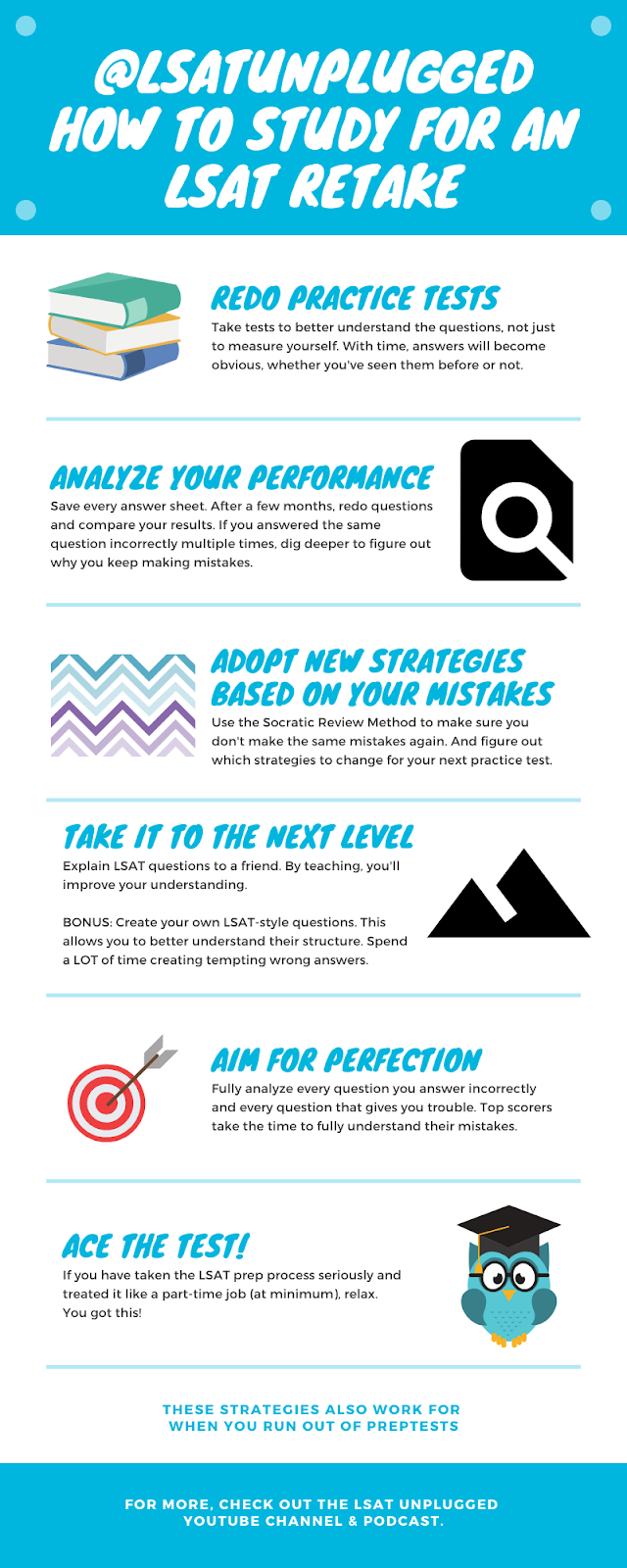
Retaking the LSAT Study Schedule

Also check out my other sample LSAT study schedules and plans.

So, you're planning to retake the LSAT.

It's incredibly important to figure out what you did wrong the first time around and plan what you'll do differently this time.

Maybe you didn't have enough time to study for the LSAT. Maybe you just didn't use it wisely. I recommend a minimum of 3 months.

It could be you didn't use the right prep books.

Maybe you didn't spend enough time on a certain section. Maybe your approach just wasn't flexible enough.

The biggest concern students have is "there aren't enough PrepTests" and/or they've "already used up too many PrepTests." There are more than 60 PrepTests.

Of course, having to resort to the older exams and having to redo newer ones isn't ideal, but it shouldn't be a major concern.

This blog post will help you figure out to move forward as you prepare for an LSAT retake.

Blog reader Whitney writes:
"[M[y concern is whether I need to do question type practice or just simply do more full length and section practice."
Ideally, you'll do a mix of practicing specific question-types and doing full-length sections. You'll end with full-length exam practice.

The real issue is figuring out what went wrong the first time around and using that info as you plan your retake schedule.

If you aren't having difficulty with a specific type of question, then full-length section/exam practice is all you need.

However, this situation is rare - most people have more difficulty with some question-types than others.

This means you'll probably need to "Drill, baby, drill."

If you didn't cancel your most recent LSAT score, review that exam and make a list of the question-types you answered incorrectly and/or that gave you difficulty.

If you did cancel it, do a few full exams (untimed) to determine question-types that give you difficulty.

If there were relatively few types that gave you difficulty, you might just want to spend a week or two drilling those types and then move onto doing a practice test or two each week.

The following 3-month retake schedule assumes you already did most/all of what I recommend in my LSAT study schedules for first-timers. If you did little or none of the things contained in those schedules, use those instead.

This schedule also assumes there are 4 Logical Reasoning question-types that give you difficulty and at least two types of Logic Games that gives you difficulty. Finally, it assumes you've already seen/used some or all of PrepTests 29-60 in your prep the first time around.

Feel free to alter this schedule according to your needs.

PrepTests 29-38 are in The Next 10 Actual, Official LSAT PrepTests. All exams after PrepTest 38 are sold individually. They're all listed in the Best LSAT Prep Books post.

Here's an example of one way you might analyze a Logical Reasoning question in more detail.


Week 1: Study my blog posts on Logical Reasoning. Do several dozen questions of that type (untimed) using the LSAT Logical Reasoning spreadsheet (from exams you've never touched, if any) from PrepTests 29-43 and/or from Grouped by Question Type. Review all questions that give you difficulty and write explanations for why each wrong answer choice is wrong and why the right answer choice is right. Before beginning the relevant question type, also consider completing the appropriate Logical Reasoning Bible chapter on that game type.

Week 2: Do the same with another type.

Week 3: Do the same with another type.

Week 4: Do the same with another type.

Week 5: Study my relevant blog posts on Logic Games and complete portions of this list of Logic Games from PrepTests 29-38 on a particular game type giving you difficulty. Do several games of that type (untimed) from PrepTests 29-44 using my Logic Games categorizations and/or Grouped by Game Type. Create diagrams to disprove each incorrect answer choice and prove why the correct answer choice is right. Before beginning the relevant game type, also consider completing the appropriate Logic Games Bible chapter on that game type.

Week 6: Do the same with another type.

Week 7: Do the same with another type, or read my blog posts on Reading Comprehension and do several timed sections of Reading Comp from PrepTests 29-44 and/or Grouped by Passage Type.

Week 8: Complete PrepTests 45, 46, and 47 as timed 4-section exams. Review all wrong answers and write out explanations for them.

Week 9: Complete PrepTests 49, 50, and 51 (splicing in sections from 48) timed. Review all wrong answers and write out explanations for them.

Week 10: Complete PrepTests 52, 53, and 54 (splicing in sections from the June 2007 LSAT (PDF)) timed. Review all wrong answers and write out explanations for them.

Week 11: Complete PrepTests 56, 57, and 58 (splicing in sections from 55) timed. Review all wrong answers and write out explanations for them.

Week 12: Complete PrepTests 60, 61, and 62 (not yet available) (splicing in sections from PrepTest 59) timed. Review all wrong answers and write out explanations for them.


Weeks 9-12 should include 5 and 6 section exams (alternating) to simulate as experimental sections. See Preparing for the Experimental Section for why, where, and how to include "experimental" sections.


I know this schedule will include exams you've already done. Remember, I said I'm assuming you already used the newer PrepTests the first time around. That's okay.

Your goal shouldn't always be to get an accurate gauge of your progress. No one (except maybe your parents) is going to give you a prize for how you do on a practice exam. The real thing is all that matters in the end.

Even if you've already done these exams (and remember them well) will you really remember all the answers? If you really think you will, do a previously-taken exam or two under timed conditions. Just see if you get perfect scores on them. If you don't, it means you still have something to learn from them.

Besides, doing them in chronological/numerical order puts at least a few months between you and any particular exam. This means if/when you answer questions correctly, it's more likely this will be due to your understanding of the questions's logic rather than your memory.

If you're really concerned about remembering them, substitute those for exams you've never seen before (see the list of all LSAT PrepTests).

However, it's important to redo the newer PrepTests to ensure that you fully understand them because the LSAT changes over time.

Good luck!
Continue Reading...»

New LSAT Reading Comprehension Tips

LSAT Blog New Reading Comprehension TipsSeems like everyone wants more help on LSAT Reading Comprehension these days, so here are some loosely-related thoughts on how to approach Reading Comp.

What to focus on
I like to think of Reading Comprehension passages as big "point at issue" questions like the ones you find in Logical Reasoning.

Comparative reading passages are the most explicit examples of this. You want to be aware of the opinions each passage expresses. Most importantly, look for areas where there's overlap between the two.

In the non-comparative (regular) reading comp passages, look carefully for any opinions expressed by individuals. If you see an opinion without an "advocate," it's the passage author's opinion.

Again, focus on the viewpoints and speakers, not the details (evidence). The LSAT isn't expecting you to remember everything, and it certainly isn't expecting you to memorize what a Koch curve is or how it's created (June 09 LSAT - PrepTest 57, RC Passage #4). It's simply expecting you to remember where in the passage you can find that info if you need to return to it.

In law school, you'll have to get through hundreds of pages a week on boring topics. This is why LSAT passages tend to be on obscure and mostly-uninteresting topics. Your job is to convince yourself that it's interesting and that you care about whatever point at issue or difference of opinion is expressed in the passage.


Identifying viewpoints
Although reading comprehension's grown more unpredictable on recent exams, there are some common RC structures you might see. This is especially true for natural science and social science passages.

Here's one common RC structure (although there are many others):

"In the past, a discussion has generally been limited to one thing, but new research, evidence, or studies have sparked new debate over the issue of X."

Alternatively, the same structure might look like this:

"People used to think things were one way, but new evidence suggests things are actually another way."

The old way of discussing, viewing, or theorizing about something is viewpoint 1.

The new way of thinking about this issue is viewpoint 2.

PrepTest 29, Section 2, Questions 16-21 (page 28 in The Next 10 Actual, Official LSAT PrepTests)
Natural Sciences Example

Old way: Bohringer's finding (Lines 18-20) - Viewpoint 1
New way: Scheich's studies (Lines 4-8, 29-41 and 54-56) - Viewpoint 2


PrepTest 29, Section 2, Questions 22-27 (p30 in Next 10) -
Social Sciences Example


Old way: Most scholars' lack of interest in how medieval law actually affected women (Lines 11-14) - Viewpoint 1
New way: Interest in how the law actually affected women, and what's necessary to study that (Lines 16-28, but especially 25-28) - Viewpoint 2


Summarizing viewpoints
One way I stay engaged and keep track of viewpoints is to reduce them to a core word or phrase. Why?

Because sometimes they'll say, "Some scholars believe X, while other scholars believe Y."

I'd call them the X-ists and the Y-ists.

Example: PrepTest 22, Section 1, Passage 4, Questions 22-26 (p124 in 10 More Actual, Official LSAT PrepTests)

Lines 18-24 of this passage give us the core of the argument:
The debate centers around whether language corresponds in some essential way to objects and behaviors...or...whether the relationship between language and things is purely a matter of agreed-upon conventions, making knowledge tenuous, relative, and inexact.
I'd mark "V1" and "V2" in the margin (to the left) of the words "essential" and "convention," respectively.

One group believes language has an essential meaning, and the other group believes its meaning is conventional/relative.

Throughout the passage, I'd mentally call the viewpoints "essentialist" and "conventionalist," and I'd mentally call the groups in the debate the "essentialists" and the "conventionalists."

This concise summary of the viewpoints allows us to place just about every piece of information in this passage into one of these two groups.


PrepTest 31, Section 4, Passage 4, Questions 21-28 (p102 in Next 10)

In this one, the passage even gives us names for the groups in lines 37-38 - "subjectivists and objectivists." Use these names to make the reading easier for you. YOu'll now be able to go back and note in the margins where evidence for each viewpoint appears.


Red herrings
Most passages start by jumping into the main topic they're actually about. However, a few begin with a topic that is unrelated to the topic that the passage is actually about. I suspect LSAC does this with the goal of tricking those who want to save their least-favorite topic or type (natural science, social science, law, and humanities) for last. Don't be fooled!

Examples:

The essentialist/conventionalist passage in PrepTest 22 starts with a paragraph about math.

PrepTest 35, Section 2, Passage 3, Questions 15-20 (p332 in Next 10) starts with a paragraph about "philosophers of science" while the passage itself is more concerned with biologists.

Photo by prawnwarp / CC BY-NC-SA 2.0
(FYI, that photo depicts our friend de Saussure.) Continue Reading...»