* Funny and absurd lawyer commercials. [LSAT Blog]
* LSAT-themed Bingo is fun for the whole family. [LSAT Blog]
* What do old people think about the LSAT? [LSAT Blog]
* In which I analyze two spam emails for the soundness of their arguments. [LSAT Blog]
* Did you know the LSAT is also administered in India? [LSAT Blog]
* Stephen Colbert commits logical fallacies. [LSAT Blog]
* Elle Woods gets a 179 on the LSAT and is accepted to Harvard Law. This could be you. [LSAT Blog]

February LSAT Score Release Dates
 The February 2011 LSAT scores / results are scheduled to be released via email by March 7, 2011. However, LSAC generally releases LSAT scores the Friday before.
Let's look at the trend over the past several years (click to enlarge):

(Contrary to expectations, February 2010 LSAT scores were released Saturday, February 27, 2010. This may be due to the East Coast snowstorm that closed LSAC's offices on Friday, 2/26/10.)
It seems pretty likely that February 2011 LSAT scores will be released on Friday, March 4, 2011.
"But at what time specifically? I need to know when to constantly refresh my email / LSAC account!"
In batches over the course of several hours. Likely starting late in the day (Eastern Time).
No one knows how the batches are organized, if at all.
The batches do not seem to be organized in any of these ways:
alphabetical/regional/high-to-low scores/low-to-high scores/test center #, etc.
Wish everyone all the best!
***
See other LSAT score release dates posts.
***
While you're waiting for your score, get busy with my Law School Admissions Book Recommendations list and other admissions-related blog posts.
Feel free to leave comments and vent at the injustice of having to wait so long for what is rightfully yours.
Finally, here's Victory Baby, in case you prefer him to the other baby for your Facebook profile photo or something:

LSAT Diary: Supernatural Wasps
 This installment of LSAT Diaries comes from Caleb, who scored a 171 on the December LSAT, a 10-point increase from his October LSAT score! Caleb's one of my favorite blog readers and an excellent writer, too.
(He's the man behind the Logic Game about seagulls.)
Even if you don't always read LSAT Diaries, be sure to take a look at Caleb's below. It's funny. And he'll probably respond to all of your comments.
If you want to be in LSAT Diaries, please email me at LSATUnplugged@gmail.com. (You can be in LSAT Diaries whether you've taken the exam already or not.)
Thanks to Caleb for sharing his experience and advice, and please leave your questions for him below in the comments!
Caleb's LSAT Diary:
I hate wasps. They are literally the crappiest of all God's creatures. I have thrown babies and old women out of the way as I run shrieking away from a single wasp. I'm a grown man who has gone skydiving, yet I'm afraid of wasps. Weird.
I set aside a little area in my house for full practice tests every Saturday. It was a calm and peaceful area, surrounded on three walls by 6-foot windows. A room that had never, ever seen a single wasp. Until my first practice test leading up to the October LSAT.
During my first PrepTest I glanced up at my analog watch to see how I was doing on time and I felt something hit my head and fall off. I looked on the table and there it was - Waspzilla. Staring at me. Almost like he had a message, but his only communication was a slight twitch of his antennae. I freaked out, mashed him with my "10 official LSAT" book, and finished the test with shaking hands. I gave myself an extra 1 minute to compensate, but I still did lower than average on that particular section.
Everyone laughed when I told them this story, and thought it was strange that a single wasp would attack me on the day of my first full PT. Well, the next Saturday rolled around and guess what? Another test, another wasp. True story. This one was in the window and harder to see, but I'm sure he was looking at me just like the first one. Dumbfounded, I ran to my garage to get one of my (many) cans of Raid and sprayed him down. Then I checked to see if the corpse of last week's wasp was still around, just to make sure I wasn't dealing with a zombie-wasp. Nope- there it was. 2 separate wasps. This was getting weird.
I won't over-dramatize the next 6 weeks, but I promise you that there was a single wasp somewhere in my test room every Saturday for 6 weeks. At first it was frightening, then hilarious, and finally I became suspicious that it had to more than a mere coincidence. What was the message? What was the universe trying to tell me? As test day approached I received a lot of messages on Facebook from people wondering what the wasps were going to do for test day. Obviously I wasn't going to be home taking a practice test that Saturday so if they were going to make their move it would have to be Friday night. I spoke on the phone about this to a lady-friend the Friday night before the October test and made a decision:
"If I score a 180, I'm going to renounce my wasp-hating forever and never kill another wasp. If I score below my 170 average, I'm going to redouble my efforts to slaughter them mercilessly."
As my friend laughed, I swear to everything sacred that a wasp flew at my face. RIGHT at my face. I have a witness to this, as the girl I was talking to heard me throw the phone down, scream, run around, and then tell her all about it. It was at this point that things went from "coincidentally creepy" to "downright f*cking supernatural." In my 2 years living at my house, I had probably only ever seen 2 wasps other than my LSAT wasps. I just don't allow them around. I spray my entire house, yard, and windows down with several cans of Raid at least twice a year. Mathematically it just wasn't possible for me to see a single wasp every week for 2 months. No way. Though every wasp so far had stared at me or attacked me, I took it as a sign that my test was going to go great.
I took the test and felt very wasp-confident. My preparation had included over 25 full PTs, many other sections done individually, analysis of every question ever missed, online resources (shout-out to Steve's blog!), and timed tests done under exact test-day procedures. I left the test as confident as I had ever been. I realistically expected around my average of 170, but hoped for a game-day boost to 175+. Four weeks later I received my score... 161.
Son-of-a-b*tching wasps!!
Let me clarify: after studying diligently for months and raising my average to the 98% level, my actual score was as bad as the very first test I took. With no explanation (well, no explanation that didn't involve supernatural wasps).
I think I hid my disappointment so well because it was hidden beneath a massive layer of genuine shock. I didn't want to complain and say my score was bad- it wasn't- but it sucked because it surely didn't reflect all of my hard work. So I vowed to retake it.
I spent the time between October and December with a much lighter study schedule. I knew I had it already; I just had to sharpen the edges and practice some of the newer tests. The greatest day of my LSAT career came when I took PT 54 and missed 3. A 179. And that, ladies and gentlemen, included an extra 5th section from another test where I didn't miss any! I was on a roll and had no idea why I was scoring so high on PTs. Then it hit me- I had taken every PT since October at my desk at work instead of my wasp den at home. What? Couldn't be. What the heck was going on here?
I took the test in December, still wasp-free, and scored a 171. That's right about my average, which is great, and certainly enough to be competitive at top schools. But now I'm done... no more studying, no more PTs. And you know what? I miss it. I miss the drive, the focus, and the self-efficacy you gain by watching your scores steadily improve. I even still have my excel spreadsheet with all my test scores!
The study tips that Steve puts on this site are spot-on. The LSAT book recommendations are great and I would agree with 95% of them. If you read through other LSAT Diaries and some of Steve's articles you can find the nuts-and-bolts of effective studying. I could tell you tips like "do a logic game or two every day" but I feel like I would just be re-hashing old advice. What I can offer you is the wisdom imparted to me from the world's nastiest creatures.
When I got my 161 I was shocked and couldn't come up with a non-wasp explanation. I was ashamed, disheartened, and defensive. I felt like I had let myself- and my friends and family- down. I had failed. Then it hit me: I was basing my opinion of myself on my test score. I was becoming my LSAT score. One of the simplest of life's lessons had eluded me and I was equating my self-worth with some stupid test. Some thing outside of myself. This sudden realization helped me let go of the need to be perfect, de-stress, and take LSAT studying on my terms. My last 3 PTs before the December test were 170, 175, and 179. I even finished one logic game in under 4 minutes. And, more importantly, I had more fun.
Maybe this is what the wasps were telling me. Maybe they were guru-wasps that were letting me know that it was my efforts, not my test score, that were a reflection on me. That, in the end, the LSAT was more for me than for any law school.
Or maybe they just didn't know where I worked and I'm going to have to kill them all.
Regardless, I wish all of you the best luck in your studies. Give yourself enough time, stay consistent, and always correct your mistakes. Even if you have to complain about a single LR question to anyone who will listen for days until you get it, make sure you understand every missed question. Above all, relax: you're not your test score.
And please, if you see a wasp, smash him and tell him "Caleb says hi!"
Thanks, Steve!
Caleb the Wasp-Killer
P.S. If you want any of my specific LSAT study tips, check out my blog.
LSAT Numbers: All, Most, Several, Many, Some, None
 Isn't it annoying when words seem to mean something different on the LSAT than they do in real life?
Starts to make you wonder about the last time an LSAT test-writer spoke with a live human being.
In this post, I clear up some of the differences between our normal understandings of common quantifiers (words that indicate the number of something) and the way the LSAT uses them.
***
All
The word "all" isn't one of the confusion-causing words, but let's cover it anyway.
Let's suppose I've got 100 chocolate-chip cookies in a box, and, by the time I finish writing this blog post, I've eaten every single one of them (writing works up an appetite, don't judge). Then, I can say with certainty, "ALL the cookies in that box were deliciously fattening."
All = 100%
Most / Majority
Let's suppose I've exercised a bit of restraint and only eaten 99 of them (I'll eat the remaining one after the February 2011 LSAT.) I can then say with certainty, "Most of the cookies in that box were finger-lickin good." I can say "most" because I've eaten a majority of them. However, until I eat the remaining one, I won't be able to tell you whether all of them were good or not, because I haven't thoroughly, ummm, "examined" each one.
As such, it's entirely possible that all of them are good, so when I say that most of them are good, we still have to allow for the possibly that all of them will be good. This is why the word "most" allows for the possibility of all.
(The same would be true if I ate 50 cookies and then took just a tiny nibble of the 51st, because I'd then be over the halfway point. At that point, I can say that a majority are good, but it's still possible that all are.)
In everyday speech, when we say things like "most of that movie was pretty good" and "most of that meal was delicious" there's an implicit (assumed) meaning that not all of it was good.
If we wanted to speak literally all of the time, we'd say things like, "most, but not all, of that movie was good. I found the ending rather elementary, old chap" or "while the majority of my dinner was delectable, the crème brûlée was a bit overdone."
However, we don't always elaborate at the outset, because then I'd have to punch you in the face for speaking like Sherlock Holmes and complaining about your fancy crème brûlée. Instead, for purposes of simplicity, we usually just emphasize the words "most" and "majority," and the other person usually asks us which parts we didn't like.
If we wanted to take those everyday sentences, with their everyday meanings, but give them just a small dose of literalism, we'd say, "most, but not all, of that movie was pretty good" and "most, but not all, of that meal was delicious."
Without the "but not all", when I hear you say, "most of that movie was pretty good", it's possible that you're simply just-over-halfway through the movie and think everything so far is good
Most / Majority = A range from 1/2 of total + 1 (or 1/2 plus the smallest possible unit that can be broken off, like a cookie crumb) - 100%
For purposes of simplicity, we might just think of it as 51% - 100%.
Several / Many
If I told you that I have a box of a 100 chocolate-chip cookies, I confirmed that several of them are tasty, you wouldn't truly know how many I ate, or how many of them are actually tasty.
"Several" and "many" refer to some kind of sizable (and plural) number, so we know it's more than one or two, but how many exactly? It's impossible to say. This is an indeterminate number. Like most/majority, it allows the possibility of all.
Several / Many = a range of more than 2 - all the way up to 100%
For purposes of simplicity, we can think of it as 3 - 100% or 3 - all.
Some
Let's suppose I catch you stuffing your face with cookies from that 100-cookie box. I ask, "How many did you eat?" You reply, ""Some..."
Vague, right? Maybe you ate only 1, or maybe you had 5, 10, 49, 75, 99, or 100. Without more information, we don't know just how many you ate.
Like the many/majority example, making a claim regarding "some" does not exclude the possibility that "all" have that characteristic, whether it's with regard to how many of them were delicious or just how many were eaten.
In order to know that you hadn't eaten all the cookies, you would've needed to specifically claim that you had eaten "some, but not all", so I'll know that there's still at least 1 cookie remaining for me to eat.
Some = a range from 1 - all the way up to 100%
For purposes of simplicity, we can think of it as 1 - 100% or 1 - all.
None
The word "none" isn't one of the confusion-causing words, but let's cover it anyway.
Let's suppose I've got a new box with 100 chocolate-chip cookies, but I now have a stomachache from eating all the cookies in the previous examples. I can't even bear to look at this new box of cookies without thinking about how I'll soon be another number in the oft-cited statistics about America's obesity epidemic.
So, I take the box of cookies and donate it to the homeless guy on the street corner (a questionable donation, I know, but I didn't think he'd want kale).
How many cookies did I eat from that box? None. Zero. Zilch. Nada. How many of the cookies in that box can I say are delicious with absolute certainty? I don't know. Maybe they're stale, and the homeless guy will get pissed at me.
None = 0%
***
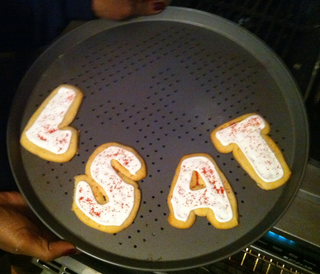
Photo by Lisa W.
Taking the February 2011 LSAT? Good luck!
 February 2011 LSAT-takers, good luck to you all!
Lisa writes:
Thanks for the blog and all of the valuable information. I've made considerable progress with your help. The LSAT took over my life for several months and now that I can see the light at the end of the tunnel, I made these cookies last night. Wish I could share them with everyone taking the test on Saturday. Good luck to everyone.Lisa, I wish we could all eat them, too!
They look delicious, and I think most of us would find it deeply satisfying to eat the LSAT.
Tried it with LSAT PrepTests before, but I think your cookies would taste better.
***
Here are some tips about LSAT Test Day.
Logic and Games
* Worst Valentine's Day gifts ever. [Yahoo Shine]
* Webcomic depicting an entire museum dedicated to deceiving children for amusement. [xkcd]
* My favorite 2011 Super Bowl commercial features more deception of children for amusement. [YouTube]
* Flowchart helps you decide whether to comment on your acquaintance's Facebook status. [MSNBC]
* The debate about whether to make the LSAT optional at 4th-tier law schools continues, but decent law schools still want to use it.
* How cyberactivists planted seeds for Egypt uprising over the past few years. [Foreign Policy]
* On-the-go confessions available with the Catholic Church's new iPhone app. [CNN]
* Fox News posts job ad seeking climate change skeptics. Any takers? [Huffington Post]
* Is it time to start investing in scratch lottery tickets (and befriending math geniuses)? [Wired]
* Debate over free speech prosecution on a college campus related to Israel/Palestine issue. I wonder if anyone has an opinion on this... [NYTimes]
* Webcomic depicting an entire museum dedicated to deceiving children for amusement. [xkcd]
* My favorite 2011 Super Bowl commercial features more deception of children for amusement. [YouTube]
* Flowchart helps you decide whether to comment on your acquaintance's Facebook status. [MSNBC]
* The debate about whether to make the LSAT optional at 4th-tier law schools continues, but decent law schools still want to use it.
* How cyberactivists planted seeds for Egypt uprising over the past few years. [Foreign Policy]
* On-the-go confessions available with the Catholic Church's new iPhone app. [CNN]
* Fox News posts job ad seeking climate change skeptics. Any takers? [Huffington Post]
* Is it time to start investing in scratch lottery tickets (and befriending math geniuses)? [Wired]
* Debate over free speech prosecution on a college campus related to Israel/Palestine issue. I wonder if anyone has an opinion on this... [NYTimes]
LSAT Test Day Clothing: What NOT To Wear
It's often been said that the similarities between LSAT Blog and The Sartorialist are uncanny. After all, I write about the LSAT, and he takes photos of stylish people.
So, I wasn't at all surprised when a blog reader recently asked me what to wear on Test Day.
My thoughts:
-Formalwear
Pros: You can boost your self-esteem by dressing in formal clothing. Feeling good about yourself is important when performing difficult tasks.
Cons: Formalwear can be constricting, which might slow you down and make you uncomfortable. Also, no one likes that guy/gal, so they'll beat you up as soon as the test is over.
Protip: Don't wear a suit or evening gown to take a standardized test. Just don't.
-Homeless Chic
Pro: You'll distract other test-takers with how disgusting you look (and smell, if you really go all-out). Which is kind of funny, if you're an asshole.
Con: They'll beat you up as soon as the test is over.
Protip: As a general rule of thumb, if you dress in rags, you won't have many friends --- unless you're filthy rich. It's nasty, so don't do it.
-Casualwear
Pros: Just about everything.
Cons: You won't be asked to model.
Protip: Wear casual, comfortable clothing. Your favorite t-shirt, sweatshirt, jeans, and sneakers work well. If you're a girl (or like to dress like one), you can also go the Juicy sweatpants route. You don't know whether the test center will be hot or cold, so layers are a good idea. Don't bring a hoodie, though. Test Day rules prohibit them.
More LSAT Test Day Dos and Donts here ----->
So, I wasn't at all surprised when a blog reader recently asked me what to wear on Test Day.
My thoughts:
-Formalwear
Pros: You can boost your self-esteem by dressing in formal clothing. Feeling good about yourself is important when performing difficult tasks.
Cons: Formalwear can be constricting, which might slow you down and make you uncomfortable. Also, no one likes that guy/gal, so they'll beat you up as soon as the test is over.
Protip: Don't wear a suit or evening gown to take a standardized test. Just don't.
-Homeless Chic
Pro: You'll distract other test-takers with how disgusting you look (and smell, if you really go all-out). Which is kind of funny, if you're an asshole.
Con: They'll beat you up as soon as the test is over.
Protip: As a general rule of thumb, if you dress in rags, you won't have many friends --- unless you're filthy rich. It's nasty, so don't do it.
-Casualwear
Pros: Just about everything.
Cons: You won't be asked to model.
Protip: Wear casual, comfortable clothing. Your favorite t-shirt, sweatshirt, jeans, and sneakers work well. If you're a girl (or like to dress like one), you can also go the Juicy sweatpants route. You don't know whether the test center will be hot or cold, so layers are a good idea. Don't bring a hoodie, though. Test Day rules prohibit them.
More LSAT Test Day Dos and Donts here ----->
LSAT Diary: Prep Success Story
 This installment of LSAT Diaries comes from Jay, who followed one of my LSAT study schedules and scored a 177!
If you want to be in LSAT Diaries, please email me at LSATUnplugged@gmail.com. (You can be in LSAT Diaries whether you've taken the exam already or not.)
Jay's LSAT Diary:
When I first started studying for the LSAT, I didn’t know anything about it. I heard from a friend that the LSAT Blog told you exactly which books to buy and gave you a plan, so I decided to check it out. Sure enough, I found Steve’s posts about all the bad books out there that you shouldn’t buy, and I felt like I was in on a secret. I know if I had just gone to the bookstore I probably would have bought Kaplan or Barron’s because that's what the bookstores have on the shelves.
Anyway, I ordered all of the books and PrepTests the blog recommended and I started the 3 month study schedule. I actually enjoyed LSAT studying much more than doing my homework, and on the weekends I would regularly stay up until 3 am with my LSAT books rather than going to fun parties (I know, I’m a nerd).
After that I started taking timed practice tests. Finishing in time was something I needed to work on, especially with the logic games section. At first I was only finishing three of the four games in time. But I worked on doing things faster; I practiced making the initial diagram for a linear game in a much shorter amount of time so I'd have more time to think. Eventually I was able to consistently finish all of the logic games in 35 minutes, many times not missing any logic games questions.
There are a few things that I think helped me with the LSAT. One was that I had taken a math class which involved lots of logic, so I was already pretty familiar with conditional statements and their contra-positives. In addition I had a strategy which I felt helped me on the test; I didn’t always read the answer choices in the order that the test makers expected me to.
Sometimes I read them backwards: E, D, C, B, and A. Sometimes I read them in a different order, like E, C, A, B, and D. I felt like randomizing the order that I read the answer choices allowed me to sidestep some traps and be able to eliminate answer choices more quickly. Finally, when it got down to the last few days before the test, I was nervous but I also felt ready. I got in the zone and felt like I was off to battle, with all the tools that I needed to succeed.
The last thing that helped me on the LSAT was reading a post about someone else’s experience with an earlier administration of the test. He said that when he got out of the test he thought that it was much harder than any of the practice tests he had taken. But later, when he got his score, he looked at the test again and realized that it was no different than any of the other PrepTests he had taken.
Indeed, all of those tests had been administered in the past and the only difference between taking those PrepTests and taking the real thing was the testing environment. The last few days before the test, I kept in my mind an image of the December 2010 LSAT being republished as a preptest in the future. I kept thinking to myself that the test I would be taking was no different than the 13 preptests I had taken before it. I knew that if I panicked during the test it was probably my mind tricking itself and not due to the difficulty of the test. In the end, I scored a 177, 7 points higher than my average for the PrepTests I had taken. At first I was surprised that I had made such a high score, but in hindsight I realize that I had done a huge amount of preparation. I feel lucky to have gotten a score so much higher than my average, but as many people have said: “Luck comes to those who are prepared”.
Photo by sully_aka__wstera2
LSAT PrepTest 43 / June 2004 LSAT - Funny Review
 I came across this funny review of LSAT PrepTest 43 (the June 2004 LSAT) on Amazon and thought you guys would get a kick out of it:
In contrast to The Official LSAT PrepTest 42, which started in such a strong and entertaining fashion, only to peter out midway through, and this title's sequel The Official LSAT PrepTest 44, which lacks the focused coherence that makes the best titles of this series without peer, The Official LSAT PrepTest 43 manages to get everything just right.
Other reviewers may disagree, but I think this could well be the most exciting book of the series --- even better perhaps than the seminal The Official LSAT PrepTest 18, which most admirers of this collection have long held as the most outstanding volume of PrepTest yet assembled, not just for the LSAT, but for any aptitude test in any field.
I can't speak highly enough of The Official LSAT PrepTest 43. It's a marvelous, life-changing PrepTest guide.
LSAT Grouped by Reading Comprehension Passages Book (More)
 For those of you who intend to complete every LSAT Reading Comp Passage ever published, there's a book for you. It's called:
More Grouped by Passage Type: LSAT Reading Comprehension- The Complete Collection of Actual, Official Reading Comprehension Passages from PrepTests 21-40
This book is incredibly useful for two major reasons (which the title makes obvious):
Reason #1: It compiles all the passages from PrepTests 21-40 for you in one book. This allows you to avoid getting 10 More Actual Official LSAT PrepTests (exams 19-28), Next 10 Actual, Official LSAT PrepTests (exams 29-38), and PrepTests 39 and 40 if you would've wanted any of those books/exams only for their Logical Reasoning questions.
Reason #2: It organizes Reading Comp passages by passage topic, rather than putting them in order by PrepTest (as the traditional books of PrepTests from LSAC do). It divides them into different "chapters" based upon the type of passage. Because these are not from the newest exams (they're from December 1996 - June 2003), you may want to complete those exams in pieces anyway, rather than as full timed exams.
While this book is a great concept, it may not be for you simply because you'll probably want to complete all of the Logic Games and Reading Comprehension sections in 29-38 anyway, or because you may want to use some of these exams for full timed sections.
Reading Comp Passage Categorization
Most prep companies simply divide passages into 4 major categories:
Natural Science, Social Science, Humanities, and Law
I find that breakdown a bit too simple, so I've done my own categorization of every Reading Comp passage from every LSAT PrepTest.
The categorization of passages in More GROUPED by Passage Type is somewhat similar to mine, only the categories are slightly broader since it's limited to PrepTests 21-40. (Because there are 4 passages per exam, you get 80 passages altogether.)
I'm listing the book's chapters so you can see the types of categories it uses:
Humanities
-Art
-Literature
-Music & Poetry
Social Sciences
-Economics
-History
-Linguistics
-Racial Minorities
-Women
Biological & Physical Sciences
-Biology
-Earth & Space
-Scientific Theories
-Species
-Technology
Issues Related To The Law
-Legal System
-Legal Theory
-Legislation
***
Who should use this book:
Most test-takers won't find this book necessary. However, anyone who intends to focus specifically on LSAT Reading Comprehension questions by type in exams 21-40 without doing those exams' Logic Games/Logical Reasoning questions (or just wants less to carry around!) will find this book worthwhile and convenient.
***
Also see GROUPED by Question Type and GROUPED by Game Type.
Columbia Undergraduate Law Review: Call for Submissions
I just received the below announcement from the Columbia Undergraduate Law Review, which is seeking submissions ASAP for its Spring 2011 issue. You don't have to be a Columbia student to submit - you can be a student anywhere in the world, and you can re-use papers from your undergraduate courses.
This is a great way to get published and to add a few extra lines to your resume. You can email culr@columbia.edu with your submissions.
Details:
The Columbia Undergraduate Law Review, a journal of undergraduate legal scholarship based at Columbia University in the City of New York, is accepting submissions for its Spring 2011 issue. The deadline for submissions is Monday, February 7, 2011 at 11:59 p.m, Eastern Time.
In recognition of the various paths undergraduates may take to study law, we welcome submission of research articles, senior theses, and essays embracing a wide range of topics and viewpoints related to the field of law. Undergraduate students in any major, track, or class year should thus feel free to send us their work. Check out www.culr.weebly.com to view past journals or to read our mission statement.
Submissions should be double-spaced in Microsoft Word .doc format, follow the Chicago style, and include endnotes. Although we will consider submissions of any length, most papers published in the journal range from 20 to 25 pages. It would be highly appreciated if longer papers could be shortened to fit this page length recommendation before submission. In the document please also include the following information:
1) Your name
2) Current email address and phone number
3) Undergraduate college/university
4) Class year
5) Title
6) 250-word abstract
7) Short explanation of when and why paper was initially written
Sincerely,
The Columbia Undergraduate Law Review
This is a great way to get published and to add a few extra lines to your resume. You can email culr@columbia.edu with your submissions.
Details:
The Columbia Undergraduate Law Review, a journal of undergraduate legal scholarship based at Columbia University in the City of New York, is accepting submissions for its Spring 2011 issue. The deadline for submissions is Monday, February 7, 2011 at 11:59 p.m, Eastern Time.
In recognition of the various paths undergraduates may take to study law, we welcome submission of research articles, senior theses, and essays embracing a wide range of topics and viewpoints related to the field of law. Undergraduate students in any major, track, or class year should thus feel free to send us their work. Check out www.culr.weebly.com to view past journals or to read our mission statement.
Submissions should be double-spaced in Microsoft Word .doc format, follow the Chicago style, and include endnotes. Although we will consider submissions of any length, most papers published in the journal range from 20 to 25 pages. It would be highly appreciated if longer papers could be shortened to fit this page length recommendation before submission. In the document please also include the following information:
1) Your name
2) Current email address and phone number
3) Undergraduate college/university
4) Class year
5) Title
6) 250-word abstract
7) Short explanation of when and why paper was initially written
Sincerely,
The Columbia Undergraduate Law Review
Logic and Games, YouTube Edition
* Cold weather got you down? Will Smith's had a solution for you since 1998. [YouTube]
* Katie Couric and Bryant Gumbel don't know what "Internet" is, but try to explain it in this 1994 clip. [YouTube]
* Stick-up man Omar Little disses criminal defense attorney Maurice Levy in The Wire (start at 6:48). [YouTube]
* Funny video promotes online dating for sea captains and the ladies who love them. [YouTube]
* Daredevils explore the subway tunnels, train tracks, and bridges of NYC. [YouTube; NYTimes]
* Abraham Lincoln hunted vampires, and books now have movie trailers. [YouTube; Amazon]
* David Cross and Will Arnett were reunited this past fall in a surprisingly-good TV show, The Increasingly Poor Decisions of Todd Margaret. [YouTube]
* Today Show hosts are good sports about The Onion's hilarious spoofs. [MSNBC]
* Katie Couric and Bryant Gumbel don't know what "Internet" is, but try to explain it in this 1994 clip. [YouTube]
* Stick-up man Omar Little disses criminal defense attorney Maurice Levy in The Wire (start at 6:48). [YouTube]
* Funny video promotes online dating for sea captains and the ladies who love them. [YouTube]
* Daredevils explore the subway tunnels, train tracks, and bridges of NYC. [YouTube; NYTimes]
* Abraham Lincoln hunted vampires, and books now have movie trailers. [YouTube; Amazon]
* David Cross and Will Arnett were reunited this past fall in a surprisingly-good TV show, The Increasingly Poor Decisions of Todd Margaret. [YouTube]
* Today Show hosts are good sports about The Onion's hilarious spoofs. [MSNBC]