* Batman went to Yale Law School. [NYMag]
* Congressman considers invading "Africa" after Libya. [Think Progress]
* Real World congressman apparently needs more than a $174K salary for daily expenses. [Gawker]
* Some sardonic brain teasers. [Thought Catalog]
* Using logical reasoning on an awful first date. [Persephone]
LSAT PrepTest Explanation PDFs Available for Instant Download
LSAC doesn't provide explanations for any of the numbered LSAT PrepTests. LSAT PrepTests are just the questions.
If you want to know why a particular answer choice is wrong, you need to get the explanations separately. On LSAT Blog, you can get PDF explanations for LSAT PrepTests by section (LG, LR, and RC):
If you want to know why a particular answer choice is wrong, you need to get the explanations separately. On LSAT Blog, you can get PDF explanations for LSAT PrepTests by section (LG, LR, and RC):
-Logic Games explanations for the newest PrepTests
-Logic Games explanations for PrepTests 72-81
-Logic Games explanations for PrepTests 62-71
-Logic Games explanations for PrepTests 52-61
-Logic Games explanations for PrepTests 29-38
-Logic Games explanations for PrepTests 19-28
-Logical Reasoning explanations for the newest PrepTests
-Logical Reasoning explanations for PrepTests 72-81
-Logical Reasoning explanations for PrepTests 62-71
-Logical Reasoning explanations for PrepTests 52-61
-Logical Reasoning explanations for PrepTests 44-51
-Logical Reasoning explanations for PrepTests 29-38
-Logical Reasoning explanations for PrepTests 19-28
-Reading Comprehension explanations for the newest PrepTests
-Reading Comprehension explanations for PrepTests 72-81
-Reading Comprehension explanations for PrepTests 62-71
-Reading Comprehension explanations for PrepTests 52-61
-Reading Comprehension explanations for PrepTests 44-51
-Reading Comprehension explanations for PrepTests 29-38
-Reading Comprehension explanations for PrepTests 19-28
-Reading Comprehension explanations for PrepTests 72-81
-Reading Comprehension explanations for PrepTests 62-71
-Reading Comprehension explanations for PrepTests 52-61
-Reading Comprehension explanations for PrepTests 44-51
-Reading Comprehension explanations for PrepTests 29-38
-Reading Comprehension explanations for PrepTests 19-28
LSAT PrepTests
The June 2007 LSAT PDF is the only free LSAT PrepTest PDF available for instant download.
I recommend getting all your other LSAT PrepTests from Amazon. The books of 10 are cheaper than getting them individually (some of the newest are not yet in books of 10, unfortunately).
LSAT PrepTest 80
LSAT PrepTest 79
LSAT PrepTest 78
LSAT PrepTest 77
LSAT PrepTest 76
LSAT PrepTest 75
LSAT PrepTest 74
LSAT PrepTest 73
LSAT PrepTest 72
LSAT PrepTests 62-71
LSAT PrepTests 52-61
LSAT PrepTests 42-51
LSAT PrepTests 29-38
LSAT PrepTests 19-28
LSAT PrepTests 7-18
LSAT SuperPrep (A, B, C)
Official LSAT PT (Feb 1997)

LSAT Crash Course Diary: You Can Do It, But You Shouldn't
 In this LSAT diary, Ricky describes how he retook the LSAT and improved his score by 7 points in just 6 weeks.
If you want to be in LSAT Diaries, please email me at LSATUnplugged@gmail.com. (You can be in LSAT Diaries whether you've taken the exam already or not.)
Thanks to Ricky for sharing his experience and advice, and please leave your questions for him below in the comments!
Ricky's LSAT Diary:
I took the LSAT twice, in December 2010 and then again several weeks ago in February 2011. The first time, I received a 153 and the second time, a 160. A lot of snobs turn the cold shoulder and dismiss anything south of 165. Pay them no mind. Everyone has different goals.
Personally, I take comfort in the fact that out of 100 college-educated people who took the LSAT in February, I did better than 80 of them. Given that, and while I am very happy with my score, and the improvement I posted and can show to law schools, I feel that I am still 5-10 points of where I could be if I did this thing right. However there is little I can do about that now (I need to go to school in the fall). You live and you learn and you can’t change the past, learn from it and move on.
One of the big things I heard about the LSAT before I really dove into it is that you either “got it or you don’t”. This is both right and wrong. For example, a very good friend of mine who is now on a full ride at a top-tier law school (ass), did his undergrad in engineering and just for shits and giggles decided to take the LSAT and got a 172 on his first practice test. I hate him, not really, but I do. I wasn’t so lucky. I thought to myself “Hey, it’s a logic-based test, I’m a logical guy, and usually a good standardized test taker, I got this, no problem.” HA! This is the first of many examples in the next few paragraphs that show me being an idiot.
This fall, I worked as an outdoor education instructor in Texas. While one would assume that a teaching job in outdoor ed would provide ample time for studying, that was not the case. We were short-staffed and overbooked. As a result, 60-hour weeks featuring 2-3 nights and intermittent Saturdays working outside in the Texas sun were the norm. While I’m sure there are some of you who have studied facing similar obstacles, I just could not do it. I registered for the LSAT a week before the deadline, found some study material and bought a book of 10 PrepTests.
In the next weeks, I finished probably 70 pages of the book and maybe a section of a practice test by the time I finished the season in Texas and moved home to start really studying. I had exactly 12 days to L-Day (get it, like D-day but for the L-SAT…hahaha, I don’t care if anyone else laughs, I thought it was funny).
8 days before L-day, I took my first practice test. 148. Shit.
That test just whooped my ass, it shocked me. I’ve been out of school for almost three years; I haven’t had to think like that in a long time. I mean, there is no way they expect me to read those four incredibly dense reading passage filled with paragraph-long sentences about the diet of caveman and how archeologists are using dental fossils to determine what they ate and finish 27 questions in 35 minutes…do they?? I’ve never taken a test that hard before. You know what, whatever; I’ll do much better tomorrow.
The next morning, took it again. 149. Shit.
I still had my sanity and my composure at this point, let’s give it one more try tomorrow. Halfway through my third test in as many days, I cracked. It was the infamous mauve dinosaur logic game that pushed me over the edge. I did not even know where to start on the problem. I didn’t understand how to start, after four or five minutes, I couldn’t even get the first answer. .I stopped working, slammed my fist on the table, hurled my practice test into a wall, and let fly a chain of expletives.
What does this have to do with Law School let alone the practice of the law? Why does this friggin clown have such complicated requirements for how it needs to dress (December 2006 LSAT Logic Game) The average LSAT score is 151, and I couldn’t even get THAT. I was frustrated, terrified, panicked, and angry.
I started looking at this blog a couple of days before the meltdown and mustered the energy to leave the fetal position and email Steve (editor of LSAT Blog) a whiny email explaining the situation and asking for help on a LSAT Hail Mary. He promptly responded with some encouragement and references to a few past posts that helped me out. Soon thereafter, I accepted the fact that I am remarkably stupid for thinking I could beat the test in two weeks and decided to take the test in December as a dress rehearsal. Once I accepted that, I went into the test relaxed. The pressure was off, I was going to retake in February.
The only thing that really threw me off on test day was having to write the “certifying (I won’t cheat) statement” in cursive. What am I in - fourth grade?? Could the LSAT get any more archaic?? I haven’t written anything more than my name in cursive in over a decade. Just stupid. Besides that, it was hard, but I felt alright about it. In early January, got the score back 153….
Time for ROUND 2!
After a few days off, I bought another round of books. I realized that I still put myself at a disadvantage. From everything I read, they said to really improve it takes 3-4 months of studying. I had about a month and some change to go before L-Day Part Two: Ricky strikes back (that’s what I named the second L-day, get it, because its like the 2nd Star Wars movie….whatever, don’t judge me)..
I moved back to my home state, Iowa (God’s country) and started studying the right way. I took Steve's advice and started breaking down my practice tests, grouping the questions and analyzing which ones I needed to improve upon. I used that information, targeted those areas and the scores on my pt’s started to creep into the consistently into the mid 150’s. I stopped any partying (which was pretty difficult while moving back to a college town and working at a bar) and was studying 4-5 hours a day. My scores on LR and RC were drastically improving.
Believe it or not and contrary to popular belief, I think RC might be the easiest area to improve on once you understand how to read the passage and keep track of the points of view. I was still getting my ass kicked by logic games; my mind just doesn’t work like that. I knew I didn’t have enough time to get really strong at those games so I did what I could and I focused on two of the more popular types of games, linear and grouping, and did what I could moving forward. My scores were now around 157-158 consistently and I was starting to feel better. I set my over/under on test day at 157, got it and I would be content, over happy, and under pissed. Bring it.
Luckily, I never have really gotten test day anxiety, and I felt good going in. The test itself is a blur. LR felt harder, until I thought about it and realized that all LR sections, past, present, and future are the same. I got caught spending too much time on one RC passage, but thought I recovered alright, and the games were slightly less awful than usual. There were several people in my testing room that felt the need to have a coughing competition at the end of one section; lsat during flu season is a crap shoot. I felt good, it was over. I went to aforementioned bar and got reacquainted with my friend, Jameson.
Test score came back a month later, 160. I was happy. Here is my advice for all of you:
* Do not cram, you will lose. It can be done in two months with some success, but it shouldn’t be. If I had another month or two to study, I could be several points higher, I’m sure of that.
* Do a ton of practice tests in real conditions, three sections, ten minute break, two sections. Do not deviate from that, no allowing extra time, answering a text, working after the buzzer or taking a bathroom break.
* Get an LSAT study plan from Steve and simplify your life. Know your weak areas and attack them. Understand how/why you got every question wrong.
* Come up with a badass playlist to listen to on L-Day. I chose All I Do Is Win by DJ Khaled, It’s My Time by Fabolous ft. Jeremiah, and Here I Come by The Roots. That stuff gets you jacked!
* Do your research before buying books/signing up for a prep course. Don’t sign up for Kaplan because they have an “improve your score guarantee.” Anyone who is exposed to the test that much is going to improve their score no matter what. It helps for some, but you don’t need a prep course to improve. Use the books but adapt the strategies to fit your strengths. Don’t diagram too much on LG’s, and don’t underline too much in RC. You're wasting time you don’t have.
* Relax on Test Day morning. I know it is easier said than done, but if you’ve done the appropriate prep you will be fine. If you have done PrepTests under the right conditions, nothing is new. The worst thing you can do is freak-out about it, get out of your head and trust yourself. If something throws you off, take a deep breath, close your eyes for a second and move on.
As much as I hate to say this, I do miss studying for the test. You know you’ve crossed an unfortunate plateau when you start laughing at jokes about sufficient and necessary conditions and finding logical flaws in conversations about anything. Love it, or hate it, but if you want to be a lawyer it has to be done. Hit me up in the comments if you got something to say. Try to have fun with it. This video does a good job of running through the gamut of LSAT emotions, particularly how good it feels to be done. Good luck.
Photo by wallyg
Logic and Games
* Worried about law school stress? Yale Law School lets students borrow a "therapy dog" to play with for 30 minutes at a time. [NYTimes]
* Justin Bieber doesn't care whether you love him or hate him, and neither should you. [The Onion]
* Apple sues Amazon for using the term "App Store." [Ars Technica]
* Is The Daily Show a boy's club where women can't participate? [Jezebel]
* There's apparently a regular Nintendo game based on The Great Gatsby, and you can play it online for free. [Great Gatsby Game]
* To truly be happy, buy experiences rather than material goods. [Journal of Consumer Psychology, PDF]
* Rebecca Black's Friday is destroyed by clever satire. [Thought Catalog; imgur]
* An etiquette guide to tsunamis and other disasters. [Gizmodo]
* Rainn Wilson (Dwight from The Office) is a pathetically-funny superhero in this movie trailer. [YouTube]
* Justin Bieber doesn't care whether you love him or hate him, and neither should you. [The Onion]
* Apple sues Amazon for using the term "App Store." [Ars Technica]
* Is The Daily Show a boy's club where women can't participate? [Jezebel]
* There's apparently a regular Nintendo game based on The Great Gatsby, and you can play it online for free. [Great Gatsby Game]
* To truly be happy, buy experiences rather than material goods. [Journal of Consumer Psychology, PDF]
* Rebecca Black's Friday is destroyed by clever satire. [Thought Catalog; imgur]
* An etiquette guide to tsunamis and other disasters. [Gizmodo]
* Rainn Wilson (Dwight from The Office) is a pathetically-funny superhero in this movie trailer. [YouTube]
Logical Reasoning: Inference Questions and the Contrapositive
 A while ago, I did a brief post covering one simple format for formal logic inference questions in the LSAT's Logical Reasoning section.
However, they can follow a variety of formats - not simply that particular one.
In this blog post, I'll cover another common type of inference question - one in which the stimulus first sets up a conditional statement. The stimulus then provides us with a clause that activates the sufficient condition of the contrapositive of the previously-provided conditional statement.
***
I know that was a mouthful.
What do I mean?
Suppose a Logical Reasoning stimulus is composed of a conditional statement, like X -> Y, as well as the additional information, NOT Y.
We can then take the contrapositive of that conditional statement, NOT Y -> NOT X, and plug in the additional information of NOT Y to spit out the result, NOT X.
***
Must Be True Example
This is all a bit abstract, but let's look at it with an example from a real LSAT Logical Reasoning question, a Must Be True question:
(Please see PrepTest 30 (December 1999 LSAT), Section 2, Question 20 - page 59 in Next 10 to follow along. Due to copyright law, I'm unable to reproduce the text of the question itself.)
This stimulus begins with a claim made by critics saying (paraphrased):
If continued public funding is justified, then there must be some indication of public benefit.
We can diagram their claim with the following symbols:
CPFJ -> IPBThe stimulus continues by saying that if the critics' claim is true, then there would not be tremendous public support.
We can diagram this statement with the following symbols:
"CPFJ -> IPB" -> NOT TPSRather than using the word "NOT", I'd probably draw it instead like this:

I placed the critics' claim in quotes to indicate that the truth of their conditional statement's claim is serving as the sufficient condition of another conditional statement - the one with the necessary condition being (paraphrased), "then there would not be tremendous public support."
However, it doesn't simply say then there wouldn't be tremendous public support - it says, there wouldn't be all the tremendous public support that we do, in fact, have.
In other words, we DO have tremendous public support (diagrammed as):
TPSAs such, we can now take the contrapositive of the big conditional statement we just talked about:
"CPFJ -> IPB" -> NOT TPSIf there is tremendous public support, then the critics' claim that "in order for continued public funding to be justified, we must have an indication of public benefit" is NOT correct.
In other words, if we have tremendous public support, then an indication of public benefit is not necessary in order for continued public funding to be justified.
We can diagram this as:
TPS -> NOT "CPFJ -> IPB"
Again, rather than using the word "NOT", I'd probably draw it instead like this:

Since we do have tremendous public support, then we can conclude that the critics 'claim is not correct.
NOT "CPFJ -> IPB"
Choice E of this question pretty much says just that.
***
Recommended assignment:
Now go through this process with another Logical Reasoning question that follows a similar format. I recommend PrepTest 31 (June 2000 LSAT), Section 3, Question 22 - page 101 in Next 10.
2012 US News Law School Rankings Released
 The 2012 U.S. News law school rankings were just released this week.
Here are the 2012 U.S. News Rankings for the top 14 law schools (some are tied):
1. Yale
2. Harvard
3. Stanford
4. Columbia
5. Chicago
6. NYU
7. Michigan
7. Penn
9. Berkeley
9. Virginia
11. Duke
12. Northwestern
13. Cornell
14. Georgetown
14. Texas at Austin
There aren't too many huge changes to the top-14 law schools (the biggest is the addition of Texas), but U.S. News has begun ranking some of the lower-ranked law schools, rather than lumping them all together.
Lots of analysis (and links to other analysis) on AboveTheLaw, this U.S. News article, another one on changes in how the law school rankings are calculated, and one in the Wall Street Journal.
Finally, see my previous blog posts about the U.S. News rankings:
Choosing a Law School Using U.S. News Rankings
U.S. News Rankings Articles
More U.S. News Rankings Articles
Sudoku Puzzles for LSAT Logic Games Prep
If you're into sudoku, you've probably heard of DJAPE. His Samurai Sudoku puzzles appear in the Washington Post and many others around the world.
He's been kind enough to work with me to put together another sudoku book - a collection of sudoku puzzles and sudoku variants exclusively for LSAT Blog readers - LSAT Blog's More Sudoku Puzzles for LSAT Prep.

But why are there TWO books in the photo?
Because I've also put together a book of 208 easy-to-medium difficulty sudoku puzzles, along with a brief introduction to sudoku.
"What are sudoku variants?"
They're puzzles just like regular sudoku, only with a twist.
Sudoku variants can include things like:
outside sudoku, consecutive sudoku, jigsaw sudoku, diagonal sudoku, and tridoku.
If you've never heard of these variants, don't worry. The book explains how to approach all the included puzzles in the introduction.
This book contains 50 sudoku variant puzzles along with 300 regular sudoku puzzles.
That's 350 puzzles altogether!
The puzzles are placed in order of increasing difficulty, and we've included the answers at the very end so that you can check your work or sneak a peek.
You can have this on your computer within minutes, and you can print out as many copies as you need.
You can print and carry a few of them with you, rather than having to carry an entire book. You can also print out multiple copies of the same puzzle so that you can do and redo it without having to erase.
Why practice sudoku for LSAT prep?
Many of you have been asking me for a good way to prepare for the Logic Games section without getting into the actual LSAT material.
And solving a sudoku puzzle requires a little something nerds call "deductive reasoning."
Basically - making inferences!
Sound familiar? It's the exact same thing you have to do in LSAT Logic Games, so sudoku's a great tool for developing the skills you need.
This sudoku book is for you:
- if you plan to take the LSAT down the road and want to get an early start on your prep
- if you don't want to expose yourself to the limited number of real LSAT Logic Games out there
- if you just want to take a break from the LSAT without completely wasting your time on social media and Netflix
Get both books (208 regular sudoku and DJAPE's book) for only $17.94:


Get your copy of DJAPE's book for only $9.97:

Get your copy of the 208 regular sudoku book for only $7.97:

Fun Fact:
This is a PDF available for instant download. It'll be sent to whichever email address you submit.
P.S. DJAPE's book when paired with the one containing 208 easy-to-medium difficulty puzzles is a lethal combination.
LSAT Diary: Law School Acceptance Call
 This installment of LSAT Diaries comes from Kerrianne, who previously wrote an LSAT Diary about her prep.
In this LSAT Diary, she updates us on her experiences (and acceptances!) in the law school admissions process.
If you want to be in LSAT Diaries, please email me at LSATUnplugged@gmail.com. (You can be in LSAT Diaries whether you've taken the exam already or not.)
Please congratulate Kerrianne below in the comments!
Kerrianne's LSAT Diary:I'm done with the LSAT and have been for awhile. My GPA is "good " and I go to a great school. The College of Business I am enrolled in is ranked nationally. My work experience is outstanding and I have been published for my research in my law professor's book.
Furthermore, I knew that I would have great letters of recommendation as I have worked hard for the past four years. I revised my resume and made it 2 pages (many law schools allow this because there is no interview and they want to get to know you as best as possible.)
I have applied to three schools so far and I really only want to apply to one more. I have been accepted to two of the three and I have yet to hear back from the other one. Funny enough I got accepted into a school in California that I didn't even apply to. Something about that makes me wonder... how could they grant admission to someone when they haven't viewed my resume or personal statement?
Anyway, so far my favorite part of the whole LSAT/Application process was that I attended Graduate School Fairs and Pre-Law Fairs and I developed a good relationship with the three recruiters from my top 3 favorite schools. I have been able to keep in contact with them for the past few months which has alleviated some stress in my life.
My applications went in the week of Christmas (Happy holidays, let me into your law school), and while I was still at home over break my cell phone rang. That is a pretty weird thing to happen as I despise talking on the phone and anyone who has my number knows that. I didn't answer the phone because I didn't recognize the number, but when I listened to the voicemail I heard the voice of one of the recruiters telling me to call her. I immediately thought "What did I forget to do on my application?" I called her back, we made small talk, and after a few minutes she told me that she was calling to congratulate me on my acceptance into their law school.
6 days before my letter of acceptance crossed her desk. You can try to imagine my excitement as I thought the call was about me messing up my application only to find out that I was accepted into the law program. It is worth it to communicate frequently with the recruiters. I jumped up and down for awhile, told my mom, called my dad, text my sisters, and emailed the attorney I work for. I will always remember that call because it made my dream a reality:
I am officially going to law school!
While I wait to hear back from another school or two more I have considered retaking the LSAT, as a higher score (I kid you not - one point higher than my score) would make me eligible for good scholarships, but I've decided against it. Why you ask? Retaking the LSAT is a $200 investment that can save me $1,000's. I've gone back and forth over this decision but really it is quite easy. I spent a huge portion of my Senior year fall semester hunched over with my nose in every LSAT book I could find, I did my LSAT time and I'm done. Loans will cover my expenses and when I am the next big attorney I can pay them off. For now I will enjoy my senior year as much as I can (though I still have two jobs and 17 credit hours.)
The LSAT helped me reformat my discipline and study habits, I got straight A's last semester with two jobs with that silly LSAT test consuming my life.
The LSAT is over for me, its time to usher some new law school hopefuls into the "worry zone." I've spent far too long here and I'm happy to leave. I will be in law school in a mere 6 months and I cannot wait.
I wish the best to all of you Law School hopefuls. The stress can be awful but it will all be worth it when you have a law school education.
I hope my ramblings have eased the pain of studying (if nothing else I got you away from those PrepTests for a little while.)
Photo by cfortier
Logic and Games
* Please donate to the Red Cross and help those affected by the crisis in Japan. Don't send socks. [Red Cross; Socks for Japan]
* Should I link to the NYTimes less often since most of you will soon have a limited number of free articles you can read there? [NYTimes]
* Details about how companies sell your personal information. [Time]
* Bret Easton Ellis writes about why Charlie Sheen's cult of personality is so effective. [The Daily Beast]
* Jail tries to confiscate inmate's hard-earned savings. [Chicago Tribune]
* Undercover government video shows footage of high-pressure sales tactics and deception used by for-profit colleges. [YouTube]
* Should I link to the NYTimes less often since most of you will soon have a limited number of free articles you can read there? [NYTimes]
* Details about how companies sell your personal information. [Time]
* Bret Easton Ellis writes about why Charlie Sheen's cult of personality is so effective. [The Daily Beast]
* Jail tries to confiscate inmate's hard-earned savings. [Chicago Tribune]
* Undercover government video shows footage of high-pressure sales tactics and deception used by for-profit colleges. [YouTube]
Arguments and Contrapositives | Necessary and Sufficient Assumptions
 I spend a great deal of time talking about the difference between Necessary Assumption and Sufficient Assumption questions in the LSAT's Logical Reasoning section.
Arguments assume a link between the evidence and conclusion presented - this link can often easily be framed as a conditional statement.
Because the contrapositive of this statement is simply a rewording of the argument itself, the contrapositive of that statement is both necessary and sufficient for that argument to work.
As such, it can serve as the correct answer to both Necessary Assumption and Sufficient Assumption questions.
***
Necessary Assumption
Let's start with the fact that the contrapositive of an argument's evidence-conclusion link can serve as a necessary assumption.
I mean that if X -> Y is an argument, then NOT Y -> NOT X is a necessary assumption (an assumption required) for that argument to be valid.
After all, if the contrapositive were negated, then the original statement would not be valid either, and the argument wouldn't be valid. As such, the original statement requires the contrapositive to be true as well.
***
Sufficient Assumption
Additionally, the contrapositive of an argument's evidence-conclusion link can serve as a sufficient assumption.
I mean that if X -> Y is an argument, then NOT Y -> NOT X is an assumption that is sufficient for the argument to be valid. What I mean is that if we're told, as new information, that NOT Y -> NOT X is valid, it must be the case that the argument itself (X -> Y) is also valid. This is because if the contrapositive of a statement is valid, then the original must also be valid, since they're logically equivalent.
This is all a bit abstract, but let's look at it with a couple of examples from real LSAT questions:
Necessary Assumption example:
(Please see PrepTest 36 (December 2001 LSAT), Section 3, Question 16 - page 275 in Next 10)
In this argument, the stimulus tells us (paraphrased):
Because reptiles can't make big behavioral changes when the environmental changes a lot, reptiles aren't capable of engaging in advanced thought
In shorthand, the argument is saying:
NOT capable of big behavior changes with environmental changes -> Not capable of complex thought
The contrapositive of this statement would be something like:
Capable of complex thought -> capable of big behavioral changes with environmental changes
In other words:
If an animal is capable of complex thought, then it must be capable of making big behavioral changes as the environment goes through big changes.
Choice D of this question pretty much says just that.
Again, if an original conditional statement that forms the core of an argument is considered to be true, then it is required that its contrapositive also be true in order for that argument to work.
Sufficient Assumption example:
(Please see PrepTest 36 (December 2001 LSAT), Section 1, Question 26 - page 261 in Next 10)
In this argument, the stimulus tells us (paraphrased):
Because Vermeer used expensive props, it must not be due to a scarcity of props that he kept using the same props over and over.
In shorthand, the argument is saying:
$ props -> NOT due to small # of props that V kept reusing them
The contrapositive of this statement would be something like:
If it were due to a small # of props that V kept reusing them, then NOT $ props.
In other words:
If it were due to a small number of props that Vermeer kept reusing the same ones, then he wouldn't have been using expensive props in the first place.
Choice E of this question pretty much says just that.
Again, if we're told, as new information in an answer choice, that the contrapositive of the argument is guaranteed to be true (or is "assumed"), then the original version of that conditional statement (the one in the argument) must also be true, and the argument is valid.
Photo by mitopencourseware
Necessary Assumption
Let's start with the fact that the contrapositive of an argument's evidence-conclusion link can serve as a necessary assumption.
I mean that if X -> Y is an argument, then NOT Y -> NOT X is a necessary assumption (an assumption required) for that argument to be valid.
After all, if the contrapositive were negated, then the original statement would not be valid either, and the argument wouldn't be valid. As such, the original statement requires the contrapositive to be true as well.
***
Sufficient Assumption
Additionally, the contrapositive of an argument's evidence-conclusion link can serve as a sufficient assumption.
I mean that if X -> Y is an argument, then NOT Y -> NOT X is an assumption that is sufficient for the argument to be valid. What I mean is that if we're told, as new information, that NOT Y -> NOT X is valid, it must be the case that the argument itself (X -> Y) is also valid. This is because if the contrapositive of a statement is valid, then the original must also be valid, since they're logically equivalent.
This is all a bit abstract, but let's look at it with a couple of examples from real LSAT questions:
Necessary Assumption example:
(Please see PrepTest 36 (December 2001 LSAT), Section 3, Question 16 - page 275 in Next 10)
In this argument, the stimulus tells us (paraphrased):
Because reptiles can't make big behavioral changes when the environmental changes a lot, reptiles aren't capable of engaging in advanced thought
In shorthand, the argument is saying:
NOT capable of big behavior changes with environmental changes -> Not capable of complex thought
The contrapositive of this statement would be something like:
Capable of complex thought -> capable of big behavioral changes with environmental changes
In other words:
If an animal is capable of complex thought, then it must be capable of making big behavioral changes as the environment goes through big changes.
Choice D of this question pretty much says just that.
Again, if an original conditional statement that forms the core of an argument is considered to be true, then it is required that its contrapositive also be true in order for that argument to work.
Sufficient Assumption example:
(Please see PrepTest 36 (December 2001 LSAT), Section 1, Question 26 - page 261 in Next 10)
In this argument, the stimulus tells us (paraphrased):
Because Vermeer used expensive props, it must not be due to a scarcity of props that he kept using the same props over and over.
In shorthand, the argument is saying:
$ props -> NOT due to small # of props that V kept reusing them
The contrapositive of this statement would be something like:
If it were due to a small # of props that V kept reusing them, then NOT $ props.
In other words:
If it were due to a small number of props that Vermeer kept reusing the same ones, then he wouldn't have been using expensive props in the first place.
Choice E of this question pretty much says just that.
Again, if we're told, as new information in an answer choice, that the contrapositive of the argument is guaranteed to be true (or is "assumed"), then the original version of that conditional statement (the one in the argument) must also be true, and the argument is valid.
Photo by mitopencourseware
Law School Diary: The 80-Something Law Student
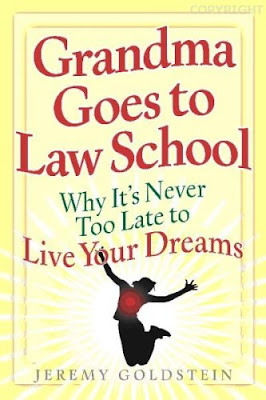 In this Law School Diary, Jeremy gives us an excerpt from his memoir celebrating his mother, Jeanette.
Jeanette graduated from law school at the age of 83, impressed her professors and fellow students, and demonstrated that you're never too old to go to law school.
Jeanette's Law School Diary (as written by Jeremy):
When the Honorable Elijah Huling, Jr. first saw the 82-year-old woman walking into his medical malpractice class at Syracuse University, he thought she was a parent. It never crossed the judge’s mind that Jeanette Goldstein might be one of his students.
But she was.
“I was shocked,” the visiting law professor said.
Judge Huling’s next reaction was that Jeanette must be a part-time student at the College of Law.
But she wasn’t.
And so Judge Huling chuckled, recalling that first introduction in an interview at school. “Amazing,” he said. In fact, the Baldwinsville, N.Y., judge says Jeanette Goldstein was one of the most remarkable students he has ever had as a visiting professor at Syracuse University’s College of Law. She was, in fact, so remarkable that Judge Huling went home to have a heart-to-heart talk with his children after he met her. His children spent about a half hour per week-night on their homework, and Judge Huling scolded them.
You’d better spend a little more time on your studies because I have an 80-year-old student who’s working a lot harder than you!
Jeanette really did work hard.
Her determined motto: Be prepared.
Judge Huling, like all Jeanette’s Syracuse law professors, said Jeanette was always prepared for class. She studied hard for one of Judge Huling’s exams and refused to sign a petition against him after classmates decided the test was unfairly difficult.
Jeanette just stared at the grade next to her assigned student number after grades were posted. She had cataracts and thought she was reading the grade wrong. That couldn’t be a B next to her name, could it?
Jeanette asked Judge Huling to check the grade. “Is that mine?” she asked.
Yes, it was. Jeanette had scored one of the highest grades on an exam that most of her classmates thought had been one of the most difficult of their law school careers. Other students would be pleased just to pass, but Jeanette wanted a good grade.
“I’m amazed,” said Judge Huling, smiling during his interview. “The competition is intense and cut-throat here, and she’s sticking herself right in that competition. She is in the pool, swimming with all the rest of the sharks. It takes courage to do that. I know the environment, and to step out of a familiar environment takes a lot of courage. Courage and fortitude. She just gets in there and plugs away.”
Judge Huling didn’t know that going to law school had been my mother’s dream.
As long as I can remember, my mother wanted to be a lawyer. In fact, she has had this desire since 1955 when she flew to Japan with my father, David Goldstein, on a business trip. My father’s company made movie camera lenses, and my father was always looking for new optical products to sell. In 1955, my father signed a contract with Olympus Corporation of Japan to be the exclusive U.S. importer of their microscopes. My mother enjoyed sitting in on the contract negotiations. In fact, she came to feel she could do a better job than the lawyers.
Could she be a lawyer? My mother had five young children at the time and lived in Rochester, N.Y. She had someone to help her with the children, but still… where could she even go to law school? Rochester didn’t have one.
Forty-one years later, my father died and my mother was grief-stricken. Like so many widows, she’d lost the man she’d loved for over 50 years and didn’t know what to do with herself. Then she thought of her old dream, becoming a lawyer. “Better late than never,” she said.
But, what would we – her children – think? There were eight of us now, all of us grown adults. “I didn’t consider other people’s reactions so much as considering my children’s reactions,” my mother said. “And what surprised me is that even though I was convinced everyone would think I was crazy, they all supported me and thought it was a great idea!”
Here comes the student.
My mother got up the nerve to take the LSAT and apply to two law schools – Nova Southeastern University in Ft. Lauderdale, Florida, and Syracuse. To her surprise, both schools accepted her! My mother chose Syracuse because of its convenience – a little over an hour away from where she lived in Rochester.
Margery Connor, a former associate dean for student affairs at the College of Law who retired while my mother was a third-year student there, said that the school accepted her because her LSAT scores and her graduate school grades were good. “I looked at her resume,” Ms. Connor said. “Her numbers were enough to let her in.”
The school couldn’t discriminate against Jeanette because of her age. Besides, Ms. Connor said, “I really advocate for the non-traditional student.”
Ms. Connor knew that Jeanette’s age might actually benefit both students and faculty. “She had a point of view that she could share with people,” Ms. Connor said. It would come from her age.
“She is most special because she has had not only life experiences but she’s had business experiences too,” said Professor Frederick J. Micale, an adjunct professor. “She brings that to class and makes a real contribution. I think it’s not only something I appreciate, but other students do, too.”
Professor Micale said students respect the courage of someone Jeanette’s age to undertake the rigors of law. Syracuse had students from all over the world, and some had language and cultural barriers.
In Jeanette’s case, the barriers were physical, Professor Micale pointed out. Jeanette’s eyes and ears were starting to fail. She sat attentively in the front row of the lecture hall because she couldn’t see the board or screen if she sat any farther back. On the negative side, while sitting in front she couldn’t hear the students in the rear.
Administrators wondered if she had the stamina to stick it out.
“She drew a lot of attention and people had doubts,” Ms. Connor said. “Law school is rigorous. You don’t get a lot of rest. I was worried about her capacity to do it all.”
Ms. Connor suggested that Jeanette enroll part-time.
Jeanette refused.
So, in the fall of 2000, Jeanette sat down beside students in their 20’s and started scribbling away on that legal pad. She was the mother of eight children and the grandmother of 22. That was about the age of most of her classmates, too. There were a few doctors, engineers or social workers in their 50’s, and a retired nun had once taken courses at the law school. But Jeanette was the oldest. And, while most of the younger students clicked away on their laptops in class, Jeanette took notes in script. She couldn’t type or use a computer.
Students set their water bottles down and sat next to her, amazed at her initiative. “Everybody was talking about this 80-year-old,” said Jason Cleckner, a 23-year-old classmate who sat next to Jeanette in Civil Procedures class.
“Was there really a president named Ronald Reagan?”
Professors were dumbfounded that they actually had a student in class who had lived through Watergate or the Reagan and Carter eras, ancient events and presidents to these students who were born years after. Jeanette could nod her head when professors spoke of the Great Depression, too. She had lived through it.
“I can make a lot of references to something that happened quite a while ago,” said Professor Christian C. Day.
Whatever grades she earned in any of her classes were hers. Professors did not help her out. That’s because each student was assigned a number, and the number was all the professors ever saw on exams or papers – without ever knowing whose it was. Although Jeanette couldn’t type exams on a computer in class, the school assigned her a typist who sat beside her. Thus, all her work was evaluated without her professors ever knowing that it was hers.
The instructors, moreover, graded on a bell curve. Very few students received As, and a few did receive Ds and Fs. My mother passed all her courses and survived, while a small percentage of students were not performing up to expectation and were asked to leave.
To be honest, it wasn’t easy for my mother that first year either. She had a master’s degree in social work. But, she said, “social work was a breeze in comparison to law school.”
Maybe it was because my mother had been out of school for so many years. “The students coming directly out of college, they knew the shortcuts,” my mother said. “They knew aspects to get through the course much easier than I did.”
Nevertheless, she persevered that first year, even pulling all-nighters when she needed to.
Ms. Connor admitted that my mother had a rocky time. “The first year is the hardest. But she managed to get through it.”
After that first year, my mother started recommending classes to the students who were a year or two behind her.
“She was right on target, too,” said Chanel Hudson, 24, of San Francisco.
As the semesters passed and graduation neared, my mother’s confidence and physical strength grew. Each day, she was forced to take a brisk walk. She’d walk from her graduate student dormitory to the bus stop, and from the bus to the law school. Then, there was the return trip at night. The wind was often blowing and it seemed to snow for days in Syracuse. The winters were cruelly gray and cold. My mother fell on the ice one day during her third year and broke her wrist.
She got a cast, and kept right on wheeling her black book bag to class.
An enrichment for all
She was an inspiration to countless professors, counselors and students. She enriched the school demonstrating that someone her age can handle such a rigorous commitment.
Remember those administrators who had doubts that she could make it full-time? “She proved them all wrong,” Ms. Connor said.
My mother did not hesitate to speak up in class. Based on her experiences with my father’s company, she can discuss distributorships in her international relations class, and then wheel her black book bag to the next lecture hall to share what she knows about negotiations.
“I admired her viewpoint,” said Professor Day.
“She has a good background of life’s experiences that I don’t have,” said Judge Huling.
“She brought the life experiences you couldn’t get from a textbook, the stuff of real law,” said Professor Micale.
In fact, though Professor Micale has thirty years of international law experience, “She knows more than I do,” he said. “When your mother speaks, she becomes the teacher and I become the student.”
He said he felt privileged to have had her in his class. “It’s just an absolute special treat to me because – and I think the best way I can sum it up is – I can truly become a student in my own class by listening to her, and that is the ultimate.”
My mother used to complain that her back bothered her. Luckily, any physical problems my mother had when entering law school began to disappear. In fact, my mother didn’t have time to think about her physical ailments. Her back problem miraculously disappeared. So did some of her concerns about the future. “You don’t think about getting old or dying while you are busy everyday,” my mother said.
Being around young people energized my mother, and her outlook on life brightened. She began to realize that it wasn’t healthy for older people to move into retirement homes with other elderly people. It was far better to be around a mix of people who still spoke about joyful things and didn’t complain about physical ailments all day.
The benefits ran both ways, too. Not only did my mother feel better about herself, succeeding in younger camp, but those younger students profited from her shared experiences. Her comments about what she had learned from my father’s international business experiences piqued their curiosity, Professor Micale said, and “the questions seemed to roll from that point.”
Ms. Connor said she “said so many prayers” that my mother would make it through school. But, she added, “her success was based on her determination and conscientiousness. She really worked at it.”
The Graduate!
Ms. Connor read my mother’s name at the graduation ceremony on May 15th when she graduated at 83. “It enriched my life,” said Ms. Connor of the experience. “My hat’s off to her.”
Professor Micale said he hoped that he had as much vitality as my mother had when he gets to be her age. Another professor said maybe he’d go back to school and study medicine the way he had always wanted.
My mother does not need to work, but she is already checking out the job market with her classmates. She’d like to find a 9-5 job with the government down in Washington, D.C. near four of her children. At her age, she needs a little flex time. “I certainly would not want to work for a big law firm where you work 80 hours per week,” she said.
Leave that to the younger grads.
I asked my mom if she had any words of wisdom for other people her age who hadn’t yet accomplished what they wanted to in life. She said, “Do whatever you want to do now, not next year or the year after. If you really want to do something, get on the road to achieving your goal today. It is never too late.”
***
This passage is excerpted from Jeremy Goldstein's book, Grandma Goes To Law School - Why It's Never Too Late To Live Your Dreams, about his mother, Jeanette. For a brand-new copy of the book, you can order it through the publisher, Dreamhouse Books.
Logic and Games
* Similarities between the Qaddafi family of Libya and the Bluth family of Arrested Development. [The New Republic]
* Lady Gaga threatens to sue London shop for selling breastmilk ice cream. [Salon]
* Busy lawyer's guide to Charlie Sheen's bitchin' termination letter. [Above The Law]
* Supreme Court rules that public universities must fund religious student groups with activities money. [Gawker]
* A bit of correlation/causation argument: girls who post more Facebook photos value their appearance more. [The Atlantic]
* The differences between books and electronics. [YouTube]
* Lady Gaga threatens to sue London shop for selling breastmilk ice cream. [Salon]
* Busy lawyer's guide to Charlie Sheen's bitchin' termination letter. [Above The Law]
* Supreme Court rules that public universities must fund religious student groups with activities money. [Gawker]
* A bit of correlation/causation argument: girls who post more Facebook photos value their appearance more. [The Atlantic]
* The differences between books and electronics. [YouTube]