February Vs. June LSAT | Which Is Better?

LSAT Blog February June Which BetterLaw schools consider applications on a rolling admissions basis. The earlier you apply in the admissions cycle, the easier it is to gain acceptance. The cycle begins in September.

For top law schools, it's especially important to apply early in the cycle because admission to these schools is particularly competitive.

February is towards the end of the cycle. Many top law schools (such as Columbia, Harvard, NYU, and Stanford) don't even accept February LSAT scores for that cycle.

(This means you can't take the LSAT in February 2010 and apply to start at those law schools in the fall of 2010. However, you can take the February 2010 LSAT and use that score to apply to start at those law schools in Fall 2011.)

Even some law schools that aren't typically considered "top law schools" have application deadlines that are before February LSAT scores are released. This means, of course, those schools don't take February LSAT scores (for that cycle), either.

Given enough prep time (and the right kind of prep), most people are capable of scoring decently on the LSAT. However, a month or two generally isn't enough time to adequately prepare.

If you're not feeling ready for the LSAT now, you'll likely do better on the LSAT if you wait. Taking it in June or October will give you enough time to work through some version of my LSAT study schedules. You've probably started working through some of the materials mentioned there for February, but perhaps you haven't gotten past Logic Games - there's still Logical Reasoning, Reading Comprehension, and several recent full-length practice exams that you should complete before taking the exam. It simply can't all be done in a couple of weeks.

Some top law schools (such as Columbia and NYU) take the average of multiple scores, rather than only the highest. Fordham does not disclose whether it takes the average of multiple scores.

Even if the law schools you're considering explicitly state that they take the highest LSAT score (and most do only take the highest when computing your LSAT and GPA), they'll still see your other scores. Ideally, you'll only take the LSAT once and get it right the first time.Try not to take the LSAT until you're as certain as possible that you're fully prepared.

Bottom line: if you're not feeling ready to take it in February, I recommend you bite the bullet and wait a year, and take the LSAT in June rather than in February. A higher LSAT score means you'll get into better law schools and/or, potentially, more scholarship money. 1 year could be well worth the wait.

If you're only shooting for less competitive schools, it won't matter as much. However, there's some debate as to whether it's worth going to less competitive (i.e. 4th-tier) law schools at all. See Anna Ivey vs. Ann Levine on this issue.

Photo by lifeontheedge

LSAT Logical Reasoning Vocabulary Words

UPDATE: If you want even more help with LSAT vocabulary than the words below (and don't want to have to memorize hundreds and hundreds of words), check out the LSAT Vocabulary Builder: Words You Need to Know.


You probably know the meanings of most words in the Logical Reasoning section.

However, if you know what all the words mean, the arguments will be much easier to understand.

I've compiled a list of common, but difficult, vocabulary words just from glancing through 4-5 sections of Logical Reasoning (and throwing in some words that you absolutely must know), so this list is obviously not intended to be comprehensive.

Because the LSAT is not intended to be a vocabulary test, you probably know most of the below words already.

However, take a quick glance through this list and make sure you know them all.

Don't spend a great deal of time focusing on vocabulary in your preparation. However, when you see a word you don't understand, look it up. Just as the same concepts and types of arguments appear on multiple exams, the same words and phrases also appear on multiple exams.

Keep in mind that the LSAT sometimes uses one of a word's less-common meanings

For example:

The LSAT often uses the word "phenomenon" to mean "event" rather than "something unusual."

The LSAT often uses the word "advance" to mean "to promote an argument" rather than "to literally move something forward."


Words directly related to arguments


Antecedent
Assertion
Assumption
Claim
Consequent
Contention
Correlation
Counterexample
Flaw
Inference
Necessary
Paradox
Premise
Principle
Proposition
Rebuttal
Subsidiary
Subsequent
Sufficient


Verbs

Accumulate
Advance
Advocate
Afford
Aggravate
Attribute
Betray
Circumvent
Compel
Conform
Constitute
Derive
Endorse
Ensure
Entail
Eschew
Equivocate
Guarantee
Imply
Impose
Indicate
Hold
Hypothesize
Justify
Oblige
Posit
Preclude
Predispose
Presuppose
Prevaricate
Qualify
Refute
Sustain
Undermine
Verify


Adverbs

Correspondingly
Intrinsically
Invariably
Manifestly
Purportedly
Solely
Strenuously


Adjectives

Aggregate
Altruistic
Ambiguous
Ample
Categorical
Coherent / Incoherent
Compatible / Incompatible
Confirming / Disconfirming
Consistent / Inconsistent
Cryptic
Crucial
Eccentric
Extant
Foreseeable
Imperturbable
Improbable
Indigenous
Indispensable
Mundane
Principal
Primary
Prominent
Questionable
Sedentary
Temporal
Unequivocal
Unwarranted
Unique
Valid / Invalid
Viable
Vulnerable (to criticism)


Nouns

Anomaly
Condition
Contingency
Extent
Generalization
Hearsay
Impediment
Impetus
Inflation
Irony
Jurisprudence
Liability
Phenomenon
Placebo
Proportion
Pundit
Skeptic
Trial


Either or / Neither nor


Contrast
Principal vs. Principle
Extant vs. Extent

***

Also see: LSAT Logic Games Vocabulary Words and Phrases

Photo by solbronumberone / CC BY-SA 2.0

Average Number Of Hours You'll Be There On LSAT Test Day

LSAT Blog Average Hours Test DayThe LSAT is a long exam, totaling just over 4 hours from start to finish, if everything goes according to plan.

Here's how I arrived at that number:

Getting started (housekeeping stuff):
Listening to rules
Bubbling-in name and address
Filling out "Certifying Statement" in cursive (stating you won't cheat):

Total: 30 minutes


4 scored 35-minute sections:
2 Logical Reasoning
1 Logic Games
1 Reading Comprehension

Total: 140 minutes - 2 hours, 20 minutes


2 unscored 35-minute sections:
1 Experimental (could be any of the 3 scored types above and any of the 1st 5 sections)
Writing Sample (taken after the 5 regular parts of the LSAT - LG, LR, and RC)

Total: 70 minutes - 1 hour, 10 minutes


Break between 3rd and 4th sections:
10-15 minutes

(Note: There is no break between sections 1-3, and no break between sections 4 and 5. Sections 1-3 are all back-to-back, and sections 4 and 5 are back-to-back.)


Altogether, this is about 4 hours and 15 minutes.

(Your mileage may vary - sometimes the proctors don't know what they're doing, can't find the booklets, etc. If this happens, you might be there much longer.)

Even if everything goes according to plan, this is still a long time, especially for smokers and other drug users.

It can be difficult to get through such a long period without a fix, especially when the first section begins at 9AM (February, September/October, and December). The June exam is the only one that begins at 1PM.

Here's LSAC's policy on bringing cigarettes, gum, nicotine patches, and coffee to the test center.

Photo by molinarius / CC BY-NC-SA 2.0

Are Cigarettes, Coffee, and Gum Allowed on LSAT Test Day?

LSAT Blog Cigarettes Coffee Gum Test DayI recently asked LSAC which of the following items are allowed in the test center on Test Day:

-Cigarettes
-Regular Gum
-Nicotine Gum
-Nicotine Patches
-Coffee

I expected to get a "no" on bringing all of these items, but I was pleasantly surprised to receive the following response:

Test takers may bring into the test room only a clear plastic zip lock bag, maximum size one gallon (3.79 liter), which must be stored under the chair and may be accessed only during the break. So, these items can be in your zip lock bag, but you would not have access to the items during the test. You can keep your coffee in plastic container (20 oz./591 ml maximum size) that you would also keep in your zip lock bag and would not have access to during the test.
The first sentence of the LSAC representative's response appears to be directly copy-pasted from LSAC's Day of the Test article (under "Items Allowed in the Test Room").

However, the rest of the LSAC rep's response above contradicts the remainder of the following paragraph on LSAC's website:
The ziplock bag may contain only the following items: LSAT Admission Ticket stub; valid ID; wallet; keys; analog (nondigital) wristwatch; medical or hygiene products; #2 or HB wooden pencils, highlighter, erasers, pencil sharpener (no mechanical pencils); tissues; and beverage in plastic container or juice box (20 oz./591 ml maximum size) and snack for break only.
This paragraph doesn't mention cigarettes, gum, nicotine patches, or coffee (assuming most people don't typically pour coffee into a plastic container or juice box).

Now, I suppose that cigarettes and coffee could be considered medical if you would suffer severe withdrawals without them, but good luck finding a doctor to write you a note.

Obviously, gum, coffee, and cigarettes won't do you much good if you can't actually use them at all during the exam or during the break. However, enforcement of the rules varies significantly.

The following is just my common-sense speculation, so don't hold me to it, but...

Cigarettes
While you almost definitely won't be permitted to smoke during the exam, there's a decent chance you'll be able to smoke during the break (just be sure to ask the proctor before you leave the room).

Gum
In a separate email to me, LSAC said, "[Y[ou may not want to chew gum because it may be annoying to other test takers." However, you'll probably be able to chew gum during the exam unless another test-taker complains.

Nicotine Patch
In a separate email to me, LSAC said, "You can wear the nicotine patch." However, it's probably best to put on your nicotine patch before walking inside the test center.

Coffee
You might even be able to drink coffee during the exam itself.

I doubt you really need to pour your coffee into a plastic container and keep it in a ziplock bag.

A regular coffee cup will probably be fine.

***
Also see Why Not To Use Adderall and NoDoz to Study for the LSAT.

Photo by sheehanpaul

LSAT Analog Watch / Timer for Test Day

LSAT Blog Analog Watch Timer Test Day
LSAC's Test Day FAQ mentions that LSAC doesn't allow digital watches or timers on the exam. Whether or not this makes sense, it means you can use an analog watch or just go without.

Most test-takers feel more comfortable having some kind of watch.

Using a regular watch means:

1. you need to turn the minute hand back to 12 before each section

OR

2. you need to do math to determine how much time you have left in a given section

Neither option is ideal.

#1 isn't a great option because you'll typically have only 3 to 30 seconds between sections (excluding the break, of course). This time is best spent recuperating, clearing your mind, and preparing yourself for the next section - NOT fiddling with a tiny watch dial.

#2 isn't a great option because it would force you to add/subtract whenever you want to know how much time you have remaining. This energy and time are best spent answering questions.

So where does this leave you?

There is a watch out there that satisfies LSAC's security requirements without either of the disadvantages I outlined above.

Here is a watch that has a rotating bezel, so you can easily see how much time you have left.

(The bezel is the thing with the markings that go around the watch's face.)

Before each section, just turn the "0" part of the bezel to wherever the minute hand is. When the minute hand hits 30 on the bezel, you have 5 minutes left. At this point, it might be a good idea to bubble in your answers if you haven't already. When the minute hand hits 35 on the bezel, your proctor will likely announce that time's up (if he/she hasn't already).

Whichever watch you use, make sure you're comfortable using it during at least a few timed practice exams.

LSAT Logic Games Vocabulary Words and Phrases

LSAT Blog Logic Games Vocabulary Words PhrasesUPDATE: If you want even more help with LSAT vocabulary than the words below (and don't want to have to memorize hundreds and hundreds of words), check out the LSAT Vocabulary Builder: Words You Need to Know.


Logic Games vocab is a tricky thing. The problem generally isn't knowing what each word means. The problem is knowing how the words interact with each other and what various phrases actually mean.

For this reason, I've decided to go over several things in this blog post rather than simply doing a vocab list:

1. Words and phrases that can help you recognize a particular type of game.
2. General tips to help you watch out for linguistic trickery and avoid making unwarranted assumptions.
3. Phrases indicating List/Acceptability questions
4. Tips on understanding a particular kind of question that differs from List questions
5. Phrases indicating Suspension and Substitution questions.
6. Tips on understanding some rules that indicate double-arrows
7. A list of 10 words you must know for Logic Games


1. Recognizing Types of Games

Pure Sequencing, Basic Linear, Advanced Linear
Consecutively / Sequentially / Successively
Ranking / Ordering
No two occur simultaneously, no two occur at the same time
One at a time / One after the other
Not simultaneously, not concurrently, not at the same time

Precedes = comes before
Follows = comes after
Immediately follows
Immediately precedes

Preceded by
Followed by
Immediately preceded by
Immediately followed by


Selection
Selected
Contained
Chosen


Splitting
(Variables are divided among) exactly one of two (groups)


2. Avoid making unwarranted assumptions with regard to order

Pay attention to the order in which things occur or are ranked (this applies to Pure Sequencing, Basic Linear, and Advanced Linear games):
front - back
earlier - later
before - after
most - least
behind - in front


Also pay attention to how rules and answer choices are presented.
LSAC often gives you the second of two variables first, which requires you to mentally rearrange the variables.

Examples:
PrepTest 34, Game 3, Question 16 (p212 in Next 10)
PrepTest 36, Game 2, Question 9 (p279 in Next 10)


3. Recognizing List / Acceptability Questions
They're often the first question in any Logic Game.

Could be the composition
Could be a complete and accurate list
Could be accurate matching
Could be an acceptable selection


4. Understanding "Complete and accurate list...any one of which" Questions
For these questions, they're not asking if each variable in each answer choice's list could perform a given action simultaneously. They're just asking in general.


5. Recognizing Suspension and Substitution Questions
Rule suspension questions (when the fundamental rule of a game are changed):
Suppose the condition is added...all the other/original/initial conditions remain...
Suspended


Rule substitution questions (appeared in PrepTests 57, 58, and 59)
Which one of the following, if substituted for the restriction/condition that...would have the same effect?
Assume original condition X is replaced by condition Y


6. Recognizing and Understanding Double-Arrow Rules

"If, and only if" / "If, but only if"
Both of these create a double arrow: X <---> Y

The first "if" introduces the sufficient condition, and the second "if" introduces the necessary condition. This means that X and Y are both sufficient AND necessary for each other. Either we have both, or we have neither.

Examples:
PrepTest 45, Game 4
PrepTest 56, Game 2


"If X then Y; otherwise, not Y."
The first half is simply what it says: "X -> Y"

The second half, "otherwise, not Y," really means "If NOT X -> NOT Y

The contrapositive of this second half is Y -> X

Combining this with the first half, we get a double-arrow: X <---> Y

Example:
PrepTest 55, Game 4

Yes, this sort of rule is identical in meaning to the "if, and only if" / "if, but only if" rule that I explained immediately above this rule.


7. List of 10 Logic Games Vocabulary Words
Adjacent = immediately next to / touching
Corresponds = matches
Distinct = different, unique
Respectively = in this particular order
Consistent = could be true / does not violate
Inconsistent = cannot be true / violates
Determine = figure out
Fully determined = completely figure out
Not necessarily = does not have to be
Neither X nor Y = NOT X and NOT Y

***

Also see: LSAT Logical Reasoning Vocabulary Words

Photo by solbronumberone / CC BY-SA 2.0

Jay-Z's Blueprint and LSAT Test Day Tips

Jay Z Blueprint LSAT BlogOn The Blueprint's second track ("Takeover"), Jay-Z raps:
Hey lil' soldier you ain't ready for war
R.O.C. too strong for y'all
It's like bringin a knife to a gunfight, pen to a test
Your chest in the line of fire witcha thin-ass vest
Contrary to popular belief, this song isn't ONLY about Nas.

After I told Jay-Z that some test-takers weren't prepared for Test Day, he became angry. At my urging, he added the lyrics above to diss those test-takers with some analogies (a classic argumentative technique) and offer his advice on getting ready.


LSAT Test Day Tips from "Takeover":

-Make sure you bring several pencils with good erasers to the LSAT. In fact, make sure you use pencils for all your practice tests, too.

-Don't bring a knife to the LSAT (or to a gunfight). Save knives for knife fights and chopping food. (Disclaimer: LSAT Blog does not endorse knife fights or chopping food and is not liable for any injuries incurred during knife fights or while chopping food.)

Want more? See all LSAT Test Day tips.

Funny Lawyer Commercials

A recent article in the New York Times (Lawyers Use Humor to Plead Case) covered the recent trend of law firms using (intentionally) funny TV commercials.

I'm including below the commercials the article mentions. Enjoy!

Wait LSAT Score Law School Applications

Wait for LSAT Score to Submit Law School Applications?
Wait LSAT Score Submit Law School Applications

I'd wait to make the file complete until your second score's released. You don't want take the chance that a school might consider your application with only the first score.


LSAT Blog Posts Outline #2

This list contains all LSAT Blog posts from 5/1/09 - 1/8/10. I've generally placed them from old to new within each category. You can see a similar list of posts from 12/1/08 - 4/24/09.

If you haven't read them all yet, now's the time!


Logic Games


Newer Logic Games: Conditional Sequencing | PrepTest 51

Newer Logic Games: Before, After, But Not Both | PrepTest 52

Newer Logic Games: Before, After, But Not Both | PrepTest 53

Dinosaur LSAT Logic Game Explanation

How Logic Games Have Changed Over Time

LSAT Logic Games Categorized by Type (PrepTests 19-38)

LSAT Logic Games Classification List (PrepTests 39-58)

Logic Games Tips | Conditional Reasoning

Logic Game | Basic and Advanced Linear | Limited Options

LSAT Logic Games Practice | 7 Games To Do Before Test Day

LSAT Logic Game Explanation: Birds in the Forest | Selection

Princeton Review LSAT Logic Games Workout - Exposed


Logic Games I've Written
The Advanced Linear, Grouping: Selection (Defined), and both Matching games I've written are more difficult than the average LSAT Logic Game. The others are pretty standard in terms of difficulty.

Free LSAT Logic Game | Pure Sequencing
Logic Games Pure Sequencing Diagram | Explanation

Free LSAT Logic Games | Linear | Easy Version

Free LSAT Logic Games | Linear | Difficult Version

Free LSAT Logic Game | Advanced Linear

Free LSAT Logic Game | Grouping: Selection / In-Out
Logic Games Selection | In-Out Diagram Explanation

Free LSAT Logic Games | Grouping: Selection (Defined)
Logic Game | Grouping: Selection (Defined) Diagram | Explanation

Free LSAT Logic Games | Grouping: Matching | Templates
Logic Game Grouping: Matching Templates Diagram | Explanation

Free LSAT Logic Game | Grouping: Matching
Logic Games Matching Diagram | Explanation


Logical Reasoning

LSAT Logical Reasoning Spreadsheet

LSAT Logic | Necessary vs Sufficient Conditions

25 Future LSAT Logical Reasoning Topics

LSAT Logical Reasoning Flaw Except Question

Words Indicating Sufficient / Necessary Conditions, and Time

Logical Reasoning | Sufficient Assumption (Justify) Questions

Most Strongly Supported Logical Reasoning Questions

LSAT Words: "Except" "unless" "until" and "without" mean...

Necessary Assumption Questions, Negation Test, and Must Be True Qs

Difference Between Necessary & Sufficient Assumption Questions

Logical Reasoning | Formal Logic Inference Questions

Sufficient Assumption Questions | Tips and Categorization


Reading Comprehension

LSAT Reading Comprehension Passages: Easy As Harry Potter

5 Hardest LSAT Reading Comprehension Passages

New LSAT Reading Comprehension Tips

Newer LSAT Reading Comp Tips And The Truth About Reading Comp

Reading Comprehension Questions | Inference and Main Point

Reading Comprehension Passage Topics

LSAT Reading Comp Passages, Categorized


Schedules

2-Month LSAT Study Schedule

3-Month LSAT Study Schedule

Retaking the LSAT Study Schedule


Studying

Preparing for the Experimental Section

How to Speed Up on Timed Practice LSAT Exams

Free LSAT Diagnostic Tests | The Shocking Truth

5 Signs of LSAT Burnout, and How to Recover From It

Why NOT to use Adderall and NoDoz to Study for the LSAT


Test Day

Test Day Tips

Cancel, Postpone, or Absence?

How to Cancel Your LSAT Score

The Dinosaur Game and Whether to Cancel Your LSAT Score

Cell Phones Not Allowed At The LSAT

How to Challenge a Flawed or Unfair LSAT Question

LSAT Test Center Problems | How To Prepare For The Worst

Test Day Stress and Anxiety? | Tips, Links, and mp3

Creating an LSAT Test Day Playlist | Songs and mp3

LSAC and LSAT Fee Waiver Score Report Delays


Secret LSAT PrepTests

The Case of the Secret LSAT PrepTests

Official LSAT PrepTest February 1997

Cost of LSAT PrepTests | Prep Course vs. Self-Study

LSAC's PrepTest Licensing Policy

Suggestions for LSAC on Restructuring LSAT PrepTest Sales

LSAT Logic at LSAC | Secret PrepTests


LSAT Logic in...

LSAT Logical Reasoning: Asteroids, Dinosaurs, and Volcanoes

LSAT Logic in the Colbert Report | Marijuana Legalization

LSAT Logic in Arrested Development

LSAT Logic in The Onion

LSAT Logic in Conservapedia


Interviews of Me

LSAT's Predictive Ability | Interview

Beating the LSAT Interview on Blackbook Legal Blog


Interviews of Others

Law School Admission Game | Interview

LSAT Anxiety and Procrastination Tips | Interview


LSAT Diaries

LSAT Diaries: The 20-Something Grad Student

LSAT Diaries: The 20-Something College Student


Questions and Answers

December 2009 LSAT | Questions and Answers

February 2010 LSAT | Questions and Answers


Things to Read / Watch

Cornell Law Admissions Dean | Rankings Article

Top Law Schools Guide PDF

About the LSAT PDF by LSAC

Pre-Law Podcast Video Series


Miscellaneous

LSAT FAQ | Common Questions When Starting LSAT Prep

LSAT Blog Manifesto

LSAT Prep Courses vs. Private Tutoring

Withdrawn LSAT Questions | Item Removed from Scoring

LSAT PrepTests and Dates Administered

Free Law School Personal Statement Help


PrepTest 58 - Summer School Courses Logic Game, Explanation

PrepTest 58 (September 2009 LSAT), Game 4, gave a lot of test-takers trouble.

It's a Grouping: In-Out / Selection game, but it's not like most In-Out logic games. In-Out games often involve both of the following types of rules:

1. A ---> NOT B
2. NOT C ---> D

However, PrepTest 58, Game 4, only involves the first kind of rule, giving you a ton of "double-not arrows" to work with (read the post linked above if you don't know what those are). These make the game seem deceptively easy - it's actually a bit more complicated.

I consider this game to be the hardest out of the 4 in that section. In this blog post, I'll explain the game from start to finish.

Those of you who haven't seen this game before, please don't look at the rest of this post until the week before your exam. You'll want to save PrepTest 58 until then.

The rest of you, read on.

Also see: Explanations for Recent LSAT Logic Games

Due to LSAC's copyright rules, I'm forced to leave out certain details of the game. You'll need a copy of the exam in order to follow along.

First off, the rules:

H ---> NOT S and NOT M

If H is chosen (IN), then neither S nor M is chosen (so they must be out). This means if either S or M is chosen, H must be not be chosen. However, I wouldn't take the time to write out the contrapostive. I would immediately jump to diagramming it with a double-not arrow, as I have below.

The remaining two rules should be treated the same way:

M ---> NOT P and NOT T
W ---> NOT P and NOT S


The three rules can be diagrammed as follows:
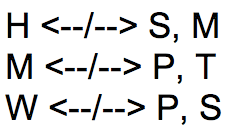
LSAT PrepTest 58, Game 4 - Rules

This means:

H conflicts with both S and M.
M conflicts with both P and T.
W conflicts with both P and S.

This means, among other things, that we must always lack at least one of H and S, one of M and T, and one of W and P. In other words, we must always lack at least 3 variables out of the 7 total.

Since the initial paragraph of the game also says that we must always have at least 3 variables in, this, when combined with the info that we must always lack at least 3 variables, means we will either have "4 in, 3 out" or "3 in, 4 out". ("4 in, 3 out" is demonstrated by the first diagram below.)


Of course, there are other pairs of variables that conflict with each other (pairs from which we must always lack at least one). However, I'm choosing these particular pairs because none of these conflicts overlap.

What I mean is - none of these conflicts mention the same variables - none of the variables are involved multiple times in the conflicts that I've chosen.

By choosing these particular conflicts out of all the conflicts mentioned in the rules, I can create the following 2 main templates / options:


Both diagrams indicate that we must always lack at least one of H and S, one of M and T, and one of W and P. The "4 in, 3 out" diagram is nearly complete because the conflicts I've chosen fill all the "out" slots, so everything else must be in, including L. The "3 in, 4 out" diagram is a bit more ambiguous because we still have 1 "out" slot remaining, and we don't know which variable will fill it.

It's important to remember that these diagrams don't address all of the rules - only the ones I handpicked. We still have to deal with a few conflicts, which are:

PrepTest 58, Game 4 - Remaining Rules

Let's keep these in mind as we go through the game.

Question 18
Typical List/Acceptability question

We're always going to lack at least one of H/S. Choice A violates this.
We're always going to lack at least one of M/T. Choice E violates this.
We're always going to lack at least one of P/W. Choice D violates this.

Looking at the conflicts not included on the diagram, we're always going to lack at least one of M/H. Choice B violates this.

By elimination, Choice C is our answer.


Question 19
Knowing that we must have at least 3 in and at least 3 out, the max we can have in is 4. We already know this from the inferences we made before starting the questions.


Question 20
If both P and W are out, our diagram becomes:

Choice A: We can't lack both H and L because L is definitely in. Eliminated.
Choice B: We CAN lack both H and M because there's no reason we can't have both S and T. This would create:
IN: STL
OUT: HMPW

This doesn't violate any of the remaining conflicts not included in the main diagram, so it's our answer.

I'll go through the rest anyway.

Choice C: We can't lack both H and S because there's only space in the out column to lack one of the two.
Choice D: We can't lack both L and M because L is definitely in.
Choice E: We can't lack both S and T because this would create:
IN: HML
OUT: STPW

H and M can't both be in because this violates one of the remaining conflicts not included in the main diagram.


Question 21
This is a local question asking what must be true if M is in. Remember that there are two major possibilities: having 3 variables in and 4 variables out, or having 4 variables in and 3 variables out.

In both possibilities, if M is in, H, P, and T will automatically be out. H and P will be out because M conflicts with both in the "remaining rules" not included on the main diagram. T will be out because we must always lack at least one of M/T according to the main diagram.

This fully determines the "4 in, 3 out diagram", creating:


This diagram is invalid because due to the "remaining rules," S and W can't both be in.

This leaves us with the "3 in, 4 out" diagram, which is a little ambiguous. We will again lose H, P, and T for the same reasons as above. However, there's still one more "out" slot to take care of. It's addressed by the fact that, in our "remaining rules", S and W conflict with each other. At least one of the two must be out, and since there's only one more "out" slot, whichever one of S and W isn't out must be in.

The diagram becomes:


In this diagram, L must be in, so L is our answer.


Question 22
The most efficient method here is to use previous work (previous valid scenarios).

In Q21's "3 in, 4 out" diagram, we could have lacked both H and S, so Choice A is eliminated.

In Q18, we lacked both L and W, so Choice C is eliminated.

In Q20's diagram, we could have lacked both M and P, so Choice D is eliminated.

In Q21's "3 in, 4 out" diagram, we could have lacked both T and W, so Choice E is eliminated.

By elimination, Choice B is our answer.


Question 23
We already know that M conflicts with H, P, and T. This means that the only courses out of the 7 it could ever be with are L, S, and W. Choice B says this, so it's our answer.

Choice B is just another way of saying something we already know, so if B is true instead of M conflicting with P and T, it'll have the same effect.

Photo created at www.addletters.com/bart-simpson-generator.htm

Recent LSAT and Law School Admissions News

Recent LSAT and Law School Admissions NewsTwo recent articles in the New York Times worth checking out:

1. Recession Spurs Interest in Graduate, Law Schools

2. Law School Admissions Lag Among Minorities

Related, in the Wall Street Journal's Law Blog, Study: As U.S. Grows More Diverse, Law Student Population Whitens.